Biography
Edmund Arrowsmith
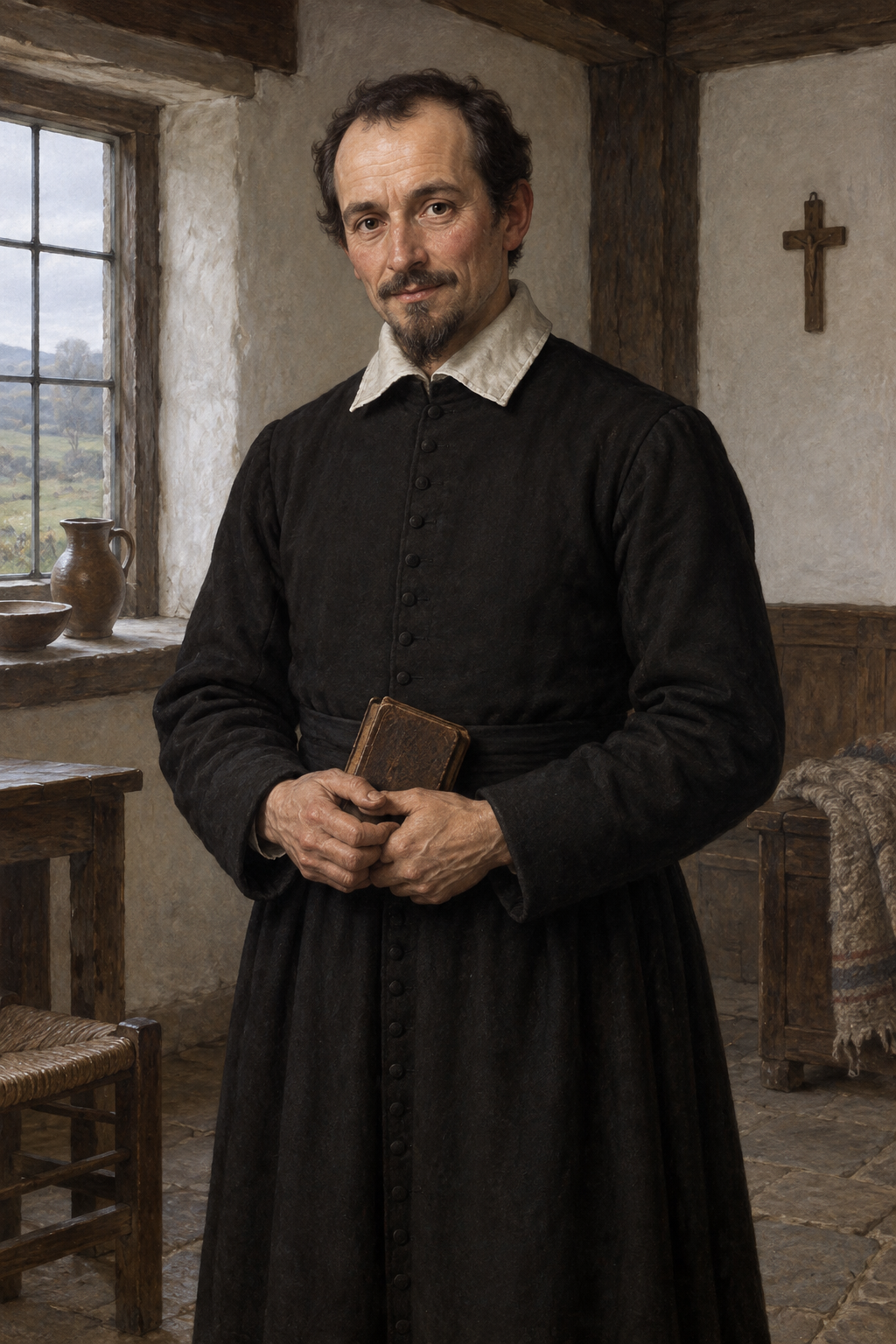
About Edmund Arrowsmith
Edmund Arrowsmith was a priest from Haydock in Lancashire, born in 1585 to Robert Arrowsmith and Margery Gerard. Baptized Brian, he later used his confirmation name, Edmund. His parents suffered imprisonment for their Catholic faith. After his father’s death, an older priest educated him and helped him reach the English College at Douai in 1605. Ill health interrupted his training, but he was ordained in 1612 and returned to Lancashire the following year.
The Jesuit archival exhibition adds that repeated fines had impoverished his family. A bursary established to assist English seminarians abroad supported his studies. His education therefore depended on help extending beyond his own household. The same exhibition recalls him as short, talkative and humorous, with theological learning and a ready wit: a more personal picture than a portrait of unvarying solemnity would suggest.
His vocation developed through years of ministry. Tom Rochford’s Jesuit biography connects his wish to enter the Society of Jesus with making Ignatius’s Spiritual Exercises while a student. He first worked in Lancashire as a priest outside the order and later became a Jesuit. Rochford remembers his energy and sincerity during fifteen years of pastoral service. Membership in the Society continued work already under way among local Catholics.
Robert Scully’s historical study places his Jesuit entry probably in 1623, while other accounts give 1624. Scully distinguishes an initial retreat in Essex, his listing at the Clerkenwell novitiate and the likelihood that much of his formation took place during active ministry. The evidence does not support imagining two uninterrupted years spent in a secluded foreign monastery. His aliases included Bradshaw and Rigby.
An early memorandum, preserved in Henry Foley’s documentary collection, describes a fellow priest who had known him at Douai and on the English mission. The writer recalls Arrowsmith discussing religious vocation and promising discretion about the affairs of the secular clergy before joining the Jesuits. The testimony suggests that his change of affiliation took place within a network of continuing friendships, responsibilities and differing views about religious life.
The material setting of this ministry survives in objects associated with it. Stonyhurst’s collection includes a horse-carried trunk containing homemade vestments, an altar stone, a pewter chalice and other necessities for Mass. The exhibition associates it with Arrowsmith and John Southworth. Its patched dress fabrics and a bonnet interpreted as a possible disguise for the contents suggest the household resources behind clandestine worship. The association is part of the collection’s history, not proof of every journey the trunk made.
Around 1622 Arrowsmith was arrested and questioned by the Anglican bishop of Chester. He was subsequently released during a period when James I sought a Spanish marriage for his son and favoured clemency toward Catholics. His renewed freedom was thus connected with changing political circumstances as well as local decisions about enforcement.
His final arrest followed a dispute about a marriage. In a December 1628 letter reproduced by Foley, William Harte reported that a couple resented Arrowsmith’s insistence on a period of separation before he used a dispensation. They informed the authorities of his presence. Harte explicitly relied on reports from others; his letter is near-contemporary evidence, but not a claim that he personally witnessed the arrest.
At Lancaster assizes, the priest faced Judge Henry Yelverton and was condemned. He was executed on August 28, 1628. The New Catholic Encyclopedia records confinement in a narrow cell and heavy restraints before his death. Its account emphasizes the inadequacy of the evidence used against him. Scully distinguishes two charges: being a Catholic priest and Jesuit, and seeking to draw others away from the established church. He also notes reported letters of support from the royal household which did not prevent the sentence. The case therefore involved tensions between royal intervention, local judicial hostility and the enforcement of religious statutes.
Scully also identifies problems within the later narrative. Accounts disagree over whether John Southworth or Ambrose Barlow administered his final sacraments. More broadly, the sources devote much more attention to his last days than to years of ordinary ministry. Their purpose was to present a martyr, so details about apparitions and cures require distinction from documented events.
The shrine at Ashton-in-Makerfield preserves a hand venerated as his relic. Historic England records that the present church was built between 1925 and 1930 to house the shrine. Designed by J. Sydney Brocklesby, it contains stained glass by Harry Clarke. This substantial later building reflects the enduring place of his memory in the local Catholic community.
He was canonized on October 25, 1970, among the Forty Martyrs of England and Wales. The parish names him as a patron alongside Oswald and commemorates him on August 28, as its website records. Its continuing veneration of his hand belongs to the history of devotion; reported healings should not be presented as independently established medical conclusions.
Wondering how to weigh the stories and sources? Learn how to read a saint biography.