Biography
Edmund Campion
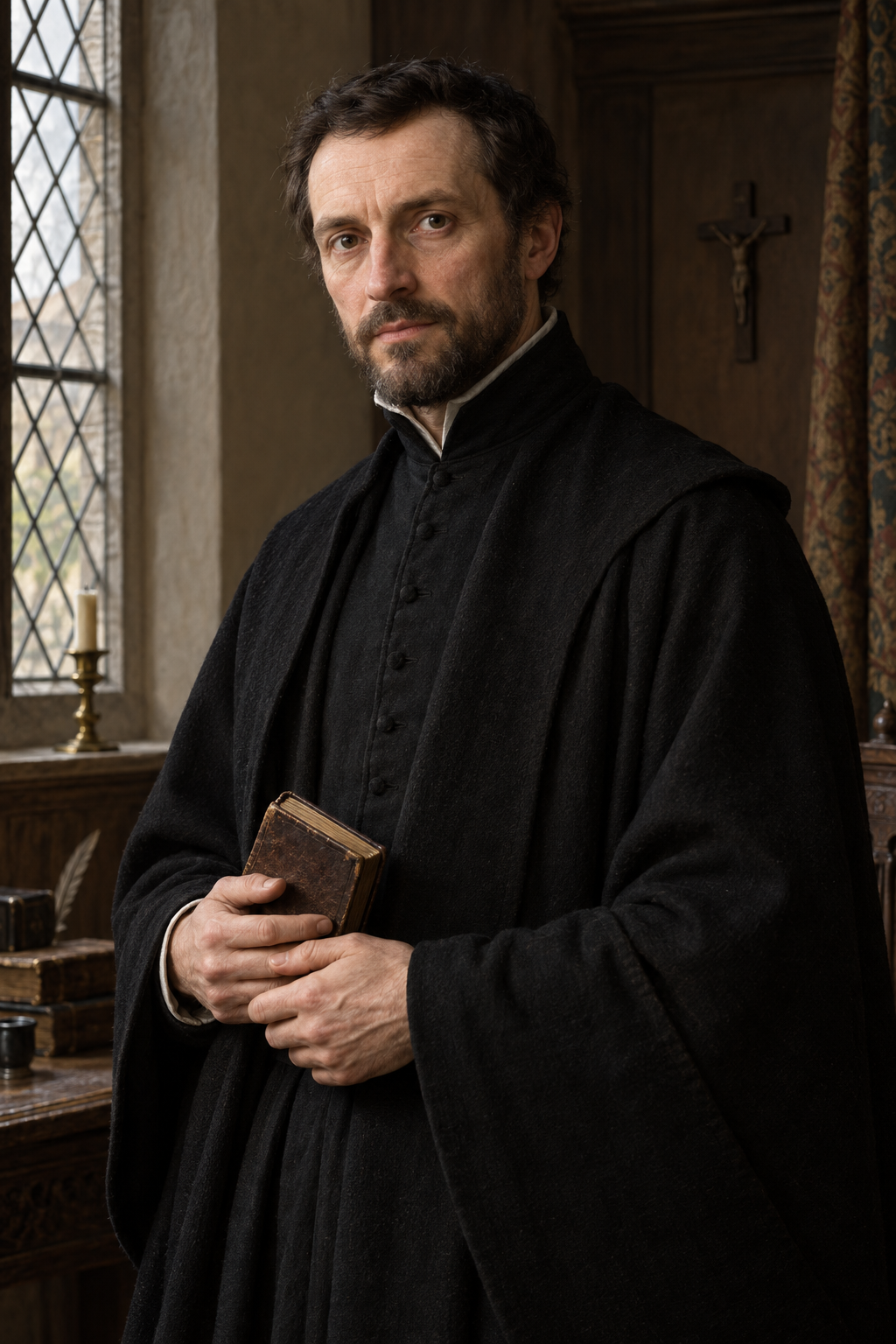
About Edmund Campion
Edmund Campion was born in London in 1540 and received an education that made him one of the notable scholars of his generation. The Jesuit account places him at Christ’s Hospital and then St John’s College, Oxford, where he received a degree in 1564. The British Jesuits give January 24 as his birthday and record his ordination as an Anglican deacon in 1568. His later Catholic vocation emerged from that changing religious and academic world, rather than from an uninterrupted path already set in childhood.
Campion left Oxford, spent time in Ireland, and then traveled to Douai in France, where he entered a Catholic seminary. He went to Rome in 1573 and entered the Society of Jesus. The Irish Jesuit biography describes his later teaching of rhetoric and philosophy at the Jesuit college in Prague. These years show a scholar and teacher preparing for ministry, not only the martyr whose death later came to dominate accounts of his life.
In June 1580 Campion returned to England as part of the first Jesuit mission there. The British Jesuits say he used a merchant’s disguise and moved through several counties while serving Catholic households. The work involved preaching and sacraments in places where public Catholic ministry carried danger. The need for concealment shaped the rhythm of his short English mission, but it did not end his efforts to write and teach.
Campion’s Decem Rationes, or Ten Reasons, was a printed defense of Catholic belief that circulated covertly at Oxford. The work attracted attention from authorities already pursuing priests and those who sheltered them. An Oxford lecture description notes that historians still debate how political aims and religious ministry intersected in the early mission. The question deserves care: prosecution for treason is part of the record, but the charge alone cannot be treated as a neutral description of Campion’s intentions.
Campion was captured in July 1581 and imprisoned in the Tower of London. The Jesuit account says that he was repeatedly tortured and then tried for treason. He continued to say that his mission was religious rather than a plan to overthrow the state. The trial and punishment took place during an acute struggle over allegiance, worship, and the authority of the crown, a context essential to understanding the danger faced by clergy and the families who received them.
Gerard Kilroy’s study of Campion’s final days traces how accounts of the trial and execution moved quickly through manuscript and print. Reports were circulating in London and Paris within weeks, and their public reception became part of the contest over the meaning of his death. Kilroy also points out the distance between the historical scholar and friend and the larger heroic image built from later retellings. Remembering this distinction preserves more of Campion’s life than an account confined to his final hours.
Campion was executed at Tyburn on December 1, 1581, with Ralph Sherwin and Alexander Briant. The Holy See’s Jesuit martyrology records the date of his death and his canonization on October 25, 1970. Paul VI’s homily at that canonization situated the Forty Martyrs within the history of English and Welsh Catholic communities. Campion remains significant as a teacher and priest whose written defense, clandestine pastoral work, and death show the human cost of England’s sixteenth-century religious conflict.
Wondering how to weigh the stories and sources? Learn how to read a saint biography.