Biography
Edmund Gennings
About Edmund Gennings
Edmund Gennings was an English Catholic priest whose short ministry ended with execution in London in 1591. He came from Lichfield and was raised Protestant. As a young man he became a page in the household of Richard Sherwood, a Catholic gentleman. Sherwood’s influence helped lead him to Catholicism and, eventually, to preparation for the priesthood abroad. His religious vocation therefore began through a personal relationship rather than through the faith in which his family had raised him.
He studied at the English College at Reims. The New Catholic Encyclopedia describes a period when overwork and austerity damaged his health, followed by recovery and ordination in 1590. Because he was only twenty-three, he needed a dispensation. He then returned to England as a missionary. His work there lasted little more than a year, leaving a much shorter record of pastoral activity than the stories subsequently written about his death.
The older Catholic Encyclopedia records that he used the name Ironmonger for his mission. On returning, he sought his relatives at Lichfield, but learned that only his brother John remained alive and had moved to London. After searching the city, Edmund found him. John feared that contact would make him suspect and rejected his brother’s religious appeals. The account preserves a painful division within a family, alongside the wider conflict between religious communities.
In November 1591 Gennings was arrested while celebrating Mass in Swithin Wells’s house near Gray’s Inn. Richard Topcliffe, known for pursuing Catholic priests, led the arrest. Thompson Cooper’s historical account explains the different accusations brought against the prisoners: the priests were prosecuted for returning to England contrary to the statute, while lay supporters faced charges for assisting them. Their gathering joined priestly ministry with the risks borne by the households that made worship possible.
Gennings and Wells were executed outside the house on December 10, 1591, while other condemned prisoners died at Tyburn. Cooper also describes the later printed Life, published at Saint-Omer in 1614, with a portrait and eleven engravings by Martin Bas. Its title page incorrectly gives November for the execution month. Even an early commemorative publication therefore requires comparison with other evidence; its date should not replace the December date supported by the historical accounts.
The life story survives through texts with different purposes. Alison Shell’s study identifies an earlier account, now lost, behind the familiar 1614 book. She examines the roles of Edmund’s brother John and the priest John Wilson in preparing the later publication. Details could change as the narrative travelled. In particular, the story that Gennings was dressed in a fool’s coat is absent from an earlier report. Shell treats such differences as reasons to examine how martyr narratives developed.
The same caution applies to the stories surrounding John’s conversion. Hess reports John’s later account of remorse after Edmund’s execution, followed by his reception into the Catholic Church. He also warns against accepting John’s harsh retrospective judgment of his own youth without qualification. John eventually became a Franciscan and helped restore the English province. It was John, rather than the martyr Edmund, who belonged to that order. In this remembered experience, John compared his own life with his brother’s willingness to die. His subsequent decision included leaving his familiar surroundings to seek instruction in the Catholic faith.
Shell shows that Edmund’s memory could be used by opposing religious audiences. A later abridgement framed the story with anti-Catholic ridicule while retaining substantial Catholic material. She also distinguishes early devotion to the martyr from formal recognition by Rome. These textual histories do not erase his imprisonment or death. They do explain why miraculous speeches, visions and relic stories should be presented as devotional testimony, rather than as independently demonstrated events.
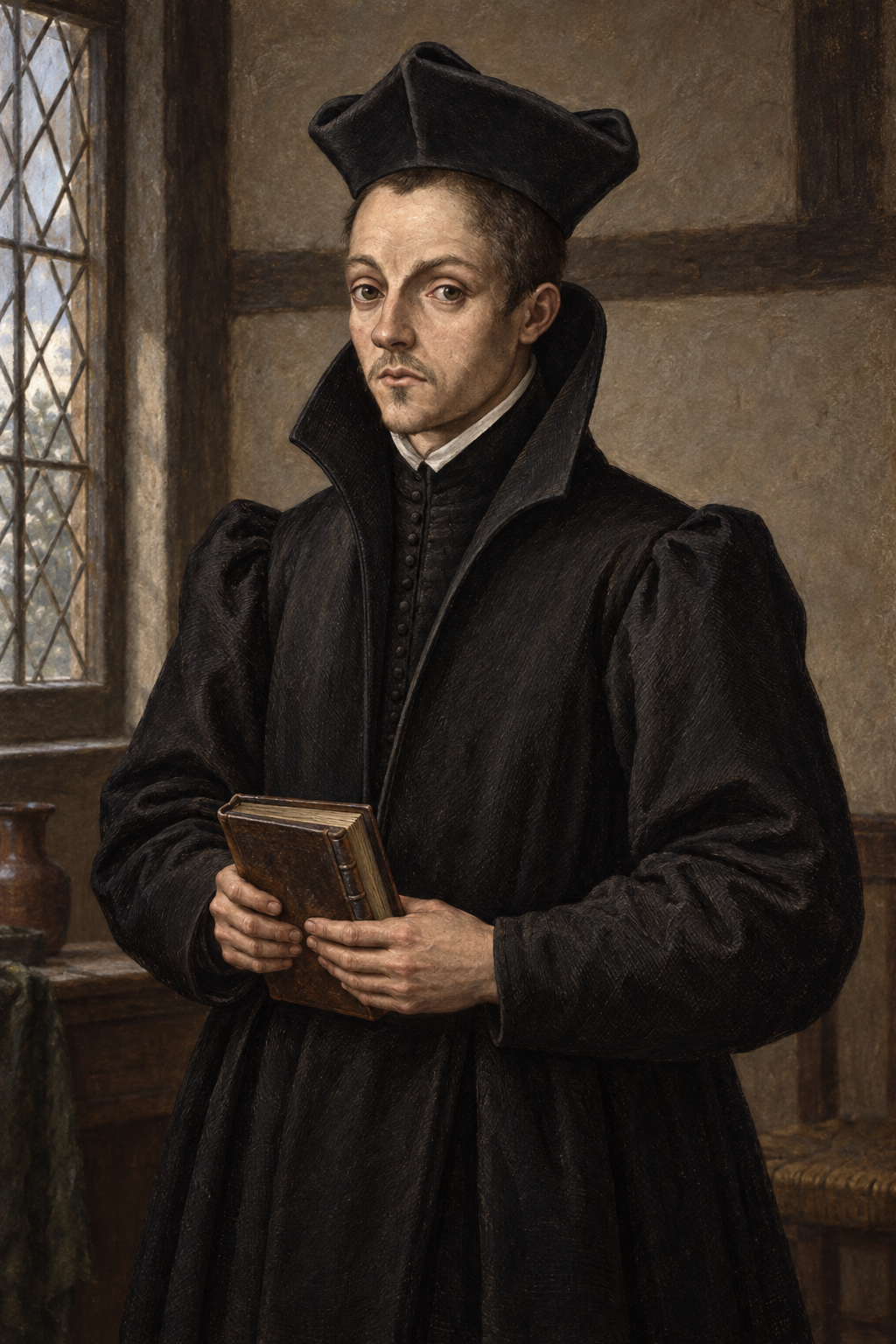
A surviving engraving gives a concrete example of this remembrance. The National Gallery of Art dates Martin Baes’s portrait to 1614, more than twenty years after the execution. It depicts a young cleric holding a book, surrounded by commemorative lettering. The print is evidence of his early visual commemoration, not an authenticated portrait made from life.
Gennings was among the Forty Martyrs canonized by Paul VI in 1970. His name later became the dedication of a church at New Invention, whose building had opened as a hall in 1967. The heritage survey records a modest prefabricated structure, showing how his remembrance entered ordinary parish life as well as illustrated books and formal ceremonies. The survey also records that the congregation had begun meeting in a room at a local public house.
At the canonization, Paul VI welcomed Anglican representatives and ended by expressing hope for Christian unity. That setting matters for the continuing remembrance of Gennings: honouring a Catholic martyr can accompany a desire for reconciliation among Christians, rather than renewed hostility toward those whose ancestors stood on another side of the religious conflict.
Wondering how to weigh the stories and sources? Learn how to read a saint biography.