Biography
Émilie de Vialar
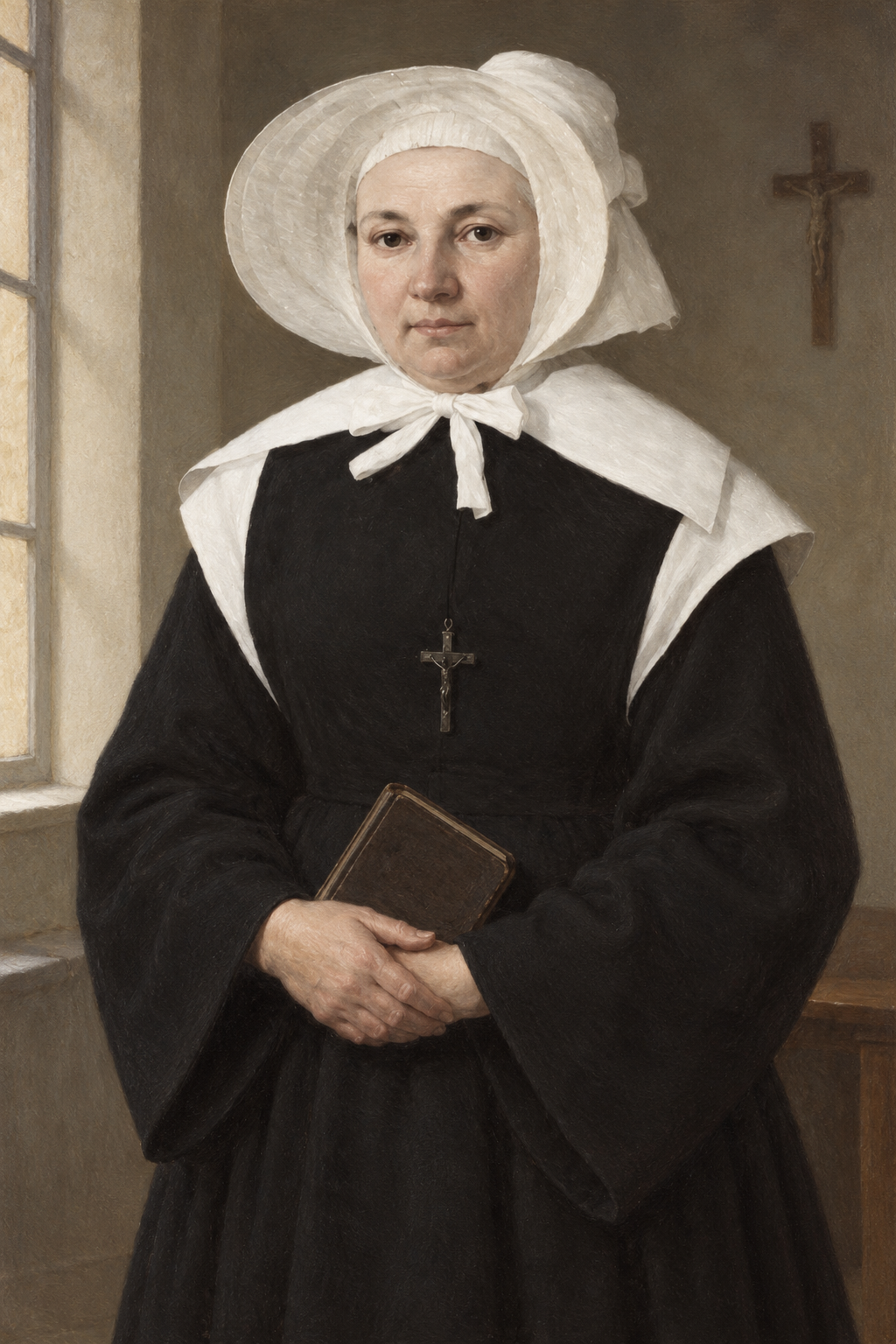
About Émilie de Vialar
Émilie de Vialar founded the Sisters of Saint Joseph of the Apparition, a congregation whose work carried her from southern France into the Mediterranean world. She was born at Gaillac on September 12, 1797, into a prosperous family. After schooling in Paris and the death of her mother, she returned home. She rejected a proposed marriage and devoted increasing attention to poor and sick people.
Her vocation developed over a long period. The diocese of Albi describes a young woman who enjoyed company, clothing and social occasions, yet found that these did not satisfy her. A parish mission helped her commit herself to God without immediately resolving the form that commitment would take. She began receiving poor people at home and drew companions into the work. Religious certainty and practical direction did not arrive together or without difficulty.
An inheritance from her maternal grandfather gave her the means to establish a house at Gaillac on Christmas Day, 1832. This became the beginning of the congregation. Archbishop François de Gualy of Albi supported the undertaking and received the vows of Émilie and seventeen companions in December 1835. Her decision placed inherited wealth at the service of a new religious community rather than securing a household of her own.
The community combined religious life with active service. According to the congregation’s account, the sisters taught children, cared for orphans, visited sick people at home and developed dispensaries and hospitals. Its missionary purpose took them beyond their original town into North Africa and the eastern Mediterranean, and eventually much farther afield. The institute understood this work through Saint Joseph’s participation in the coming of Christ into the world.
In 1835 Émilie went to Algeria, recently invaded and occupied by France. The sisters cared for people during a cholera epidemic. Their presence also belonged to the wider history of French expansion. Historian Sarah Curtis places Émilie alongside other women whose religious communities enabled them to travel, negotiate and establish institutions across political boundaries. She argues that missionary schools and care helped extend French Catholic culture, even where they were not directly controlled by the French state.
Émilie’s work in Algeria ended in conflict with Bishop Antoine-Adolphe Dupuch. The dispute concerned his effort to place the congregation under his authority and her refusal to accept that arrangement. The New Catholic Encyclopedia records that he excommunicated the sisters and expelled them from his diocese. Their wider congregation nevertheless continued to grow. The episode was an ecclesiastical rupture, not simply a passing disagreement between two strong personalities.
Material losses followed. The Clairval biography describes financial mismanagement, a prolonged lawsuit and the loss of property, as well as opposition within the community. Émilie moved the congregation’s headquarters to Toulouse in 1847 and later to Marseille, where Bishop Eugène de Mazenod offered support. These changes required the institute to continue its work with fewer resources and without the security her original inheritance had seemed to provide.
Its distant houses also required preparation and local judgment. Clairval records that she arranged Arabic instruction for sisters destined for the Middle East. She encouraged local superiors while allowing them room to adapt community customs to the circumstances of their country. Illness and deaths among the sisters made expansion costly in human terms. Her responsibilities included supporting those already abroad, rather than merely opening additional foundations.
Her own writings reveal the prayer behind that activity. In an account of her interior life, she recalls seeking awareness of God during ordinary occupations while struggling with distraction and dissatisfaction with herself. She also describes a difficult sea crossing during which she experienced a sustained inward recollection. The passage presents that experience as a grace within hardship, not as evidence that travel or leadership had become easy.
The 1841 explanation of the congregation’s rules connects charity with daily meditation on Christ’s love and mercy. In a letter to Father Balitrand, she expresses the hope that her religious zeal will last throughout her life. Both excerpts treat compassion as something to be continually renewed. They show why prayer and practical service remained closely joined in her understanding of the sisters’ vocation.
Émilie died at Marseille on August 24, 1856. Pius XII beatified her in 1939 and canonized her on June 24, 1951. Her memory has different calendar expressions: the diocese of Albi presents her on June 17, while the Vatican registry also records an August observance. Her remains were transferred to Gaillac in 1972, renewing the connection between her wider missionary legacy and the town where the congregation began.
The story was preserved through successive biographies. The congregation’s archivist Margaret Anne Beech describes an early effort to gather letters and testimony as the sisters who had known Émilie grew older. Later authors drew on those materials, often with an explicitly devotional purpose. Reading these accounts alongside her writings and historical research helps distinguish her own voice from the ways later generations commemorated her.
Wondering how to weigh the stories and sources? Learn how to read a saint biography.