Biography
Engelbert Kolland
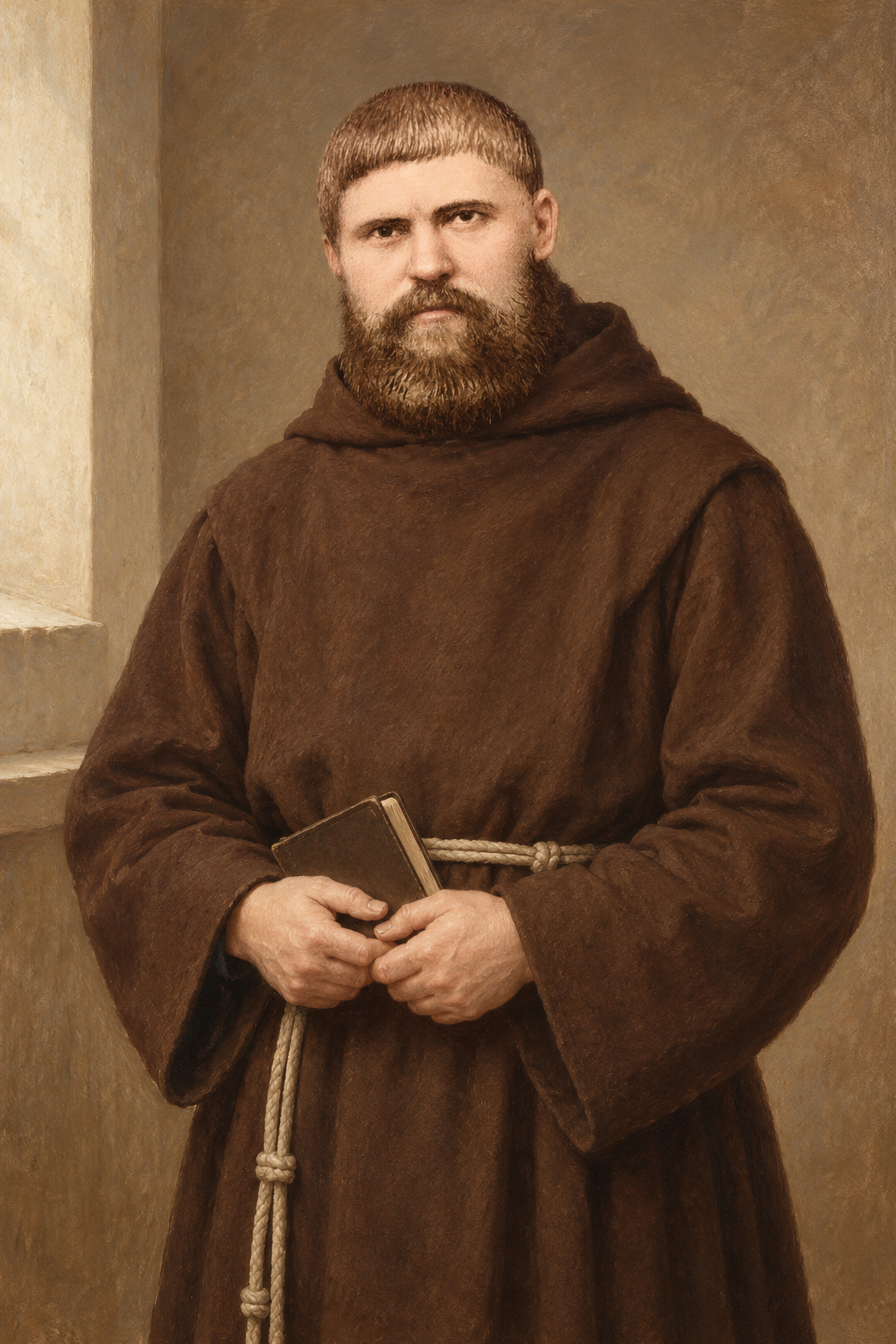
About Engelbert Kolland
Engelbert Kolland was a Franciscan priest who spent the last five years of his life serving Christians in Damascus. Born Michael Kolland in Ramsau in 1827, he grew up in a family whose Protestant convictions brought them into conflict with the religious authorities. His parents had to leave their home for Styria. He remained behind with a brother and later attended school in Salzburg. Religious intolerance was therefore part of his experience long before he became a missionary.
His education was interrupted by difficulties with Latin. After leaving school, he eventually returned and completed his studies. Frequent visits to the Franciscan church in Salzburg encouraged his wish to join the order. He entered in 1847 and was ordained at Trent in 1851. His subsequent aptitude for languages contrasted with his earlier struggles: he studied several European languages and Arabic, which would become essential to his work abroad.
Gottfried Egger’s Franciscan account describes a demanding journey to the Holy Land in 1855. Kolland suffered severe seasickness during the crossing before reaching Jerusalem in April. He first served at the Holy Sepulchre and then moved to Damascus. The community there cared for Latin-rite Christians, maintained a school and provided instruction in eastern languages. Its responsibilities also included pastoral care for Armenian Catholics who lacked a priest of their own.
Carmelo Bolta, the parish priest, was frequently ill, and much of the parish work fell to Kolland. Egger describes duties extending from religious instruction and language teaching to mediation in disputes, assistance for poor people, and visits to the sick and dying. Finding medicine could be as much a part of his day as administering a sacrament. His local reputation developed through this repeated attention to ordinary needs. Egger also credits him with arranging a tower and bell for the parish church. The account presents these improvements alongside teaching and personal assistance, as parts of the same pastoral responsibility.
Letters quoted by the community devoted to his memory reveal the cost of leaving his family. In one excerpt he expresses grief at the prospect of living far from his parents and siblings. Another, written after reaching Jerusalem, assures his parents that he remains united with them in prayer. These passages preserve affection alongside missionary commitment. They survive here as published excerpts, without the full letters or their archival references.
His biographer Johannes Laichner emphasizes the relationship between language learning and pastoral friendship. In a 2024 interview, he portrays Kolland as a priest who first learned to communicate with the people among whom he lived, made friends and then shared his faith. His work included teaching at the Franciscan school as well as parish ministry. The description places everyday contact at the centre of his vocation, rather than treating his death as the only significant event in his life.
Laichner also connects this service with the affectionate local name by which Kolland was remembered, meaning Father Angel. His interpretation of the priest’s character stresses approachability, determination and religious devotion. These are a modern biographer’s judgments, informed by work in the order’s archives and family correspondence. They offer a portrait of his manner with people without making every later recollection equivalent to a contemporary eyewitness statement.
Violence overtook the community in July 1860. The detailed devotional biography describes Kolland trying to escape across nearby roofs after attackers entered the monastery. A woman gave him a cloak, but his religious habit remained visible. According to that account, he was caught, refused to renounce his Christian faith and was killed with an axe. The reported exchanges belong to the transmitted martyrdom narrative; they are not a verbatim record that can be independently checked.
He died on July 10, 1860. The diocesan calendar records his death with seven other Franciscans and remembers him as a priest and martyr. His birth on September 21, 1827, means he was thirty-two, although several devotional accounts describe him as thirty-three. The distinction matters because those accounts sometimes connect the mistaken age with a symbolic comparison to the life of Jesus.
Pope Pius XI beatified Kolland with the other ten martyrs in 1926, and Pope Francis canonized the group on October 20, 2024. Their commemoration includes three Maronite laymen alongside the eight Franciscans.
At the thanksgiving celebration after the canonization, Bishop Hermann Glettler cautioned against misunderstanding images showing Kolland with a weapon. Such attributes referred to the violence inflicted on him, not violence he practised. The bishop instead commended patience, reconciliation and refusal of hatred. In this reading of his life, fidelity to faith and care for other people remain inseparable from a rejection of retaliation. Glettler acknowledged the difficulties of his early life and resisted presenting sainthood as an effortless success. He understood Kolland’s response to hardship as an invitation to practise hope and gentleness in ordinary relationships. He also warned against indifference to the suffering of others.
Wondering how to weigh the stories and sources? Learn how to read a saint biography.