Biography
Frances Xavier Cabrini
About Frances Xavier Cabrini
(draft)
Francesca Saverio Cabrini was born on 15 July 1850 in Sant'Angelo Lodigiano in Lombardy, Italy. The Holy See's profile describes her as the youngest of a large family and records that she was orphaned by both parents. From childhood she imagined a life of religious service, but poor health prevented the convent from accepting her when she first applied. Instead, she became a teacher and was asked to care for an orphanage. That work placed education, vulnerable children, and organized charity at the center of her vocation. [C1]
With several companions, Cabrini formed the first community of the Missionary Sisters of the Sacred Heart of Jesus. The congregation took Saint Francis Xavier as its model and patron, and Cabrini adopted the name Xavier when she made her religious vows. Her aim was missionary: she wanted consecrated women to be formed and sent into the world with their own apostolic responsibility, while remaining ready to cooperate with local churches and other communities. Pope Francis later described this as a distinctive female missionary charism, not merely auxiliary work attached to male missionary institutions. [C1][C2]
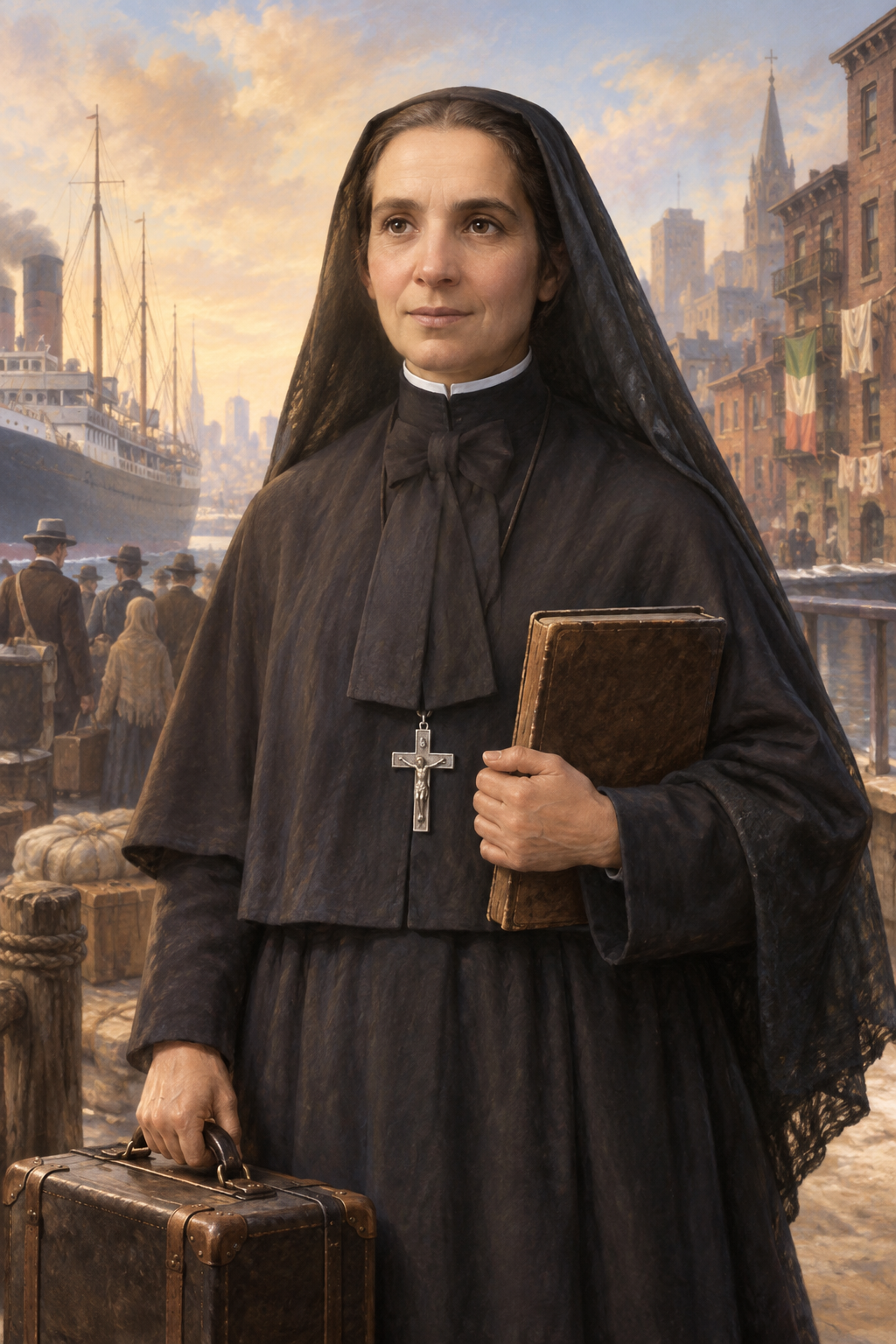
Cabrini initially hoped to evangelize in China. Her direction changed when Pope Leo XIII urged her to go west rather than east. She accepted the new assignment and traveled to the United States, where large numbers of Italian migrants were trying to build lives amid poverty, language barriers, insecure employment, and weak social support. Francis's account emphasizes that Cabrini did not treat migration as an abstraction: she met people who had left home with little more than their belongings and who needed welcome, friendship, practical help, and religious care. [C2]
The work expanded through repeated journeys. Francis records that Cabrini crossed the ocean about twenty-four times and traveled through the Americas, including the Andes and Argentina. The Holy See profile records foundations and works in Italy, France, Spain, Great Britain, the United States, Central America, Argentina, and Brazil. The congregation's activity included schools, orphanages, hospitals, shelters, colleges, workshops, and care for people who were ill. Cabrini's ministry therefore combined mobility with institution building: she traveled to identify needs, then helped establish communities that could continue serving after she had gone. [C1][C2]
Her concern extended beyond immigrant families. Francis names orphaned children, young people without work who were vulnerable to exploitation or crime, and men and women trapped in the least secure forms of labor. Cabrini's response was not limited to private consolation. She supported education, health care, shelter, and the formation of religious women who could remain close to people whose needs were overlooked. Francis attributes sixty-seven charitable works to this energetic apostolic period, while the Holy See's canonization account also emphasizes schools, hospitals, orphanages, and assistance to migrants. These figures and categories should be presented as official retrospective accounts rather than as an independently audited census. [C1][C2]
Cabrini died on 22 December 1917 in Chicago, at a hospital associated with her care for migrants. Her life was recognized by the Catholic Church first through beatification on 13 November 1938 and then through canonization by Pius XII on 7 July 1946. In 1950, Pius XII declared her the heavenly patron of migrants. That patronage is supported by a formal Holy See act and should be distinguished from informal claims that she is a patron of every immigrant-related cause. [C1]
The surviving official accounts present Cabrini as a missionary whose work responded to the concrete circumstances of modern migration. They also show the limits of a purely heroic summary: her institutions depended on local churches, civil conditions, collaborators, and the continued work of the congregation she founded. A responsible profile can therefore remember her energy and organizational achievement while keeping the focus on the people she served—migrants, children, patients, and workers—rather than treating institutional growth as an end in itself. [C1][C2]
Cabrini's work among migrants also required cultural translation. Italian families arriving in the United States encountered unfamiliar laws, languages, workplaces, and religious structures. Schools and hospitals could provide more than instruction or treatment: they could become places where families learned how to navigate a new society without being treated as disposable labor. The official accounts do not supply a complete institutional history for every foundation, so this interpretation should remain attached to the general pattern of work rather than assigned to a particular school without its own evidence. [C1][C2]
The congregation's expansion depended on Cabrini's ability to form other women for missionary service. Francis describes her as sending consecrated women throughout the world with a missionary horizon that was not limited to assisting male religious institutes. This point matters for the biography's structure: the foundation of the congregation was not only an early event, followed by independent works, but the mechanism through which a continuing network of women could answer local needs in different countries. [C2]
The Holy See's canonization account recalls that Cabrini's activity included young people, people in prison, patients in hospitals, and migrants who were isolated from family and homeland. The account uses the language of charity and religious witness, while a modern profile should describe the concrete actions without suggesting that every institution operated according to contemporary standards. Cabrini's historical significance is strongest when the narrative keeps both dimensions visible: she responded vigorously to immediate needs, and her work belonged to the social and ecclesial conditions of her period. [C1]
Her final years did not end the mission. Cabrini died in Chicago, but the Missionary Sisters of the Sacred Heart continued the work she had organized. The formal patronage granted in 1950 reflects the connection between her life and the care of emigrants, but it should not be used to claim that she spoke for all migrant experiences or that the Church's later title settles every question about migration policy. A careful entry can state the patronage as a juridical fact while leaving social and political conclusions to cited sources. [C1]
For readers today, Cabrini's story is therefore not simply a sequence of heroic journeys. It is a history of vocation becoming administration, travel becoming institution building, and compassion becoming schools, hospitals, shelters, and orphanages. Those categories should be checked against the congregation's own historical records when the packet is finalized, but the official Vatican accounts already support the central conclusion: Cabrini made the dignity of displaced and vulnerable people the organizing concern of her missionary life. [C1][C2]
Wondering how to weigh the stories and sources? Learn how to read a saint biography.