Biography
Guido Maria Conforti
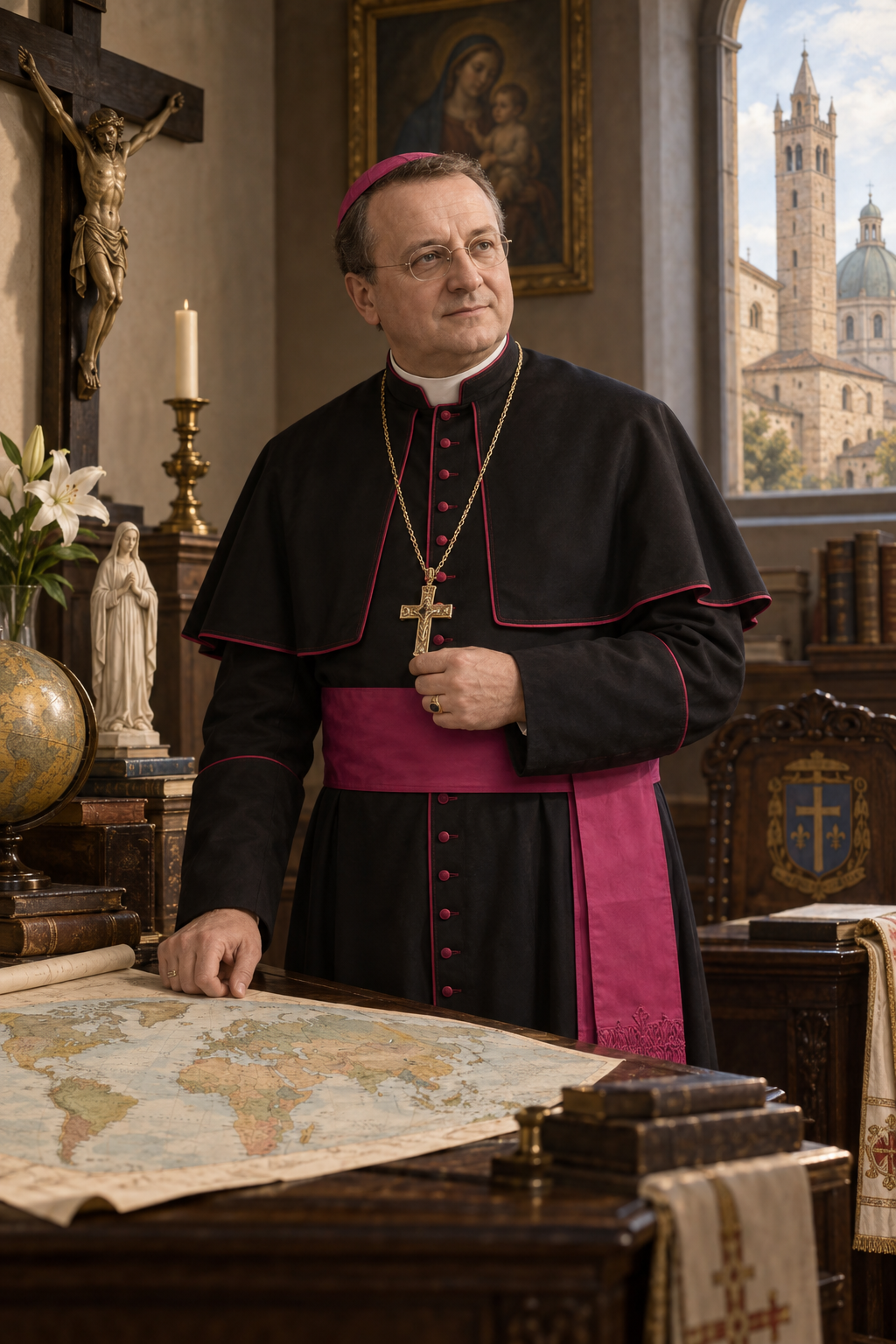
About Guido Maria Conforti
Guido Maria Conforti was born at Ravadese, near Parma, on March 30, 1865, and was baptized the same day. The Dicastery for the Causes of Saints says he entered the seminary at the age of eleven.
Benedict XVI's canonization homily says Guido overcame his father's opposition in order to enter seminary and that contemplation of the Crucified Christ drew him toward the love he wanted to announce. This source helps explain why the crucifix is an appropriate devotional and artistic attribute.
His path to priesthood was marked by illness. The official profile says a condition with epileptic-like symptoms delayed his priestly ordination. During that period he was named vice-rector of the seminary and showed notable gifts as an educator.
The seminary work mattered because it revealed a form of pastoral fatherhood before he could receive priestly orders. The source says he especially oriented young men toward holiness by the witness of a life lived in the light of faith.
After recovering his health, Guido was ordained priest in 1888. As a young priest he received the role of director of the Pious Work for the Propagation of the Faith, and before he was thirty he was called to serve as vicar general.
Guido felt drawn to foreign mission, but his health kept him from following that vocation personally. The Dicastery profile presents the foundation of a missionary institute as his answer to that limitation. In 1895 he founded the Pious Society of Saint Francis Xavier for Foreign Missions, later known as the Xaverian Missionaries.
The canonization homily links the institute to the phrase Caritas Christi urget nos, "the love of Christ urges us," and describes the family he founded as entirely at the service of evangelization. The final page can mention the motto briefly if the Latin is not allowed to dominate the profile.
The institute's purpose, according to the official profile, was the evangelization of non-Christians. In 1899 Guido sent the first two missionaries to China, and later many others followed. The public page should state this as mission history, avoiding romantic or exoticized description of China.
In 1902, at the age of thirty-seven, Pope Leo XIII called Guido to govern the Archdiocese of Ravenna. On the day of his episcopal consecration he made perpetual religious vows, expressing his wish to give himself entirely to Christ and to the good of souls.
His Ravenna service lasted only two years. The Dicastery source says he spent his energies for the good of the diocese, but his health did not hold. Out of responsibility for the flock entrusted to him, he submitted his resignation, and Pope Pius X accepted it.
Benedict XVI's homily describes Guido's life as marked by serious trials, which he accepted as part of providence and as a way of building God's kingdom through self-renunciation and daily acceptance of God's will. This should be paraphrased without turning illness into melodrama.
Guido then returned to his institute and dedicated himself to forming missionary students. After his health improved, Pope Pius X asked him in 1907 to govern the Diocese of Parma. He served there for more than twenty-four years.
In Parma, he made religious instruction a central pastoral concern. The official profile says he established schools of Christian doctrine in every parish, prepared catechists through courses in religious culture and pedagogy, and celebrated what it calls the first catechetical week in Italy.
He also visited the diocese extensively. The Dicastery profile records four complete pastoral visits, with a fifth interrupted by death. He held two diocesan synods and promoted Catholic associations, good press, popular missions, Eucharistic, Marian, and missionary congresses, and Catholic Action meetings.
Even while serving Parma, Guido did not neglect the missionary family he had founded. He remained superior general of the Xaverians and supported missionary animation in Italy. In 1916 he collaborated in founding the Missionary Union of the Clergy and served as its first president for ten years.
In 1928 Guido himself traveled to China to visit his missionaries and the Christian communities entrusted to them. This event belongs in the page because it shows that his missionary concern was not only organizational or rhetorical; it remained personal even in episcopal life.
The beatification homily also presents him as living the local Church's care, mission ad gentes, and renewed evangelization together. That frame is useful for the public profile because it explains why a diocesan bishop belongs in the catalog as a missionary saint.
The Dicastery profile says he died in the Lord on November 5, 1931, and that his funeral drew an extraordinary number of people. It also says his reputation for virtue and holiness spread from Parma to the countries where the Xaverians worked.
The same official source records his beatification by John Paul II on March 17, 1996, and canonization by Benedict XVI in Saint Peter's Square on October 23, 2011. It gives November 5 as his liturgical memorial. The page should center the unity of bishop, founder, catechist, and missionary rather than isolating one role from the others.
Artwork should show an Italian bishop-founder in simple episcopal dress with a pectoral cross, a crucifix, and a restrained missionary map or desk. Avoid exoticized mission figures, triumphalist colonial imagery, rendered words, logos, halos, and any exact-likeness claim.
Wondering how to weigh the stories and sources? Learn how to read a saint biography.