Biography
Henri Dorie
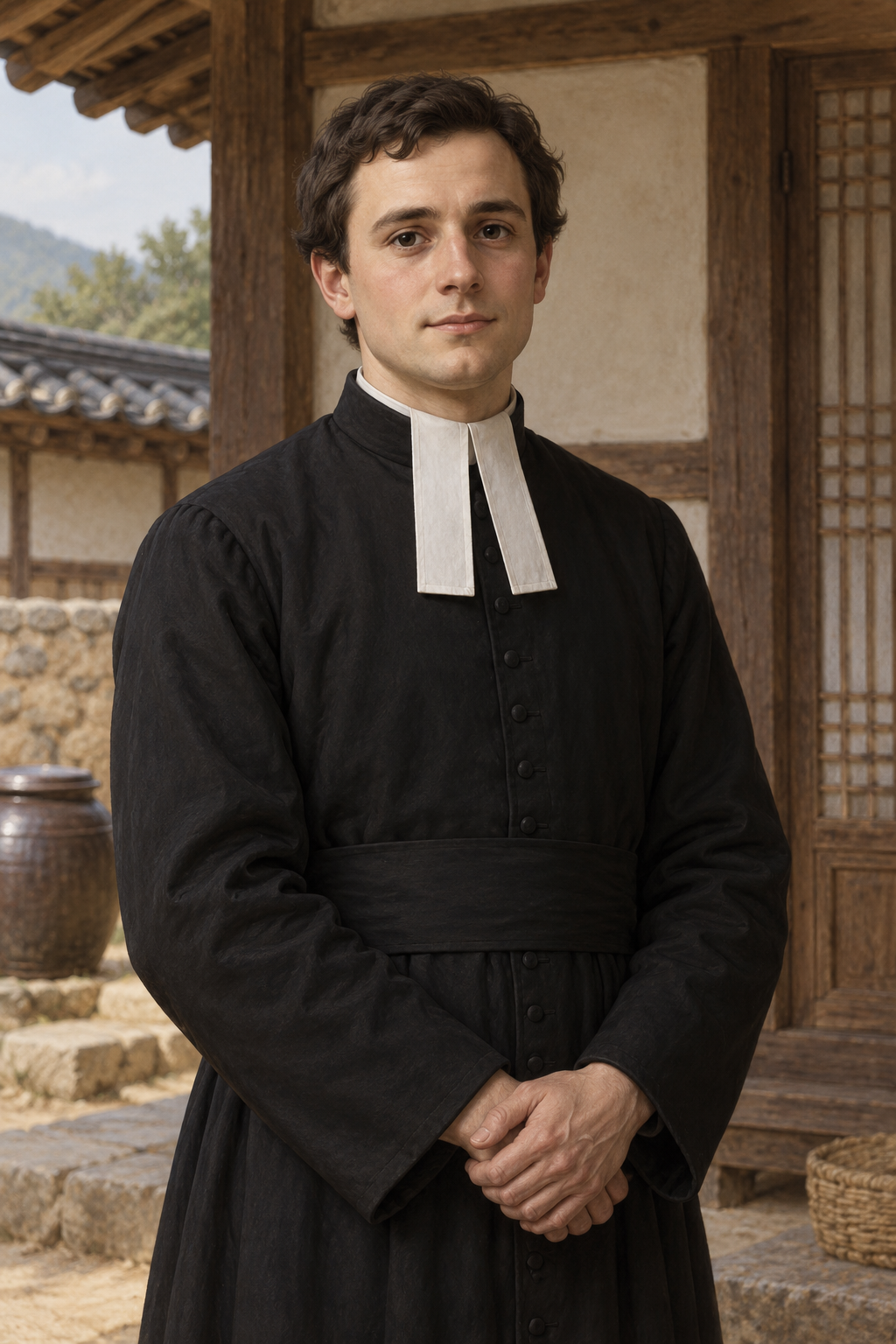
About Henri Dorie
Pierre-Henri Dorie grew up in the Vendée region of France and studied at seminaries in Les Sables-d’Olonne and Luçon. He entered the Paris Foreign Missions Society in 1862 and was ordained a priest in 1864. He was assigned to Korea and left France that summer with three fellow missionaries.
The bishops’ conference account describes his parents as devout farmers. His parish priest took an interest in him and recommended seminary education. Dorie’s decision to become a foreign missionary nevertheless met opposition from both his parents and the pastor who had supported his earlier studies. He persisted in seeking that work. The account also remembers his friendship with de Bretenières and their assignment to the same mission.
Before entering Korea, Dorie studied at Sioung-io near Yang-kouan in Manchuria. His first Korean mission posting was at Son-kol.
His letters from the mission seminary describe the happiness he found there. Writing to a friend in September 1862, he said that he had quickly become accustomed to the house and felt at home among his companions. He acknowledged that his enthusiastic description might sound exaggerated, but insisted that it expressed what he felt. The letter presents the welcome of the seminary through his own experience, before the hardships of travel and ministry abroad.
His parents found the separation harder. Later that month, he wrote to reassure them that he was well and happy. He recognized that he was farther from home than when he had studied at Luçon, but asked them to take courage and pray. He also expressed his hope that the family would eventually be reunited in heaven. These words were addressed to parents grieving his absence, rather than to readers of a public missionary report. Their sadness remained part of the decision he had made to prepare for work far from France.
Before entering Korea, Dorie stayed in a Catholic village in Manchuria. Ferdinand Baudry’s biography, published the year after his death, describes this period of preparation. Dorie studied the language and celebrated Mass for the community while waiting for a route into his assigned mission. He suffered smallpox during a visit to fellow missionaries, when Just de Bretenières helped nurse him. After recovering, he returned to the village. When he left in April 1865, its Catholics gave him food, which he shared with them at a farewell meal. The account describes an attachment formed during this temporary stay, before his departure for Korea.
In a letter to his superior shortly afterward, Dorie reported that he was stronger and in better health. He mentioned the meals supplied by his hosts and companions, including food from de Bretenières. His cheerful account of renewed physical strength was followed by concern about his spiritual life. He asked the superior to pray for him as he prepared for the next stage of his journey. The letter records both the practical care he received from others and his continuing dependence on the support of the society that had sent him.
Beaulieu’s September letter describes the four missionaries meeting a Korean vessel after traveling in a Chinese boat. They landed in southern Korea in May 1865. Dorie and Beaulieu were later sent to separate Catholic villages to study Korean. Beaulieu stressed the difficulty of the language, continued concealment and the possibility of renewed persecution.
Dorie’s new home at Son-Kol also served as the village chapel. Baudry describes its earthen walls, thatched roof and small doorway, with an improvised altar inside. Dorie lived in Korean clothing and rarely went beyond the house. When he traveled to visit Beaulieu, he used mourning garments and a broad hat to conceal his foreign appearance.
Writing to the Comte de Bessay in October 1865, Dorie described the chapel’s poverty without presenting it as a reason to leave. What encouraged him was the faith of the people who gathered there. He praised their prayer and compared their devotion favorably with that of Catholics he had known in France. In another passage of the same letter, he spoke of both the Vendée and Korea as places he loved. He had come to regard Korea as an adopted homeland. He also expressed his desire for martyrdom, a personal religious hope recorded before his arrest.
After Dorie’s death, the surviving missionary Félix Ridel wrote to his brother Pierre. Ridel reported that Dorie had learned enough Korean to begin serving nearby communities after months of study. Those plans were interrupted when news of persecution arrived. The letter recalls a ministry still developing, rather than a long-established career in Korea.
Dorie was arrested in February 1866 and imprisoned in Seoul with Bishop Berneux and other missionaries. After interrogation and torture, he was taken to Saenamteo and beheaded that March. His surviving correspondence preserves the family ties, friendships and encounters with Catholic communities that preceded his brief Korean ministry.
Wondering how to weigh the stories and sources? Learn how to read a saint biography.