Biography
Irenaeus of Lyon
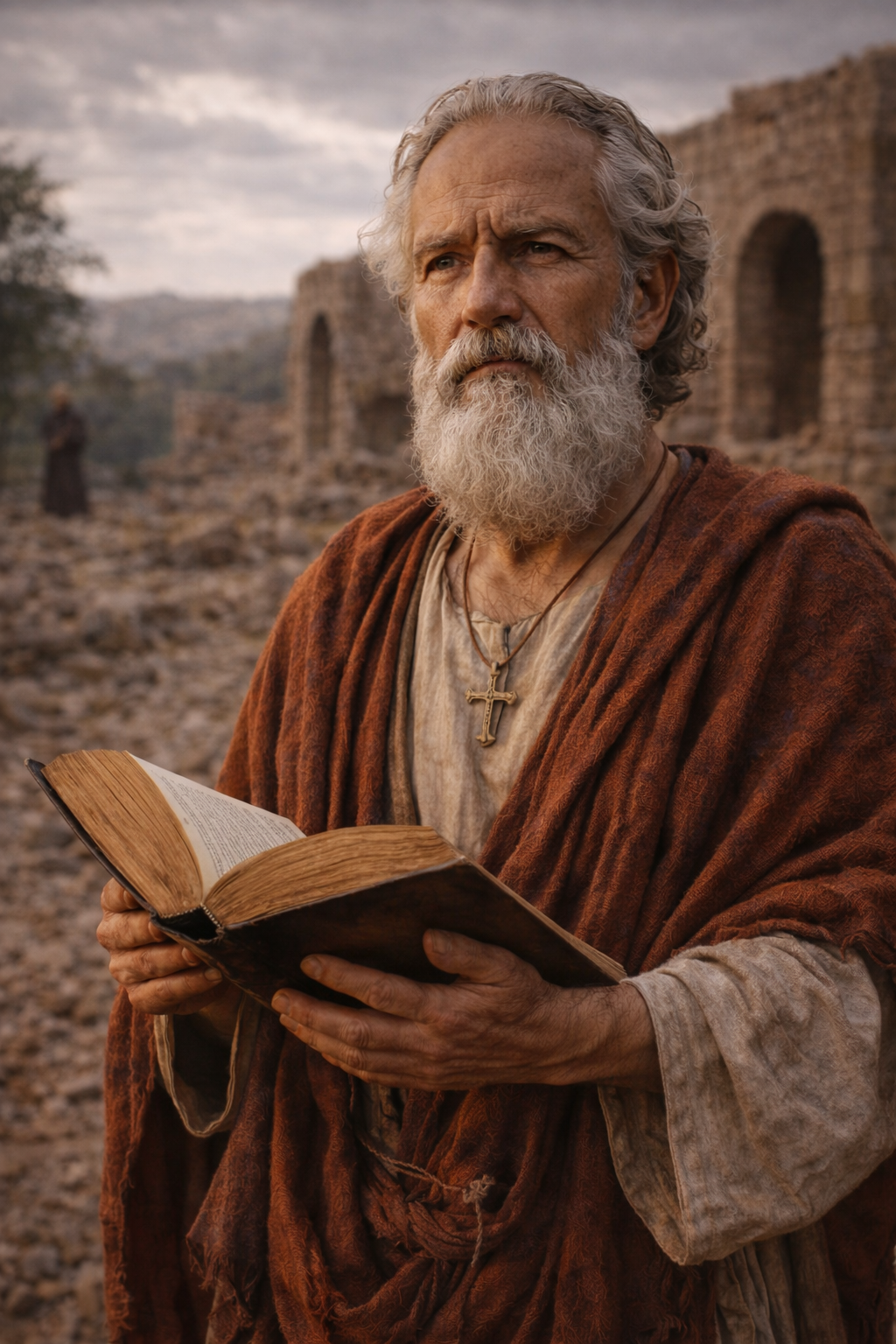
About Irenaeus of Lyon
Irenaeus became bishop of Lugdunum, now Lyon, in Roman Gaul during the later second century. Much of his early life remains unknown. Eusebius says that in youth he heard Polycarp of Smyrna, and Irenaeus's own recollection describes remembering Polycarp's manner of life and teaching. This places his formation within the Greek-speaking churches of Roman Asia, although it does not prove the catalog's former exact birthplace or a birth year of 130. That year is best treated as a traditional approximation. His surviving Greek name, Eirenaios, is related to peace, a meaning later invoked when he was named Doctor of Unity.
The first firm public event in Irenaeus's life comes from the persecution at Lugdunum and nearby Vienne in 177. A letter preserved by Eusebius recounts arrests, imprisonment, torture, and executions among those churches. While the aged bishop Pothinus was imprisoned, the community identified Irenaeus as a presbyter and sent him to Eleutherus, bishop of Rome, carrying a letter concerned with peace in the churches. The mission kept him away from the executions described in the account. Eusebius later states that Irenaeus succeeded Pothinus as bishop. The evidence does not disclose the mechanism or exact date of his selection, but it anchors his ministry between Gaul and Rome.
As bishop, Irenaeus wrote in a setting where Christian communities disagreed sharply about Scripture, creation, salvation, and authority. His five-book work commonly called Against Heresies describes and contests schools now often grouped under the broad modern label Gnostic. His opponents were not one organization, and his reports are polemical rather than neutral ethnography. Even so, the work preserves extensive evidence about second-century debate. Irenaeus argues that Christian teaching was publicly proclaimed, received in churches, and traceable through leaders rather than reserved as secret knowledge for an elite. His lists of succession serve that argument and should not be mistaken for complete institutional archives.
A central theme in Irenaeus's theology is the unity of God's work. Against teachers who separated the creator from the Father proclaimed by Jesus, he defended one God acting across the Scriptures and the history of salvation. He described the Son as gathering or recapitulating humanity's story, answering Adam's disobedience through Christ's obedience. He also stressed the reality of embodied life: creation is not an error to escape, and redemption concerns human bodies as well as minds or souls. These arguments shaped later Christian theology, although technical summaries can flatten a wide-ranging pastoral and scriptural work into a few slogans.
The shorter Demonstration of the Apostolic Preaching presents related teaching in a more instructional form. It traces the Christian confession through creation, Israel's Scriptures, the incarnation, and the church's mission. The work survives fully in an Armenian version discovered in the early twentieth century, while Greek fragments also remain. Its recovery widened modern knowledge of Irenaeus beyond his controversy with rival teachers. Together, the Demonstration and Against Heresies show a bishop explaining a coherent story of creation and redemption, not merely compiling accusations. They also reveal how heavily his reasoning depends on close reading of Scripture and inherited summaries of faith.
Irenaeus also intervened in a dispute over the date of the Paschal celebration. Eusebius reports that Victor of Rome sought to exclude churches of Roman Asia that maintained a different custom. Irenaeus agreed that the mystery should be celebrated on Sunday, yet urged Victor not to cut off entire churches whose inherited practice differed. He recalled earlier Roman bishops who had maintained communion despite disagreement. The episode survives through Eusebius's later quotation, so its details are probable rather than a complete contemporary dossier. It nevertheless provides a concrete example of Irenaeus pressing for communion while acknowledging a real dispute.
The circumstances of Irenaeus's death are not documented by the early sources used here. Eusebius, who records many martyrdoms and discusses Irenaeus at length, does not call him a martyr or narrate his death. Later churches venerate him as a martyr, and some traditions connect his death with persecution around 202. That received memory deserves accurate labeling, but it cannot support the former exact date of June 28, 202 as a historical death date. June 28 is a Roman Catholic feast, while the Orthodox Church in America commemorates him on August 23. Feast days record liturgical memory, not a civil death certificate.
In 2022 Pope Francis declared Irenaeus a Doctor of the Church with the title Doctor Unitatis, Doctor of Unity. The decree points to a life and ministry linking East and West and to the peace evoked by his name. This is a modern Roman Catholic recognition, not a title automatically shared by every Christian body. Irenaeus remains significant because unusually substantial second-century writings connect pastoral leadership, public teaching, scriptural interpretation, and efforts toward peace. His record also models historical caution: the works and episcopal activity are well grounded, while his childhood, exact chronology, and martyrdom belong to evidence of different strengths.
Wondering how to weigh the stories and sources? Learn how to read a saint biography.