Biography
Isaac Jogues
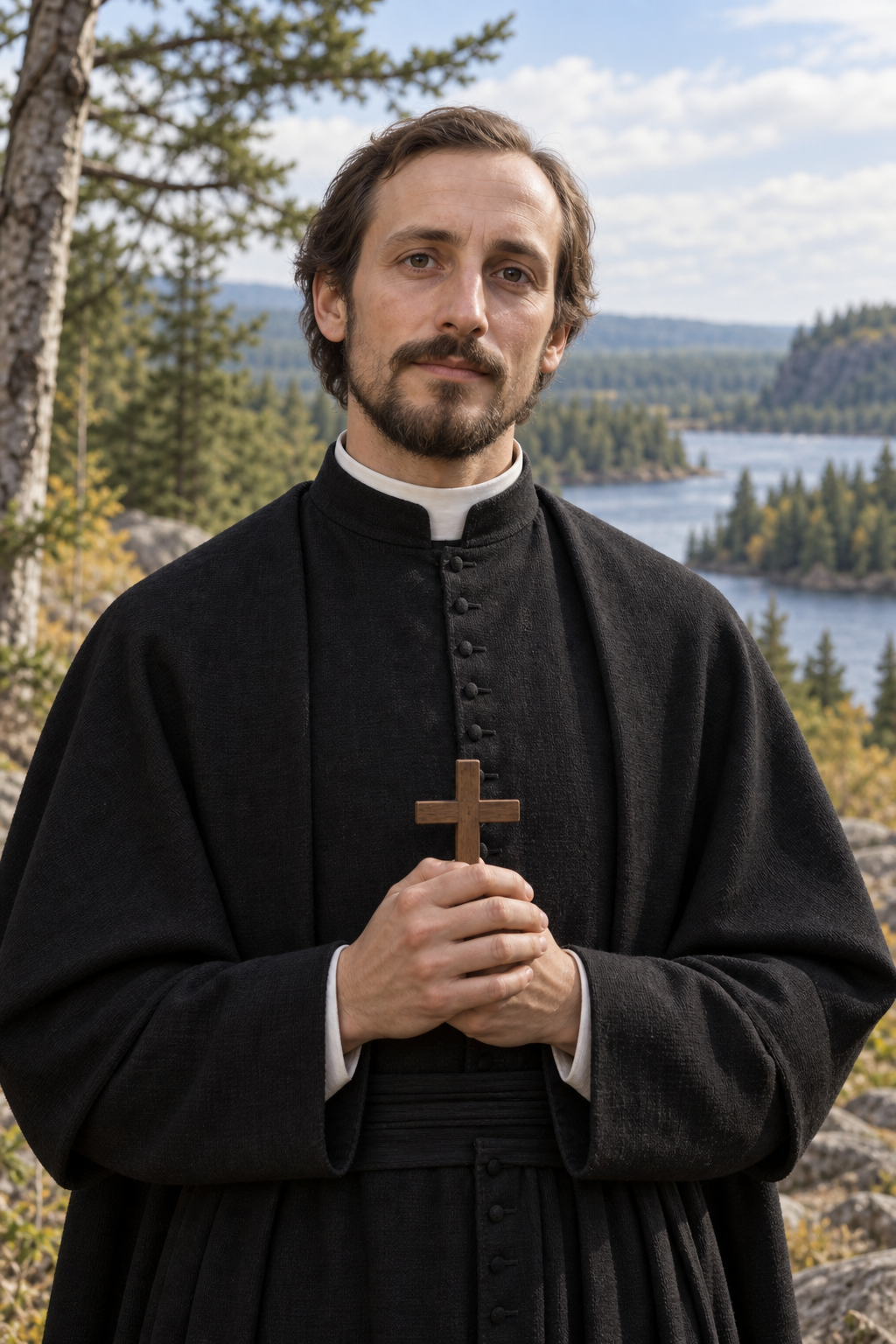
About Isaac Jogues
Isaac Jogues was born in Orléans on January 10, 1607. He entered the Society of Jesus at Rouen in 1624. Further study took him to La Flèche and Paris, where his education included philosophy and theology. Ordained a priest in 1636, he left that year for the missions of New France. His preparation had taken place in colleges, but his work would depend on travel, new languages and relationships far from home.
The journey brought him through the French settlements and into the country of the Huron, or Wendat, people. He joined Jean de Brébeuf at Ihonatiria and began to learn the language spoken there. An epidemic struck the settlement, and people suspected that the missionaries had brought the disease. Jogues later moved to other mission settlements, including Sainte-Marie. When visitors from farther west invited the priests to come to their people, he travelled to meet them in 1641. The Jesuit account says that the visitors welcomed religious instruction, but too few missionaries were available to establish another permanent mission.
These encounters took place within a war that the French missionaries could not stand outside. The Iroquois Confederacy opposed the Hurons, and the French priests were associated with their enemies. In 1642 a war party captured Jogues and his companion René Goupil and carried them to the Mohawk village of Ossernenon. There Jogues suffered torture and the mutilation of his hands, while Goupil was killed. His captivity lasted more than a year. The religious meaning later attached to these sufferings belongs alongside this political setting: the captives were caught in relationships between peoples already at war.
The Dictionary of Canadian Biography places the attack on the returning canoe party in early August and discusses uncertainty about its location. The party included Indigenous travellers as well as Frenchmen. Jogues therefore shared captivity with people whose own lives and communities had also been disrupted.
In his account of Goupil, Jogues remembers their companionship rather than merely listing their injuries. He describes Goupil caring for wounded captives and captors alike. Goupil made his religious vows during captivity. He also records his own attempts to find and bury his companion's remains after the killing. This is the testimony of a participant, written with grief and a conviction that Goupil had died for his faith. His letter before the last journey also acknowledges bodily weakness.
Dutch settlers at Fort Orange worked to obtain Jogues's freedom. Their help eventually enabled him to take refuge aboard a vessel and reach New Amsterdam. His route out of captivity thus depended on assistance from people outside his own Catholic community. After a winter Atlantic crossing, he reached the coast of Brittany at Christmas in 1643. He then made his way to a Jesuit house. The return brought public recognition of his suffering, including a reception at the French court. It also confronted him with a practical consequence of his wounds: his hands no longer met the requirements then applied to a priest celebrating Mass.
Pope Urban VIII granted permission for him to celebrate despite his damaged fingers. Jogues did not remain permanently in France; he returned to New France and sought further missionary work.
At Ville-Marie he wrote about his captivity and Goupil's death. The place is now known as Montreal. Writing preserved an account of experiences that might otherwise have remained known only to the people immediately around him.
In 1646 his work took a diplomatic form. He travelled into Mohawk territory as an envoy seeking peace, retracing a route that he had once followed as a prisoner. The first visit ended with agreement and a return to the French settlements. A later journey, undertaken with Jean de la Lande, ended very differently. Illness and damage to crops had encouraged suspicion of the belongings Jogues had left behind. He was killed at Ossernenon on October 18, 1646.
The Jesuit biography records disagreement among the Mohawk clans over his fate. Some wanted to preserve peace; others pressed for his death. That disagreement matters when reading the story: the actions of his killers cannot responsibly be made into a judgment about every Mohawk person.
Catholic remembrance places Jogues within a group of eight martyrs canonized in 1930. Their commemoration joins six priests with two lay companions, acknowledging that the mission depended on more than ordained ministers. The Jesuits celebrate the group in October in the United States and in September in Canada.
When John Paul II visited the Martyrs' Shrine in 1984, he also recalled Indigenous Christians who had become witnesses and teachers within their own communities. His address named Joseph Chiwatenwa and his family alongside the missionaries. That wider remembrance gives Jogues's life its human setting: a priest's endurance and desire to share his faith, lived among people who made their own choices, suffered losses and helped shape the Church that followed.
Wondering how to weigh the stories and sources? Learn how to read a saint biography.
Explore similar vocations
Prayers for Isaac Jogues
Isaac Jogues: sourced prayer excerpt
Would that he would somewhat enlarge my poor heart, which is so narrow