Biography
Isidore of Seville
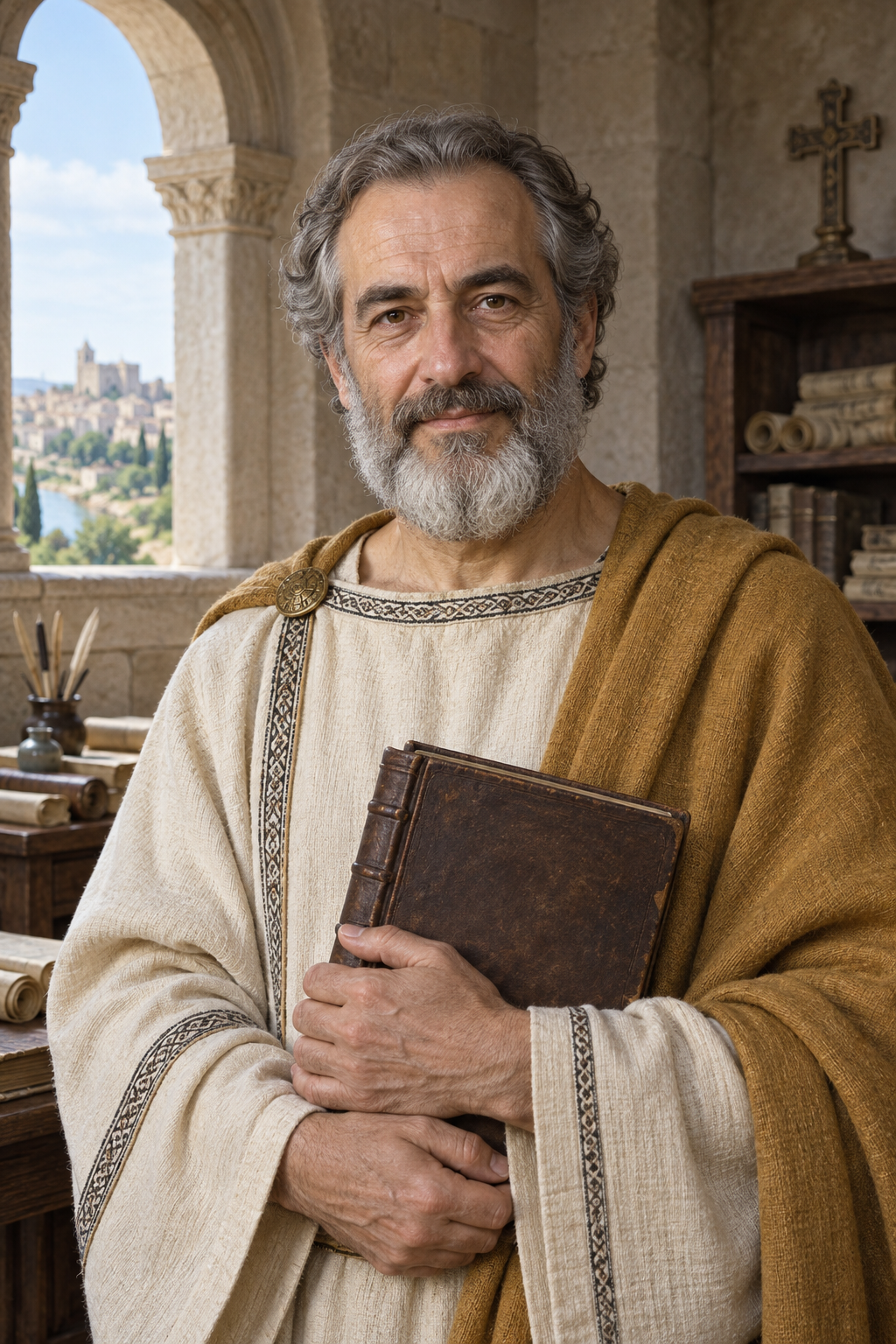
About Isidore of Seville
Isidore of Seville joined the work of a bishop to a sustained effort to gather and teach inherited learning. His elder brother Leander supervised his education, sometimes sternly, in a household with both Christian books and classical literature. Isidore later succeeded him as bishop. His writings returned to a tension he knew through that office: the attraction of quiet study and prayer, and the obligation to care for others. He did not treat contemplation as a reason to abandon people who needed assistance. In his account of Christian life, attention to God and practical love of one's neighbor belonged together.
Born around 560, Isidore grew up in a family that had moved from Cartagena to Seville during a period of conflict between Visigothic and Byzantine power. His exact birthplace is uncertain. He became bishop around 600, after King Reccared's conversion to Catholic Christianity in 587. He therefore did not initiate the king's conversion, although he helped shape the Catholic kingdom that followed it. Bishops in that kingdom participated in public government as well as church affairs, and royal influence reached into episcopal appointments. Isidore's leadership developed within this close relationship between church and monarchy.
His best-known work, the Etymologies, begins with learning itself. It presents grammar, rhetoric, dialectic, arithmetic, music, geometry, and astronomy as the seven liberal disciplines. In explaining letters, Isidore describes writing as a way to preserve what memory cannot retain and to hear the words of someone who is absent. The project brings words, their proposed origins, and the things they name into an ordered account. Its opening moves from the learner to the tools of reading and argument, before turning toward number and the natural world. Knowledge is something acquired through instruction, not merely possessed by rank or inherited with an office.
A separate book, On the Nature of Things, answered a request from King Sisebut. Isidore addressed the ruler directly and explained that he had consulted earlier writings to assemble an account of the physical world. The subjects included days and months, the changing seasons, the elements, the movements of the sun and moon, winds, and tides. He defended sober investigation of nature against the idea that such knowledge was necessarily superstition. His defense appealed to Christian scripture and to earlier Christian writers, placing the study of creation within religious learning. The result was a compact teaching work for a particular reader, not a report of new experiments.
Braulio, a fellow bishop who knew his work, describes books written for quite different needs. Isidore prepared an explanation of church offices for his brother Fulgentius, tracing practices through earlier authorities. He wrote a monastic rule intended to be moderate enough for its readers, and a work of consolation in which reason addresses a troubled soul. His histories concerned the peoples who had ruled in the peninsula. This range was not simply an accumulation of titles: he adapted earlier material for worship, communal discipline, consolation, and an account of the kingdom's past.
His public work also took place in councils. He presided at Seville in 619 and at the Fourth Council of Toledo in 633. The latter sought greater unity in church practice across the kingdom. These assemblies brought the bishop's concern for teaching into institutions that could require obedience, not merely recommend a course of study. His authority as a writer and his authority within the church were thus exercised in the same political world.
That pursuit of religious unity could have coercive consequences. The Toledo council rejected future forced conversions of Jews but required those already baptized to remain Christian. Its measures restricted contact between baptized and unbaptized Jews and penalized a return to Jewish religious practices. Children of converts could be removed for Christian upbringing, although scholars debate the reach of the relevant provision. These decisions protected neither Jewish religious freedom nor families' freedom to pass on their faith. They belong in the history of the council Isidore led, without assuming that he personally composed every canon or overlooking the people harmed by its policies.
Isidore died on April 4, 636. His unfinished encyclopedic work continued to circulate after his death, with Braulio involved in its transmission. The breadth of the bishop's writing left later readers more than a single theological argument: it offered organized materials that could be consulted and taught in different settings.
A surviving twelfth-century manuscript now in the National Library of Scotland makes that later use tangible. It contains the Etymologies together with letters associated with Isidore, Braulio, and Sisebut. Its headings, corrections, and scribal notes show the labor needed to copy and organize the text. This copy groups the material into seventeen books rather than the usual twenty, a reminder that the work reached readers through particular manuscripts, not a single fixed printed format. The volume preserves both Isidore's learning project and the work of later people who kept it available.
Wondering how to weigh the stories and sources? Learn how to read a saint biography.
Explore similar vocations
Prayers for Isidore of Seville
Isidore: opening of the Roman collect
Graciously hear the prayers, O Lord, which we make in commemoration of Saint Isidore