Biography
Jacob of Alaska
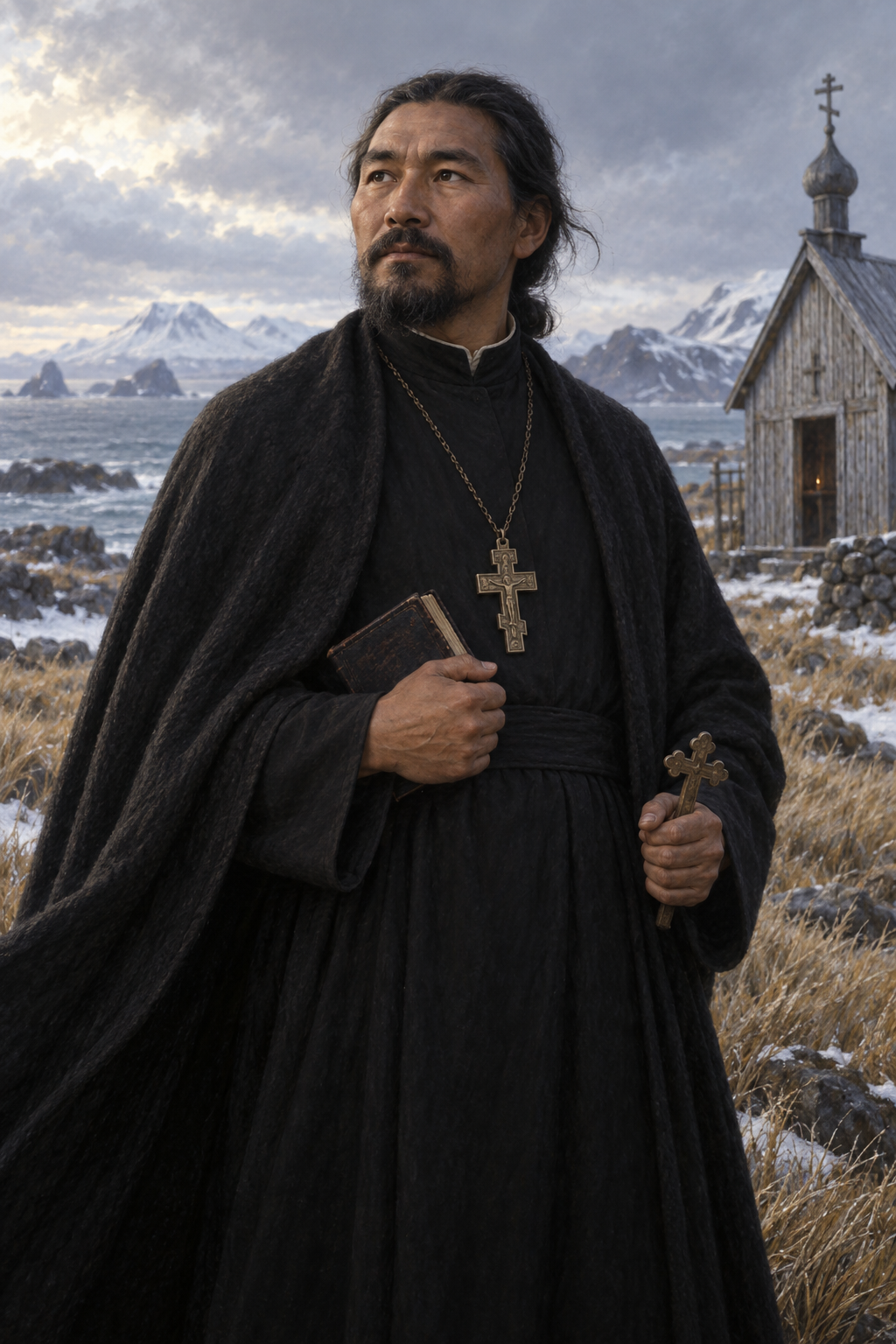
About Jacob of Alaska
Jacob of Alaska was born in 1802 on Atka Island, Alaska, according to the and the OCA life. The OCA life names his father as Yegor Vasil'evich Netsvetov, a Russian from Tobolsk, and his mother as Maria Alekseevna, an Aleut woman from Atka. That family context belongs near the beginning of the profile because Jacob's ministry was not simply Russian mission to Alaska. He was born in Alaska and carried both Russian Orthodox and Aleut family inheritance into his priestly service.
The OCA life says that Jacob's family moved to Irkutsk in 1823 and that he entered the Irkutsk Theological Seminary. He was tonsured subdeacon in 1825, married Anna Simeonovna, graduated in 1826, was ordained deacon that same year, and was ordained to the priesthood on March 4, 1828. The catalog does not need every date in the first screen, but these details make clear that his return to Alaska followed formal preparation and church assignment, not a vague devotional journey.
After ordination, Jacob set out for Alaska with his wife Anna and his father, who had been tonsured reader for the Atka church. The OCA life says the family left in 1828 and arrived at Atka on June 15, 1829. His first assignment was a demanding one. The Atka parish stretched across a wide island and coastal territory, including places named in the OCA life as Amchitka, Attu, Copper, Bering, and Kurile Islands. A careful profile should use that scale to show the physical demands of his ministry without turning travel hardship into spectacle.
When Jacob reached Atka, the Church of Saint Nicholas had not yet been built, so he began services in a large tent. The repeats this detail and presents it as one of the central teaching scenes of his life. Later he oversaw schooling so children could learn to read and write in Russian and Unangan Aleut. OCA sources note that students from this work later became distinguished Aleut leaders, so the profile should connect his education work with local leadership rather than treating it only as imported instruction.
Jacob's language work was also central. The OCA life calls him bilingual and bicultural and says he corresponded with Innocent of Alaska about linguistics and translations. It also says he worked on an adequate alphabet for the Unangan-Aleut language and translated Scripture and other appropriate literature. The DCE summary corroborates the alphabet and translation work. The final packet should avoid implying that language belonged to him to own; it should say he served through language study, translation, and teaching among people whose own communities carried that language.
The 1830s brought intense personal suffering. OCA's life says that Anna died of cancer in 1836, that Jacob's home burned the same year, and that his father died in 1837. Jacob sought permission to return to Irkutsk and enter monastic life, but no replacement came. When Bishop Innocent later visited, he comforted Jacob and directed him toward further mission in Alaska. This episode gives the profile a careful turning point: grief did not disappear, but his vocation was redirected into a new form of service.
In 1844 Innocent appointed Jacob to lead the new Kvikhpak mission. The OCA life places his later work among Yup'ik communities and along the Yukon and Kuskokwim regions, with travel to many settlements. It also names assistants and family helpers, including Innokentii Shayashnikov, Konstantin Lukin, and Vasilii Netsvetov. Those names should be preserved where space permits because they keep the mission from becoming a one-person story. The catalog should also avoid flattening Yup'ik, Athabascan, and other peoples into a single audience.
The same OCA life includes miracle-like and conflict episodes, including an exorcism narrative and a village conversion story. These may belong in a later devotional expansion, but the base profile should distinguish them from the secure chronology of birth, ordination, schooling, translation, travel, and repose. The safest featured events are the return to Atka, education and language work, Yukon/Kuskokwim mission, and final year in Sitka.
Jacob spent his final year in Sitka after false charges were dropped and his health worsened. The OCA life states that he served a Tlingit chapel, died on July 26, 1864, and was buried near the chapel. The OCA profile gives his glorification date as October 15-16, 1994, while July 26 remains his repose commemoration. The final structured data should preserve July 26 as the main feast field and record the glorification range in review notes unless range support is added.
The final profile should present Jacob as a priestly missionary, educator, and translator whose holiness was joined to Alaskan birth and service among Native peoples. His bicultural identity should be treated with care: it is relevant because OCA sources say it equipped him for pastoral work, but it should not be used as a decorative label. The completed record should leave patronage, coordinates, quoted journal passages, and miracle claims empty until each is separately reviewed.
Wondering how to weigh the stories and sources? Learn how to read a saint biography.