Biography
Jacques Berthieu
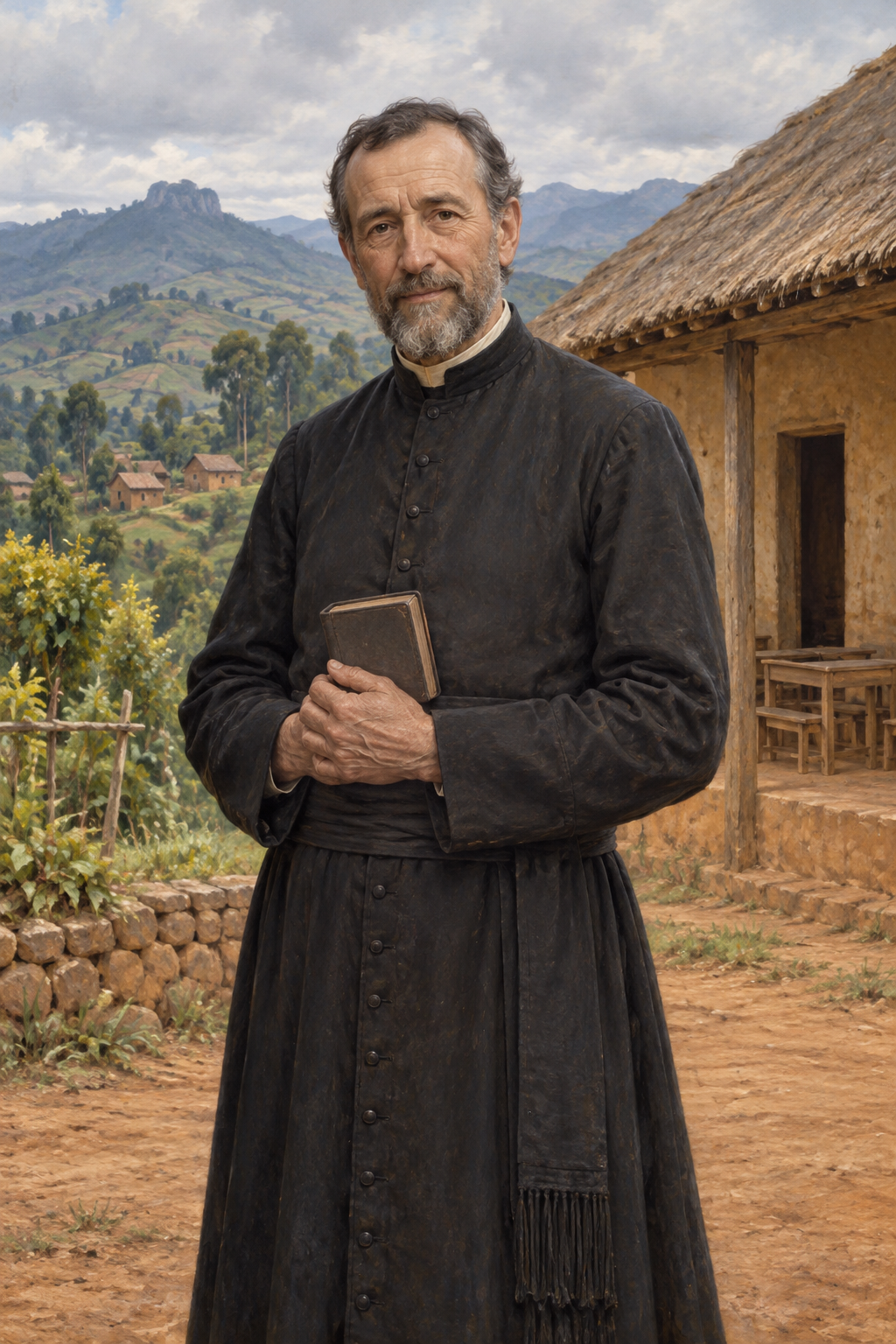
About Jacques Berthieu
Jacques Berthieu was born on 27 November 1838 at Montlogis, a farm near Polminhac in France's Cantal region. His parents were farmers. The future priest studied first in a minor seminary and then in the major seminary of Saint-Flour. These details come from later local and church biographies rather than a diary of his childhood. His birth day is consistent across the official cause and canonization sources.
Saint-Flour's diocesan account says Berthieu was ordained on 21 May 1864. A 1977 biographical study agrees, but the Vatican's later cause page and 2012 canonization booklet say 1863. Without the original ordination register, the disagreement cannot be erased. He served as a parish priest at Roannes-Saint-Mary before entering the Jesuit novitiate in Pau in 1873. His move was from established parish work to a religious community that could send him abroad.
The Jesuits sent him toward Madagascar in 1875. The canonization booklet dates his departure from Marseille to 26 September. He began on the island of Sainte-Marie, now Nosy Boraha, then under French control. There he studied Malagasy and worked with an established mission, teaching catechism and administering sacraments. His work depended on Malagasy speakers and Christian communities already present, not simply on a European priest acting alone.
A Jesuit account published in 1965 describes Berthieu's work on Sainte-Marie as a combination of catechesis, visits to Christian families, support for a school, instruction in farming and care for sick people, including people with leprosy. These activities met practical needs alongside the mission's religious aims. The account centers the priest, leaving the contributions of Malagasy coworkers less visible.
French legislation drove Jesuits from Sainte-Marie in 1881. Berthieu moved to the larger island of Madagascar, where assignments and wars repeatedly disrupted his work. Blot's biographical study traces a move to Ambohimandroso, evacuation during the first Franco-Malagasy war, ministry on the coast, and later service at Ambositra. Those changes were shaped by both the religious order and French colonial policy; they were not simply a succession of chosen adventures.
At Ambositra, beginning in 1886, Berthieu supervised a district with several country stations. The Jesuit account then places him north of Antananarivo at Anjozorofady in the 1890s. Long travel between settlements, teaching and pastoral care were ordinary parts of this work. The sources preserve his devotion to the people he served, but they tell the story mainly from missionary viewpoints. The lives and choices of Malagasy Christians remain part of the history even when those accounts say little about them.
French armies had conquered the capital in 1895. The uprising known as the Menalamba revolt followed in a society already strained by political burdens, famine and disease. Historians differ over the weight of resistance to French conquest, opposition to a state-linked church, and religious crisis. These causes cannot be compressed into a claim that every rebel merely hated Christianity. Nor did every Malagasy Christian simply represent the colonial state.
The Jesuit superior general's account says Berthieu tried to put Christians under French military protection as the revolt spread. It also says he challenged a French colonel's treatment of local women. These are claims from a church retrospective, and the latter should not be turned into a fully documented confrontation without more evidence. They do show why Berthieu's last journey cannot be understood apart from both pastoral loyalty and colonial authority.
In June 1896, Berthieu tried to lead displaced Christians toward safety as the revolt reached his district. A later church account places him with that group before Menalamba fighters captured him on 8 June. It also preserves detailed scenes from the final walk. Those scenes are valuable evidence of how his death was remembered, but they are retrospective testimony, not eyewitness transcripts available to us.
Menalamba fighters captured him on 8 June and killed him near Ambiatibe. Church accounts report that he refused demands to abandon his Christian faith. They differ in some details of the final encounter and preserve words attributed to him long afterward. The central historical facts are his death, its setting in the uprising, and the later ecclesiastical judgment of martyrdom. The last dialogue is presented as the Church's received account, not as an independently checked verbatim exchange.
The Catholic Church opened inquiries into his death in the twentieth century. A formal decree concerning his martyrdom was promulgated in 1964. Paul VI beatified him on 17 October 1965, during the Second Vatican Council. In remarks that day, Paul VI described him as a missionary witness and spoke especially to pilgrims from Madagascar and Saint-Flour. Those words explain the Church's judgment; they do not settle every historical question about the revolt in which he died.
Benedict XVI canonized Berthieu on 21 October 2012. His Catholic memorial falls on 8 June, the date of his death.
The memory of his service belongs to both French and Malagasy Catholic communities. His care for displaced Christians and the Church's recognition of his death belong beside the Menalamba movement's wider social and anticolonial history. That fuller setting makes his choices intelligible without reducing Malagasy people to background figures.
Wondering how to weigh the stories and sources? Learn how to read a saint biography.