Biography
John de Brébeuf
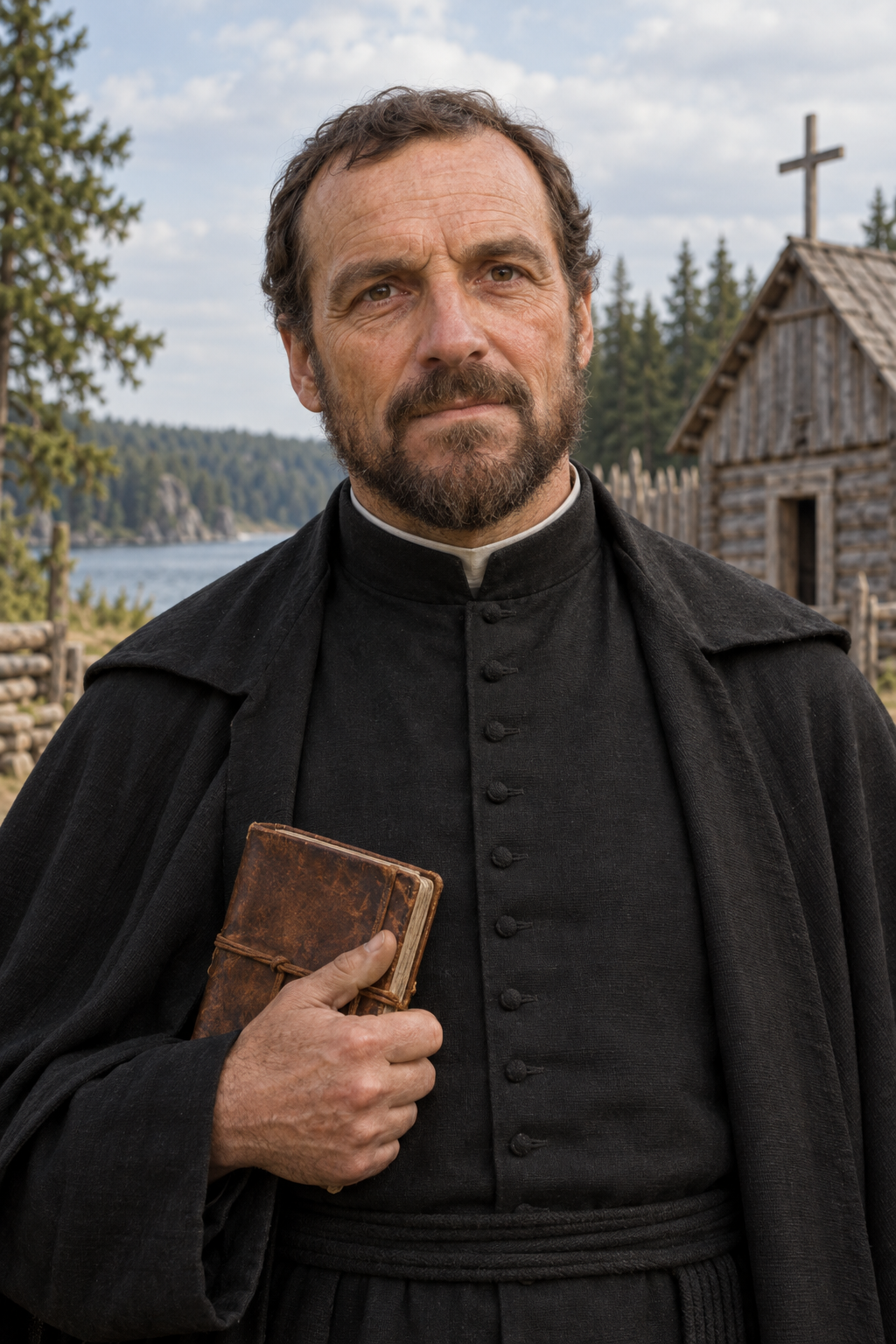
About John de Brébeuf
John de Brébeuf came to New France as a Jesuit priest and began by learning to live among Indigenous hosts. Born at Condé-sur-Vire in Normandy on March 25, 1593, he entered the Society of Jesus in 1617. Poor health interrupted his preparation for priesthood; he was ordained in 1622 and worked at the college in Rouen before sailing for Quebec in 1625.
During his first winter he travelled with Innu people, then commonly called Montagnais by French writers. In 1626 he made the canoe journey to the Wendat homeland, depending on Indigenous companions to navigate waterways and carry supplies across portages. His first years among the Wendat brought few conversions, but gave him time to learn their language and become familiar with daily life in their communities.
The mission was interrupted when Quebec fell to the English in 1629, forcing him to return to France. He came back to New France in 1633 and resumed work among the Wendat the following year. At successive residences he helped develop the mission's linguistic resources, compiling vocabulary and contributing to the knowledge that other missionaries needed to speak with their hosts.
Learning meant accepting correction from people who knew far more than he did about their own language. René Latourelle describes Brébeuf showing objects to children, listening to the words they supplied, and attempting to put those words into writing, even as they laughed at his efforts. He ate the corn-and-fish dish called sagamité and lived in the same kind of dwelling as his hosts. His growing command of Wendat then helped him teach other missionaries, who faced a long apprenticeship of their own. Language learning thus brought a reversal of roles: the French teacher first had to become a pupil. Latourelle notes that even gifted missionaries could need about six years to acquire the language, and some never mastered it.
Teaching required repeated encounters rather than a public sermon. The Jesuit account of his work describes him instructing children during the day and adults in the evening. As epidemics spread, however, missionary activity could become a source of fear: people saw baptisms followed by deaths and suspected that the newcomers were bringing disaster.
His mission also stood within a colonial struggle over trade and alliances. French traders had entered networks linking Wendat, Innu, and Algonquin partners, whose rivalries involved the Haudenosaunee Five Nations. These conflicts were not simply a dispute about Christianity: access to commerce, military assistance, and the replacement of relatives lost in war and disease all mattered. Captivity could lead to adoption as well as death, within practices associated with mourning and the renewal of communities. The world in which Brébeuf travelled was shaped by Indigenous political decisions as well as the ambitions of European newcomers.
Instructions attributed to Brébeuf made cooperation practical for missionaries preparing to travel. They were to be ready when their companions wanted to depart, help carry loads, and avoid interrupting the work of paddling with unnecessary questions. They should accept food and remain cheerful when travel became difficult. This advice placed their conduct on the journey before their ability to teach: fellow travellers would judge them by what they did in the canoe and on the carrying trails.
Brébeuf's assignments extended beyond the Wendat villages. He accompanied Pierre-Joseph-Marie Chaumonot on an unsuccessful mission to the Neutral people in 1640, and later worked at Sillery near Quebec. In 1644 he returned to the Wendat mission. His companions included Noël Chabanel. His service included assignments away from the Wendat, interrupted by changing needs and dangers.
At Sainte-Marie, the Jesuit mission had acquired a more substantial base. Beginning in 1639, French lay workers and Jesuits built a palisaded community with a church, workshops, residences, and space for Indigenous visitors. This was a shared undertaking, sustained by workers whose tasks differed from the priests' preaching and sacramental duties. The buildings were abandoned and burned in 1649; archaeological and historical research later enabled reconstruction on the original site. Today's historic site identifies the graves of Brébeuf and Gabriel Lalemant in its Church of Saint-Joseph.
Brébeuf was captured with Gabriel Lalemant during the attack on Saint-Louis and taken to Saint-Ignace. He was killed there on March 16, 1649, after torture. Brébeuf was canonized with seven companions in 1930.
In 1984, John Paul II remembered Brébeuf and the other martyrs at Huronia, while also naming Indigenous Christians whose contribution belonged to the history of the Church in their own right. He singled out Joseph Chiwatenwa, his wife Aonnetta, and their family as witnesses to lay participation in evangelization. His address connected Brébeuf's hope for a Church among the Wendat with the continuing responsibilities of Indigenous Catholics. That remembrance places named families alongside the missionaries, rather than leaving the story of Christian life entirely in the hands of the men who arrived from France.
Wondering how to weigh the stories and sources? Learn how to read a saint biography.
Explore similar vocations
Prayers for John de Brébeuf
John de Brébeuf: sourced prayer excerpt
Pray for us.