Biography
John de Britto
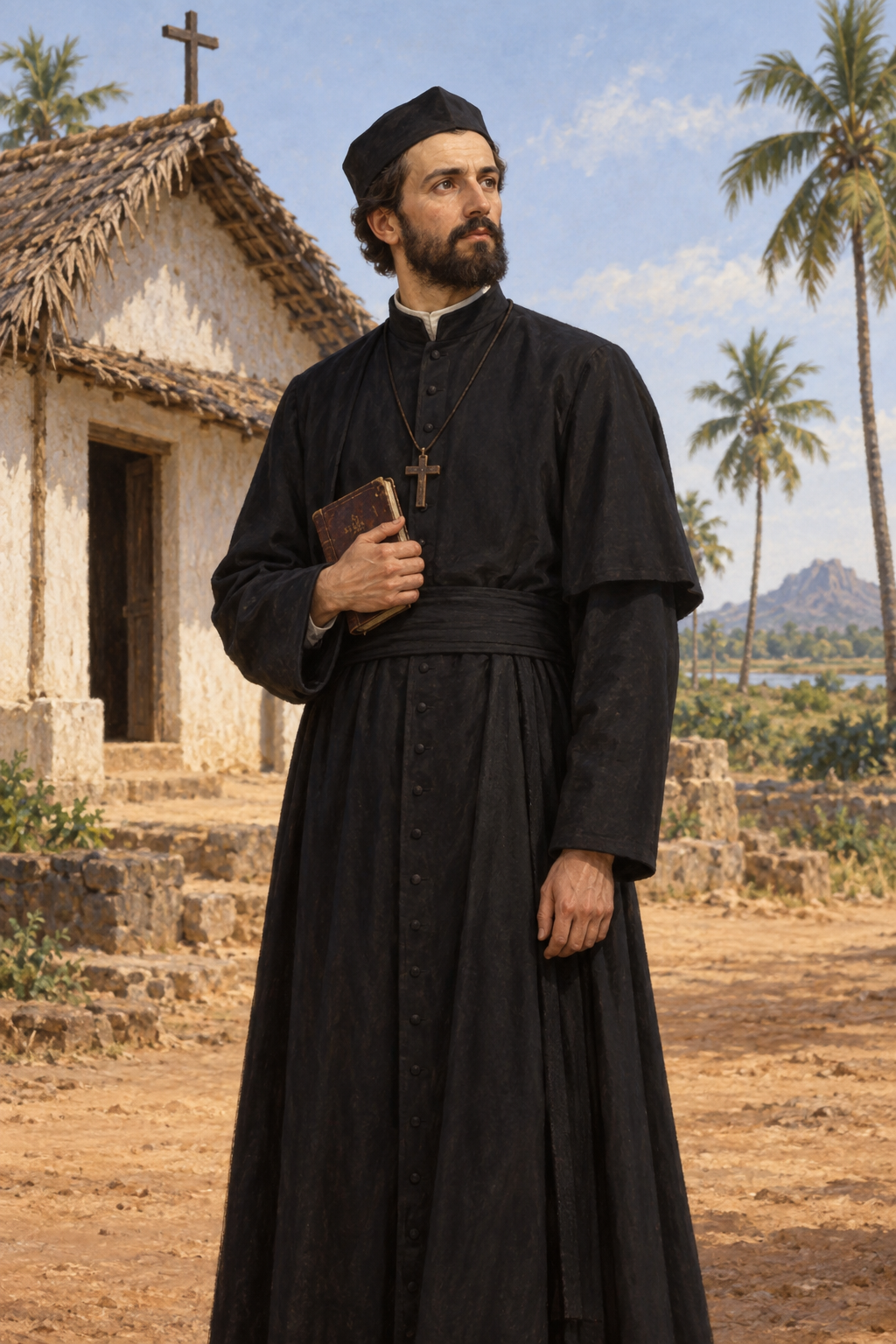
About John de Britto
John de Britto, known in Portuguese as João de Brito, was born in Lisbon on 1 March 1647 to a noble family. He entered the Jesuit novitiate in Lisbon in December 1662, after spending part of his childhood in the royal household. He studied classics and philosophy, interrupted by illness, and asked to be sent east as a missionary in 1668. After completing theology, he was ordained in February 1673 and sailed to Goa the following month. De Britto joined the Madurai mission in 1673. His work included learning regional languages and serving mission districts in southern India. The Jesuit account describes him adopting the title and way of life of a pandaraswami, an ascetic permitted to approach people across caste lines. Recent historical studies place that adaptation within broader debates about Jesuit methods in southern India. Cabús notes that earlier historiography often centered the Italian missionary Roberto de Nobili; his study examines how Portuguese Jesuits such as de Britto also developed particular adaptive strategies. After about eleven years, de Britto became superior of the Madurai mission. In 1686 soldiers captured him and several catechists; after imprisonment he was released and sent to Portugal to report on the mission. He returned to India in 1690 despite an earlier threat from the ruler of Marava. On his return, he travelled between mission stations to celebrate Mass and baptize converts. The Jesuit profile links his arrest to the baptism of Prince Tadaya Theva and the local ruler’s response. Modern scholarship treats the death within regional political disputes and analyzes how the later biography shaped its account. Cabús’s study analyzes the biography written by de Britto’s brother Fernão Pereira de Brito, first published in 1722, as a work that shaped an image of sanctity. That later hagiography remains evidence for memory and representation, but its narrative should not automatically be treated as contemporary testimony for every detail. The Jesuit biography says the raja sent de Britto into exile at Oriyur, where he was executed on 4 February 1693. Its page heading gives a different day, so this profile follows the narrative and Catholic Encyclopedia chronology for the execution date. He was beatified in 1853 and canonized in 1947.
Wondering how to weigh the stories and sources? Learn how to read a saint biography.