Biography
John Henry Newman
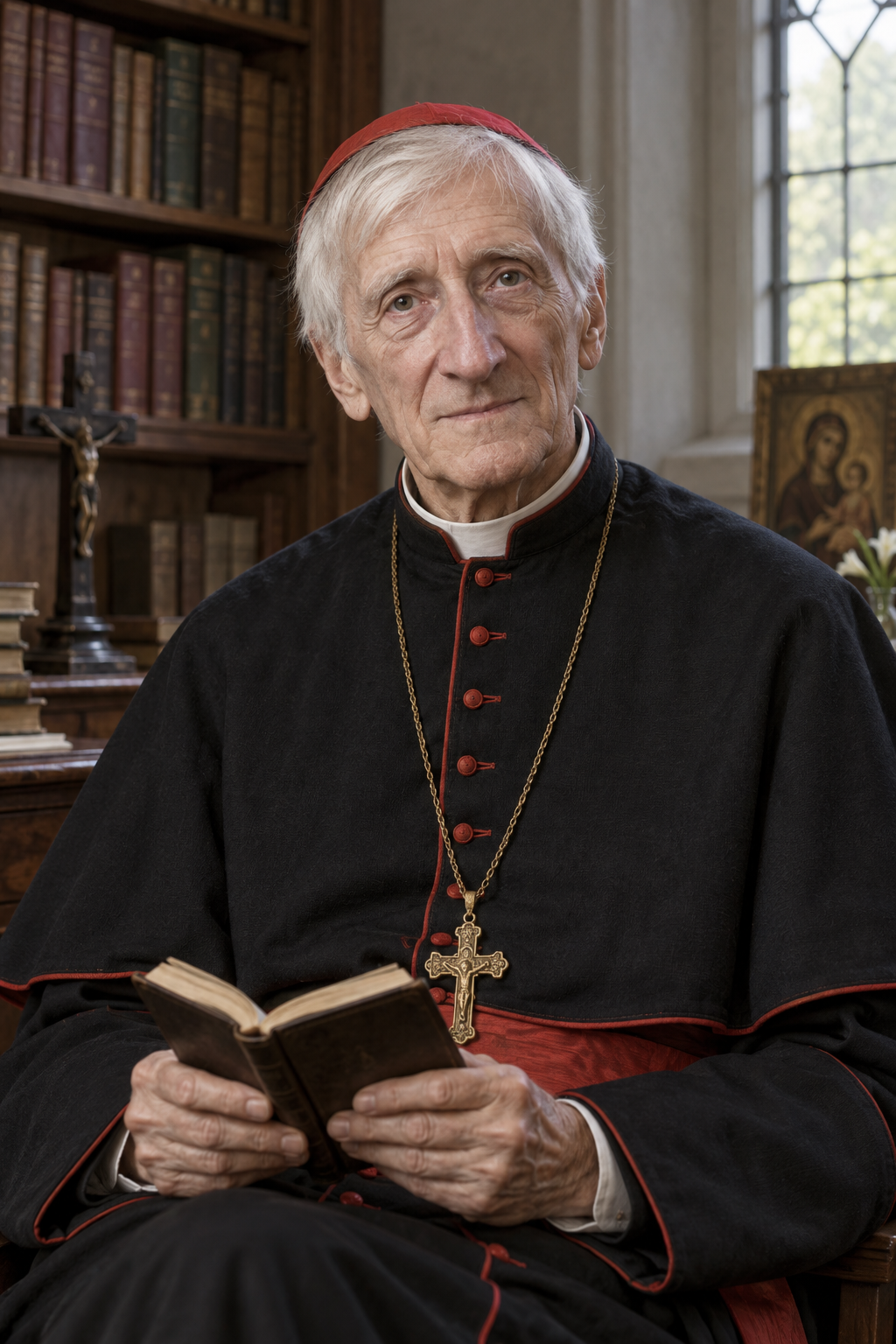
About John Henry Newman
John Henry Newman was born in London on 21 February 1801, the eldest of six children. His father was John Newman and his mother Jemima Fourdrinier. He became an Anglican priest before entering the Catholic Church much later in life. His story crosses those ecclesiastical boundaries without beginning anew at the moment of conversion. The priest, writer and founder of the English Oratory remained the same man whose religious life had taken shape within the Church of England.
In his autobiography, Newman traced a decisive religious awakening to the autumn of 1816. The teaching of Walter Mayers and books from the Calvinist tradition helped give his beliefs a definite shape. He also encountered early Christian writers through Joseph Milner's church history. Those different influences did not immediately fit together. His later account remembers a long development of conviction, rather than a childhood already consciously directed toward Rome.
At Oxford he became a fellow of Oriel College and then vicar of the University Church of Saint Mary the Virgin. He helped spread the Oxford Movement's ideas through the Tracts for the Times. The movement's appeal to Christian antiquity drew him more deeply into disputed questions about the Church of England. Controversy over Tract 90 brought university censure and an end to the series. In 1843 he resigned his parish and preached his final Anglican sermon at Littlemore.
He also expressed prayer in verse, composing a poem at sea on 16 June 1833.
Historical continuity became a central problem in Newman's thinking. In his Essay on the Development of Christian Doctrine, he examined the appeal to beliefs supposedly accepted everywhere and at all times. He argued that this rule was much harder to apply than it first appeared. A rigid demand for explicit early statements could undermine doctrines retained by Anglicans as well as doctrines they rejected in Rome. The question was therefore not simply whether Christian teaching had acquired fuller expression over time. It was how to judge that growth fairly, without applying one standard to favored beliefs and another to unwelcome ones.
Dominic Barberi received Newman into the Catholic Church on 9 October 1845. Newman subsequently trained for Catholic priesthood and established the English Oratory. Another demanding undertaking took him to Dublin, where the Catholic University opened in 1854. His work involved building institutions as well as writing about religious belief.
The Idea of a University presents education as more than preparation for a particular occupation. Newman argued that different branches of knowledge correct and illuminate one another. Students need not master every subject to benefit from living among teachers who represent a broad range of learning. Such an environment can cultivate sound judgment and an enduring habit of thought. He defended knowledge as worth pursuing in itself, not only for the wealth or professional advantage it might bring. This was not a denial that education could be useful. It was an insistence that its value could not be measured solely by its immediate practical returns.
Public controversy also gave his writing a personal urgency. In the Apologia, he answered accusations that his words could not be trusted. Rather than offer only a succession of isolated rebuttals, he decided to explain the history of his convictions. He acknowledged the contributions of Protestant friends, books and his own reflection. The resulting self-portrait defended his honesty while exposing the changes and tensions through which his beliefs had developed.
His Letter to the Duke of Norfolk examined another disputed question: the relation between Catholic obedience and conscience. For Newman, conscience was a judgment about duty, not permission to follow any passing preference. He distinguished general doctrinal teaching from particular commands and acts of government. In exceptional circumstances, a person could be obliged to follow conscience against a papal command. He did not turn that possibility into a casual exemption from obedience. His argument rested on moral responsibility before God, while resisting the claim that every papal decision possessed the authority of an infallible teaching.
The intellectual disputes were only part of his work. At the Birmingham Oratory, Newman visited sick and poor people, comforted those who were grieving and ministered to prisoners. Benedict XVI highlighted this pastoral work at his beatification, recalling the crowds who lined the streets for his burial. That ministry places his books beside concrete responsibilities toward neighbors. His vocation involved personal attention to people whose needs could not be met by winning a theological argument or completing another volume.
Leo XIII made Newman a cardinal in 1879. He died at Birmingham on 11 August 1890.
Pope Francis canonized him on 13 October 2019.
In 2025 Leo XIV proclaimed Newman a Doctor of the Church and a co-patron of its educational mission with Thomas Aquinas. That recognition highlights a lasting conjunction in his work: sustained intellectual inquiry, religious conviction and responsibility for the people being taught.
Wondering how to weigh the stories and sources? Learn how to read a saint biography.
Explore similar vocations
Prayers for John Henry Newman
John Henry Newman: petition for guidance
Lead Thou me on!