Biography
John Kochurov
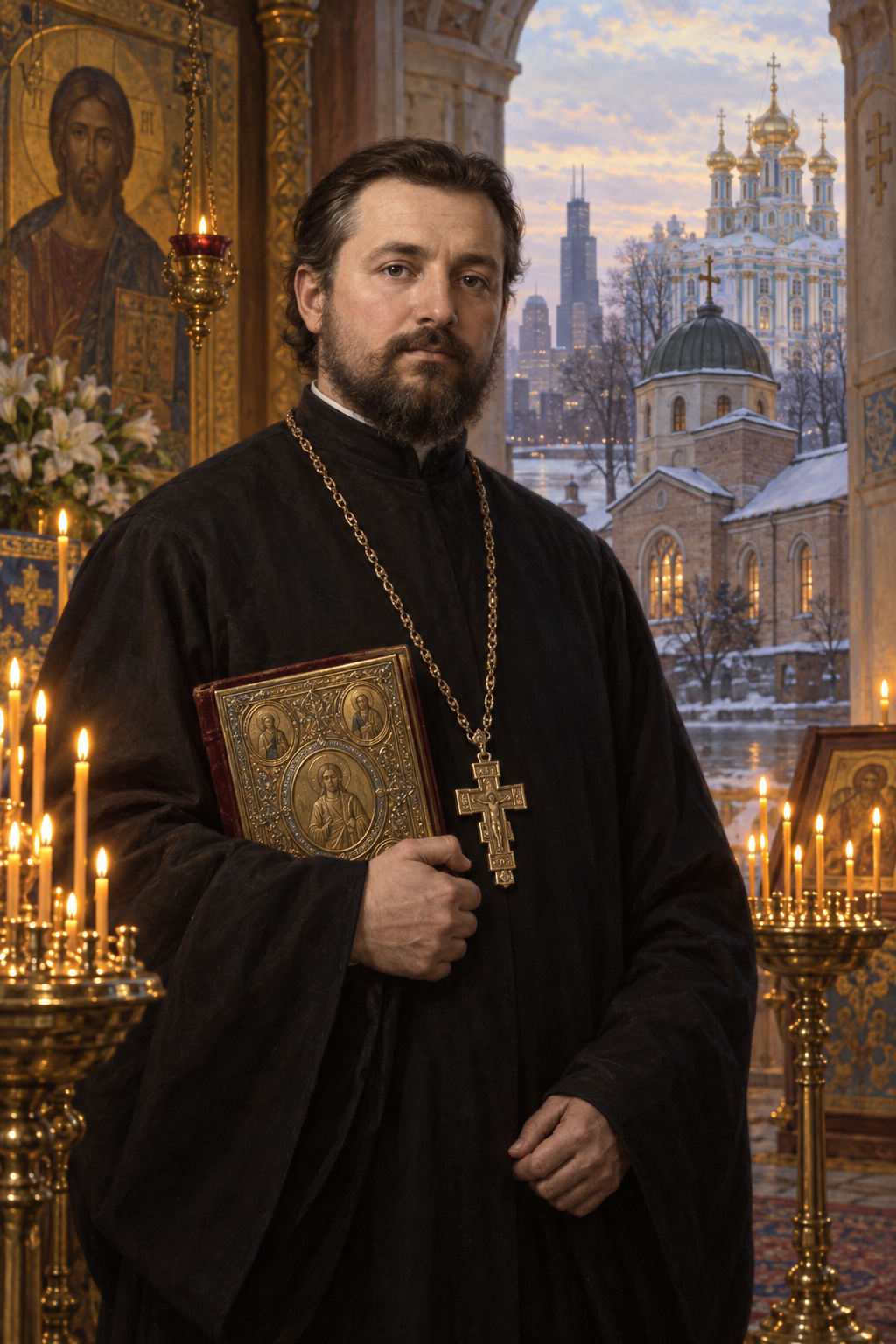
About John Kochurov
John Kochurov was born on July 13, 1871, in Bigildino-Surky in the Ryazan region, according to the and the OCA life. The OCA life gives his fuller name as John Alexandrovich Kochurov and names his parents as the priest Alexander Kochurov and Anna. His early formation belonged to a clerical family and to formal theological schooling: Danky Theological School, Ryazan Theological Seminary, and then the Saint Petersburg Theological Academy.
The OCA life says that John already connected parish priesthood with missionary service during his student years. After graduation and marriage to Alexandra Chernyshova, he was sent to the Diocese of the Aleutians and Alaska. He arrived in the United States before he had learned English and entered a North American Orthodox setting that was scattered, multilingual, and institutionally fragile. That context matters because his missionary work was not frontier romance; it was the slow creation of durable parish life for immigrant and convert communities.
John was ordained to the priesthood on August 27, 1895, and assigned to Saint Vladimir's Church in Chicago, with the Three Hierarchs parish in Streator linked to the same ministry. The OCA life describes the parish as small, poor, multinational, and spread across great distances. His work included liturgical service, preaching, organization, schools, and pastoral care among Russians, Slavs, Arabs, Bulgarians, and others. The final profile should avoid reducing these communities to a single immigrant category when the source itself names a mixed parish.
One of John's best-documented American works was the building of Holy Trinity Church in Chicago. The OCA life says he received Bishop Tikhon's blessing for the project, traveled to Russia to raise funds, and managed the construction of the new church, which was finished in 1903 and consecrated by Bishop Tikhon. This event belongs in the public profile because it turns missionary labor into visible pastoral infrastructure: a parish home, a place of worship, and a sign that Orthodox life in Chicago had become more stable.
John's North American ministry also included diocesan responsibilities. OCA sources name service on censorship and mutual-aid bodies, participation in diocesan clergy meetings, and work connected with parish organization beyond Chicago. These details can be summarized rather than fully enumerated. Their importance is that they show John as more than the builder of one church. He was part of the institutional formation of Orthodox life in North America during the period in which Tikhon of Moscow and Raphael of Brooklyn also served. The profile should therefore connect his missionary title to concrete parish, educational, publishing, and mutual-aid work rather than leaving it as a vague honorific.
In 1907 John returned to Russia after twelve years of service in America. The OCA life says he was assigned in Narva, where he taught the Law of God in male and female gymnasiums for the next nine years. This part of his life should not be skipped, even though it is quieter than the Chicago years or the martyrdom. It shows continuity in his vocation: pastoral teaching, catechesis, and care for young people remained central after he left North America.
In November 1916 John was assigned to Saint Katherine's Cathedral in Tsarskoye Selo, where the OCA life says he became known as an eloquent preacher and beloved pastor. The following year brought revolutionary upheaval and local danger. OCA's account says that on October 30, 1917, clergy at Saint Katherine's offered prayers for an end to civil conflict and organized a procession in the town. The profile should describe that action as a pastoral prayer for peace, using the OCA narrative, rather than trying to resolve every political claim surrounding the moment.
John was killed on October 31, 1917, at Tsarskoye Selo. The OCA life preserves eyewitness and church accounts of his arrest and death, and the OCA profile reproduces the Russian Orthodox Church's glorification proclamation. The catalog should present martyrdom as the Church's recognition of his death, not as a neutral forensic conclusion made by the site. It can say that Orthodox sources venerate him as priestmartyr and first clergy martyr under the Bolshevik yoke, while keeping graphic details out of the main biography.
The aftermath of his death was itself part of the Church's memory. OCA sources describe diocesan services, concern for his bereaved family, remembrance by Patriarch Tikhon, and later inclusion among Russia's new martyrs. The profile should mention this reception briefly because it explains why his death became a public ecclesial witness rather than only a local tragedy.
John was glorified in 1994. The OCA profile gives the glorification date as December 3-4, 1994, and October 31 as his repose commemoration. A final approved packet should preserve October 31 as the main feast field and record the glorification range in review notes unless the schema supports ranged dates. The completed profile should leave patronage, exact coordinates, quotations, and graphic martyrdom scenes out until each has separate review.
Wondering how to weigh the stories and sources? Learn how to read a saint biography.