Biography
John Ogilvie
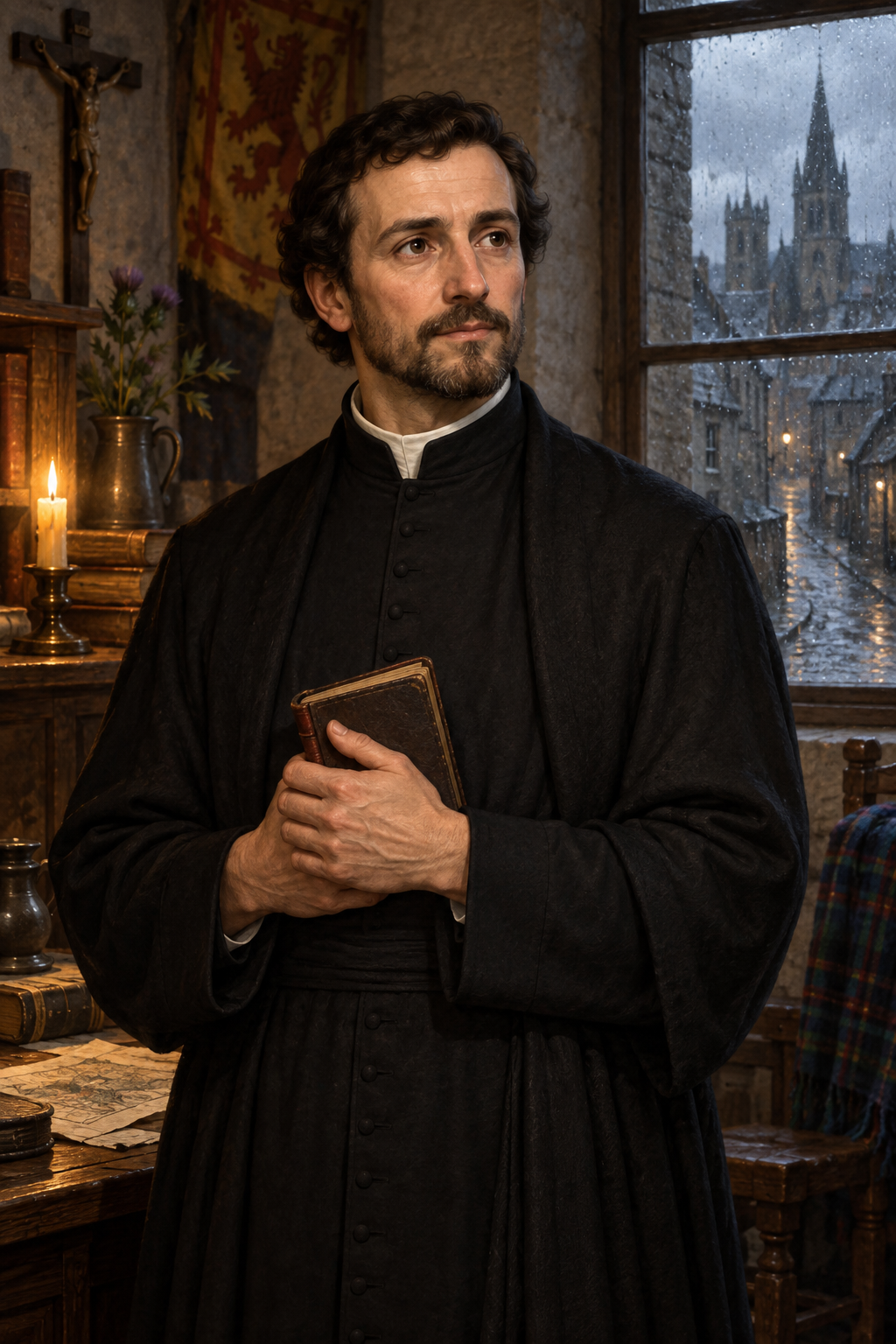
About John Ogilvie
John Ogilvie was born in Scotland in 1579 according to Glasgow Life's archival account. It places his family in the northeast and says he was raised as a Protestant. Older reference works give about 1580, and no contemporary birth register is cited here. His early life therefore belongs to a divided religious landscape, even if its exact calendar day is unsettled. His later conversion and priestly ministry made the conflict between church and state authority central to his story.
A Cambridge reference entry also dates Ogilvie's life 1579–1615. That agreement supports retaining the existing birth year without treating the more precise July day found in one timeline as settled. Dates in a modern encyclopedia heading are a useful cross-check, not a substitute for a sixteenth-century baptismal record. His later movements are better documented than his earliest years, because colleges, the Jesuit order and the trial generated records that traveled beyond his family.
He studied on the European continent and became a Catholic while still young. The Glasgow Story identifies places in his formation, including the Benedictine college at Regensburg and Jesuit houses at Olomouc and Brno. These cities show how international his training was before he returned to his own country. His commitment preceded his Glasgow imprisonment. Education, conversion and years of religious preparation preceded the short mission for which he is most often remembered.
The Jesuit Institute dates his entrance into the Society of Jesus to 5 November 1599 in Brno and his priestly ordination to 1610 in Paris. He taught grammar and humanities and studied theology in several European houses. He had not begun as a public opponent of the Scottish government. It presents a priest who had served in schools and colleges before seeking the dangerous assignment of returning to Scotland.
The Jesuits' mission in Scotland was broader than one priest. An introduction to a scholarly collection places that mission from 1581 into the eighteenth century and cautions that its effects on religious life remain understudied. Ogilvie's execution is vivid and unusually well recorded, but it should not stand for every Catholic household or every Jesuit effort in the country. The religious landscape included local continuities, changing government policy and people whose names never entered a martyr's biography.
Ogilvie returned in 1613 under the name John Watson. Glasgow Life's local archivist describes his arrival at Leith in November and ministry among Catholics in Edinburgh before he went to Glasgow. Disguise was a practical response to restrictions on Catholic worship and priestly work. It also reminds us that the people who received him faced risk. His ministry depended on hosts, fellow priests and communities willing to meet quietly; he could not have acted alone simply by crossing a border.
Glasgow was not religiously uniform. A study of Ogilvie's execution finds a sizable and influential Catholic community in the town and examines the local people caught in the events of 1614–15. The study reads the trial as a public demonstration of royal and archiepiscopal authority as well as a response to one missionary. Its analysis warns against viewing the proceedings only through the final scene at the scaffold. Local elites, prisoners, officials and worshippers all formed part of the story.
Ogilvie was arrested in Glasgow in October 1614. A University of Glasgow study compares the Catholic account from Douai with Archbishop Spottiswoode's response for the government. Each sought to shape how readers understood the prison and trial. The Catholic narrative stressed fidelity to the faith; the official version stressed treason and royal authority. Their difference shows why neither can be used as a neutral transcript. It also asks readers to consider how the execution was presented to a watching public.
The date of arrest also has two forms. Hernández Arana gives 4 October 1614 under the Scottish Julian calendar, while the Jesuit chronology and later public commemorations use 14 October in the Gregorian calendar. The same ten-day difference places the execution at 28 February 1615 in Julian records and 10 March in Gregorian memorials. The event did not happen twice. The alternative dates reflect calendars then in use, and this profile follows the Gregorian dates used in the modern feast tradition.
The Glasgow Story describes pressure during imprisonment to disclose the names of other Catholics. He did not do so. The same account explains that the final conviction concerned high treason, particularly his denial of the king's spiritual jurisdiction and affirmation of the pope's spiritual primacy. That legal description does not erase the religious conviction for which the Catholic Church honors him; it identifies the charge used by the court. Neither the court's account nor later devotional retellings should be mistaken for a complete neutral transcript.
He was hanged at Glasgow Cross on 10 March 1615 in the Gregorian dating used by later Catholic records. Paul VI recalled the place and date in the homily for Ogilvie's canonization. In that ceremony the pope interpreted his death as witness to a conviction held above his own safety. Those words explain why Catholics revere him as a martyr. A historical account must also leave visible the contested politics of his trial, rather than saying all who witnessed it shared the pope's later judgment.
The account of Ogilvie's imprisonment circulated beyond Scotland soon after his death. A university study of early print culture traces the spread of editions about the Scottish martyr in the German lands. Publication helped create a transnational memory of the event. It also means later readers often encountered a text shaped by advocacy and editing, not an untouched diary of every day in custody.
The 1929 beatification and 1976 canonization occurred long after those first printed accounts. Paul VI explicitly named 22 December 1929 and Pius XI as the beatification date and pope. A metadata field on the Dicastery page says 1928 instead; the original papal homily embedded on that same page is stronger evidence for the ceremony. The distinction matters because a data record can disagree with a primary statement even when both appear under one institutional domain.
Liturgical remembrance also depends on place. The Vatican-hosted Jesuit martyrology lists 14 October as a day of celebration, while recording his death on 10 March. Those two dates serve different purposes: the former is an observance and the latter the death anniversary. This is why a single generic feast field cannot tell the whole story. The existing 10 March field remains supported by Scottish and British Jesuit use, with the other observance stored separately for readers who need its jurisdiction.
Ogilvie's legacy is thus study, discreet care and fidelity amid conflict about religious and state authority. Catholics honor him for dying without abandoning his priestly allegiance. Historians also read the trial as an event involving a Scottish town, royal policy and rival public narratives. Both perspectives make his story more precise when sources are named. His biography should resist invented last words or a simplified cast of heroes and villains, and remember the vulnerable people whose names were at stake in his ministry.
Wondering how to weigh the stories and sources? Learn how to read a saint biography.