Biography
John Paul II
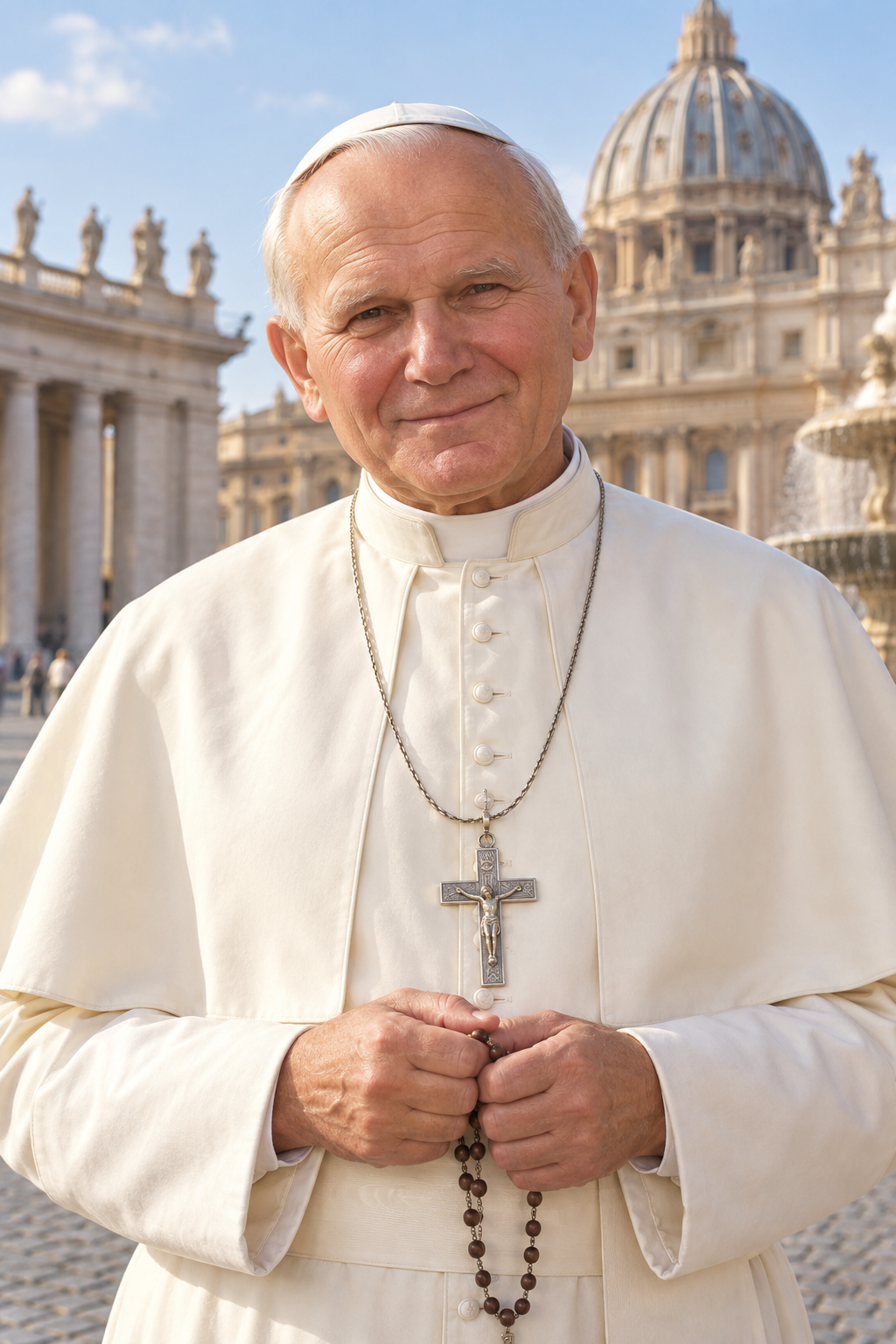
About John Paul II
Before he was John Paul II, Karol Józef Wojtyła was a young Pole whose education unfolded under occupation. Born in Wadowice in 1920, he entered Kraków's Jagiellonian University in 1938. After the Nazis closed the university, he worked in a quarry and a chemical factory. In 1942 he began clandestine preparation for the priesthood under Archbishop Adam Stefan Sapieha. The official biography also records his involvement in an underground theatre: religious formation and cultural life continued despite the occupation.
Literature, acting and philosophy remained important to Wojtyła's development. The Pontifical Academy of Sciences describes a student interested in poetry and theatre who later combined pastoral ministry with philosophical teaching. His doctoral work concerned faith in John of the Cross, and his later academic work explored ethics. As a bishop participating in the Second Vatican Council, he argued for religious freedom, including the freedom of people outside the Catholic Church. The principle asked Catholics to defend for others a liberty they sought for themselves.
His election as pope in October 1978 brought that teacher and pastor to a much larger audience. At his public inauguration he described authority in terms of service rather than worldly power. He recalled his predecessor's decision not to wear the papal tiara and likewise declined it. His appeal to open public life to Christ addressed political systems, economic arrangements and culture. The homily joined a confident invitation to faith with a prayer that he himself might become a servant.
On 13 May 1981 he was shot in Saint Peter's Square before a general audience. The contemporary Vatican notice distinguishes the attack from the address he had prepared but did not deliver.
Four days later, a recorded message from his hospital bed thanked those praying for him. He remembered the other people wounded in the shooting and said that he prayed for and forgave his attacker. He understood his own suffering as something he could offer in prayer for the Church and the world. Forgiveness here was not a distant theme in a teaching document: he spoke about the person who had just tried to kill him.
His teaching also entered the ordinary world of employment. In Laborem exercens he placed the worker, rather than the product or the machinery, at the center of an account of human work. A person's dignity did not depend on whether a job was manual or intellectual. Technology could assist people, but it could also displace them or make them subordinate to production. For John Paul II, assessing work therefore required more than measuring output: it required asking what happened to the people doing it.
He made encounters with young people a lasting part of his ministry. At Easter in 1984 he entrusted a large wooden cross to young people associated with Rome's San Lorenzo center. The following year's gathering in Rome helped prepare the way for World Youth Day. An annual observance was announced in December 1985; the first diocesan celebrations followed in 1986 and an international gathering in Buenos Aires in 1987. The cross became a traveling sign of an invitation that was no longer confined to a single meeting.
Other encounters required facing painful histories. When he visited Rome's synagogue in April 1986, he thanked Chief Rabbi Elio Toaff and spoke against antisemitism. He rejected the idea that Jews collectively bore responsibility for the death of Jesus. He did not suggest that Christians and Jews had ceased to differ in their beliefs. Instead, the visit combined recognition of those differences with a call for mutual understanding and cooperation. Meeting in the Jewish community's own place of worship gave that commitment a concrete setting.
At Assisi later that year, he brought Christian leaders and representatives of other religions together to pray for peace. They did not adopt a common creed or merge their forms of worship. His opening address explained a program of prayer in distinct places, fasting and a silent pilgrimage before gathering again. He presented the day as a contribution to peace that political negotiation alone could not supply. The arrangement allowed people to act together while acknowledging religious differences, rather than pretending those differences had disappeared.
His record of leadership also includes grave failures of judgment. Vatican News's official account of the McCarrick investigation describes warnings about Theodore McCarrick reaching Rome before his appointment to Washington. John Paul II initially set his candidacy aside after requesting further information. Following McCarrick's denial, he reconsidered and approved the appointment. The account reports incomplete and inaccurate information from bishops consulted during the inquiry. This sequence belongs in an assessment of his governance alongside his public teaching and pastoral achievements.
The Pontifical Academy of Sciences remembers another sustained concern: the relationship between scientific inquiry and faith. He addressed scientists about human dignity, peace and the responsibilities attending knowledge. In 1992 he received the conclusions of the commission studying the Galileo affair. That engagement belonged to a wider effort to keep the Church in conversation with intellectual life, rather than treating scientific achievement as something beyond its pastoral attention.
John Paul II died in the Apostolic Palace on 2 April 2005. After his death, Catholic recognition of John Paul II acquired a place in the Church's calendar. The United States bishops' calendar page records his inclusion in the General Roman Calendar in 2014. His optional memorial falls on 22 October, recalling the beginning of his public papal ministry. The calendar remembers a pastor whose teaching, encounters and decisions continue to invite both gratitude and careful assessment.
Wondering how to weigh the stories and sources? Learn how to read a saint biography.
Explore similar vocations
Prayers for John Paul II
John Paul II: prayer of service
Make me be a servant.
Totus Tuus
Tuus totus ego sum, et omnia mea tua sunt.
I am entirely yours, and all that I have is yours.
Saint John Paul II, pray for us.