Biography
Joseph Vaz
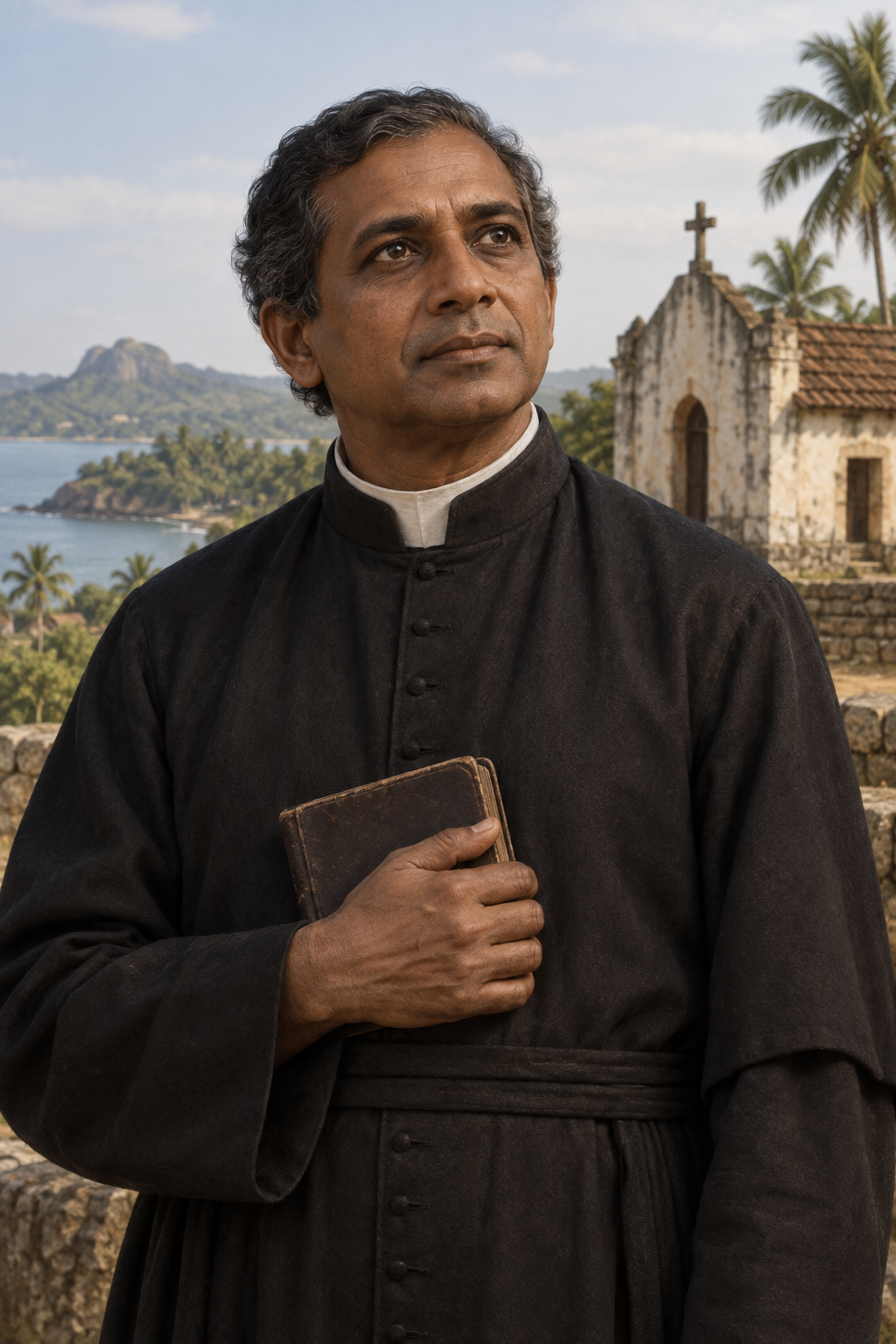
About Joseph Vaz
Joseph Vaz was born on 21 April 1651 in Benaulim, Goa, on the west coast of India. A Vatican canonization booklet records his ordination as a priest of the Archdiocese of Goa in 1676. He first served in India, including the Kanara region, where local Christian communities needed sustained pastoral care. His later mission to Sri Lanka did not appear from nowhere; it grew from work as a priest in places where distance and political conditions made ordinary parish life difficult. The exact details of his early education are reported differently in later accounts, so the core record is his origin, ordination, and Indian ministry.
In Goa, Vaz joined other Indian priests and helped organize an Oratorian community. The church's account places that development in the 1680s and links it to his response to Catholics in Ceylon, now Sri Lanka, who lacked priests under Dutch rule. This was an Indian-led mission rather than a European priest arriving with colonial protection. That distinction matters to the story: Vaz came from a nearby Catholic community and entered an island shaped by conflict among European powers and local kingdoms. He did not command a state or army. The work required mobility, discretion, and relationships with people who could welcome him safely.
Vaz reached Sri Lanka in 1687, initially working around Jaffna. The Archdiocese of Colombo describes him arriving dressed as a laborer and serving Catholics discreetly. He celebrated worship and sacraments where public Catholic ministry was restricted, and he relied on local contacts to find scattered believers. Accounts of every journey are not equally secure, so a map of precise stops would imply more certainty than the sources give. What is clear is the pattern: a priest moved among communities, sometimes at personal risk, while political authority and confessional boundaries affected where he could work openly. His ministry was practical as well as sacramental.
The kingdom of Kandy became a center for his later work. Sources remember a period of suspicion and restraint before he received greater freedom to serve there, although their exact dates differ. An institute devoted to his memory places his arrival in Kandy in 1691 and a rain-related tradition in 1693; another church account gives later years. The rain story belongs to devotional memory and should not be narrated as an independently verified meteorological event. A better historical point is that access to Kandy let Vaz establish a base from which he could visit other parts of the island and communicate with fellow priests.
Service during a smallpox epidemic became one of the remembered features of Vaz's time in Kandy. John Paul II's beatification homily recalls his selfless care for victims of an epidemic in 1697. The homily does not supply a medical case history or exact number of patients, and neither should this profile. It does show why care for the ill belongs beside preaching and the sacraments in an account of his mission. His presence mattered when fear could isolate sick neighbors. In the pope's reading, Vaz crossed social and religious boundaries by serving people in need rather than confining compassion to members of his own community.
Vaz did not remain a solitary traveler. The Joseph Naik Vaz Institute records other Indian Oratorians joining him in the late 1690s. Their arrival made it possible to share ministry and sustain communities when one priest was away. Later Catholic memory describes travel to multiple districts, but assigning each journey a precise date would exceed the evidence used here. The important development was institutional: a network of priests and local helpers could continue worship, teaching, and care. This also prevents a misleading portrait of one exceptional man single-handedly rebuilding the whole church. Vaz's contribution was central, yet it depended on colleagues and on people in Sri Lanka who received and supported the mission.
The Archdiocese of Colombo remembers his death in Kandy on 16 January 1711 after years of travel and illness. The Vatican booklet gives the same date and place. The scale of Catholic life after his ministry is sometimes expressed in later numerical estimates, but those figures are not needed to explain his significance. He left an Oratorian network and communities able to continue pastoral life. Two centuries later, John Paul II beatified him during a visit to Sri Lanka in 1995. Pope Francis canonized him in Colombo on 14 January 2015. Those public acts of the Catholic Church are distinct from the earlier local reputation for holiness that followed his death.
At the canonization, Francis presented Vaz as a priest attentive to people beyond divisions of race, creed, and status. That assessment is a papal interpretation of his legacy, not a claim that seventeenth-century Sri Lanka lacked conflict. The historical record shows a Goan priest who crossed the sea, adapted his movements to danger, cared for sick people, and worked with others to serve dispersed communities. His memory remains significant because his ministry joined devotion with patient presence among people whose ordinary religious life had been disrupted. The story needs no miracle claim or inflated headcount to communicate why he is honored in Sri Lanka and Goa.
Wondering how to weigh the stories and sources? Learn how to read a saint biography.