Biography
Julian of Le Mans
About Julian of Le Mans
Julian is remembered by the Diocese of Le Mans as its first bishop and an early evangelizer of Maine. He is not Julian the Hospitaller, Julian of Brioude, or another saint with the same name. The diocese places Christianity's beginnings in Maine probably in the early fourth century and says that oral tradition preserved the names Julien, Thuribe, and Pavace. This is not a contemporary biography. It gives Julian a probable historical setting and a traditional office while leaving his birthplace, family, education, ordination, and exact dates unknown.
A firmer landmark appears in a testament of Bishop Bertrand dated 616, which mentions a funerary basilica dedicated to Saint Julian, first bishop of Le Mans. That document shows that Julian's cult and title were established by the early seventh century. It does not prove the details later narrated about his mission or date his episcopate. The distinction matters: evidence for an old commemoration is not automatically evidence for every episode in the commemorated life.
Local oral tradition portrays Julian bringing water from a rock, befriending the city's Defensor, baptizing his household, and establishing Christian life at Le Mans. It later sends him into retirement at Saint-Marceau and describes a dream, death, and burial. These stories connect evangelization with hospitality, baptism, and pastoral care, but the diocese itself labels them tradition. They can support traditional events and virtues; they cannot supply eyewitness dialogue, an exact itinerary, or a civil chronology.
Ninth-century Acts moved Julian into the age of Pope Clement and encouraged an identification with Simon the leper from the Gospels. Modern church and reference sources reject that apostolic chronology. Paderborn places Julian's activity in the first half of the fourth century, while the New Catholic Encyclopedia stresses that the surviving life is late. The inherited exact death date of January 27, 348 therefore has no adequate basis. January 27 is retained only as the feast celebrated by the church of Le Mans, not as a historical death anniversary.
Julian's later reception is better documented than his daily life. The diocese records the development of his sanctuary and medieval translations of relics attributed to him. Paderborn reports veneration there from 1205 and relics arriving in 1243. Such evidence shows how communities maintained a relationship across regions; it does not authenticate every relic or turn medieval movement into Julian's own travel. Le Mans and Saint-Marceau are therefore broad associations without invented coordinates or routes.
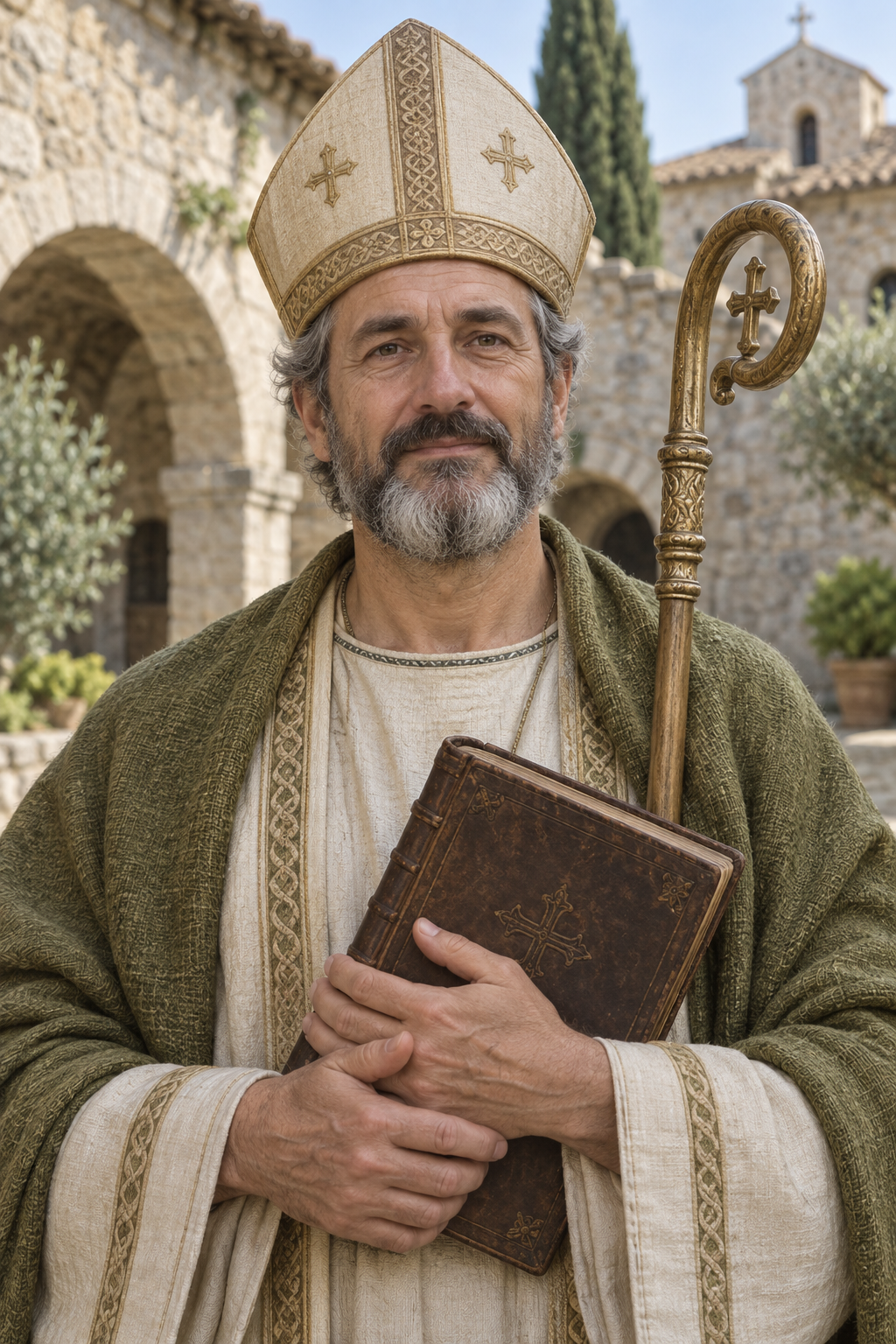
Bishop, missionary, and confessor describe the received shape of Julian's memory, with confidence kept explicit. Leadership appears in the traditional founding ministry; hospitality and faith are represented through the Defensor story. No authentic personal quotation survives. A diocesan collect exists, but its text is not copied because reusable rights were not established. The AI-generated artwork is modern devotional imagery, not a historical likeness or evidence for vestments, architecture, facial features, or a miracle.
Julian remains significant because the Christian identity of Le Mans gathered around his name long before a detailed Life survives. The record can affirm an established cult by 616, a probable fourth-century setting, and continuing local commemoration while identifying miracle, household, retirement, and apostolic stories as tradition or legend. This evidence-limited profile is shorter than a conventional biography because adding childhood, travels, speeches, or precise dates would conflate namesakes or manufacture facts.
Wondering how to weigh the stories and sources? Learn how to read a saint biography.