Biography
Justus Ranfer de Bretenières
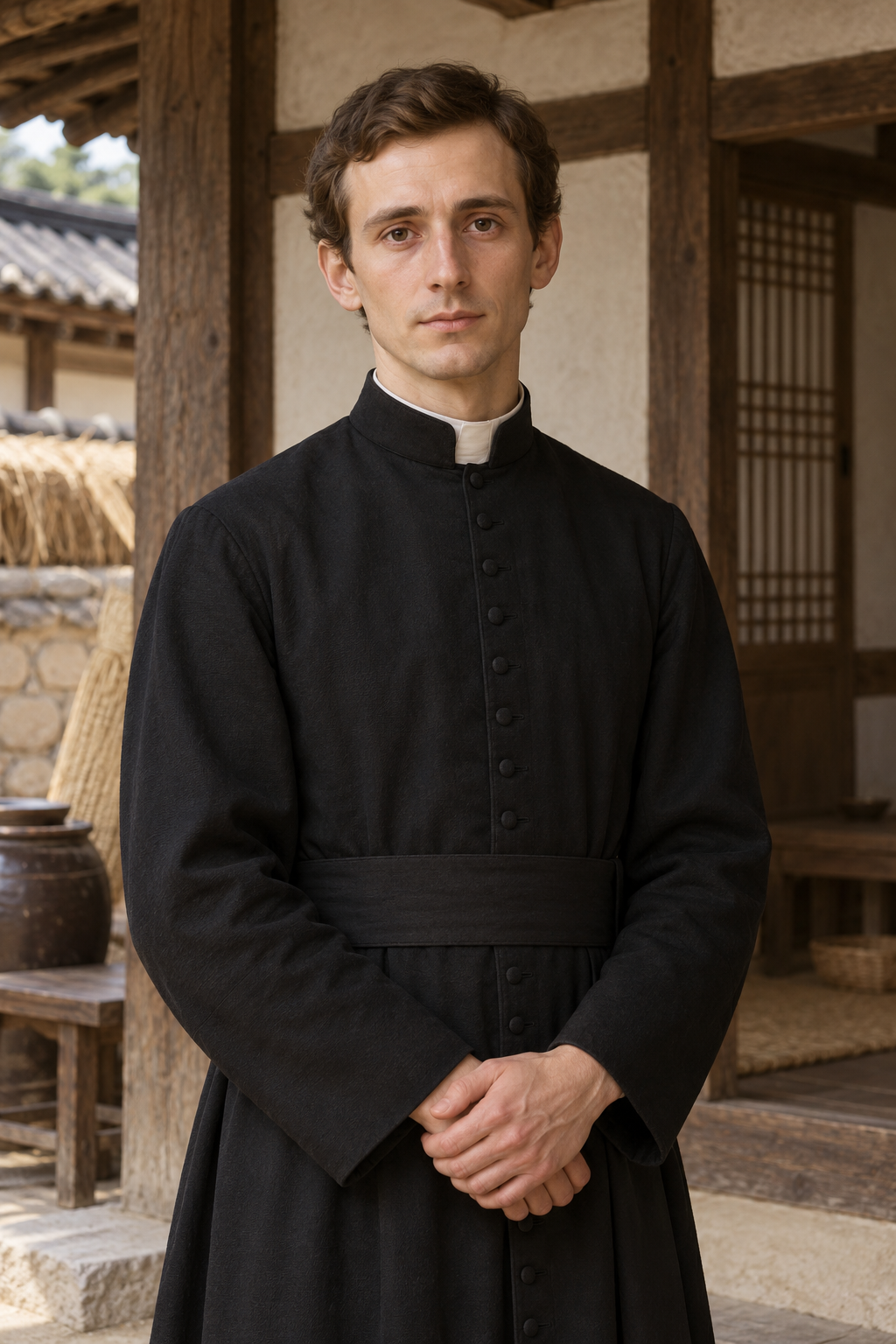
About Justus Ranfer de Bretenières
Just Ranfer de Bretenières was born in Chalon-sur-Saône, France, and prepared for priesthood at Issy before entering the Paris Foreign Missions Society. He was ordained in May 1864 and assigned to Korea. His formation included work with people whose lives differed greatly from those of his family.
Maurice d’Hulst’s biography describes his visits to elderly people cared for by the Little Sisters of the Poor in Paris. He listened to them and offered help and religious encouragement. He also joined fellow seminarians in visiting workers at the quarries near Meudon. They began by talking with the laborers about their work and offered assistance when a worker or family member was ill. De Bretenières asked his parents for resources to help these families. The account places this practical work within the years of study that preceded his departure.
An excerpt from one of his letters explains how he approached the quarry workers. He rejected the assumption that his clothing or background made him superior to them. Instead, he described setting aside his book and outer clerical garment, rolling up his sleeves and taking a tool to help with the work. He hoped that sharing their labor would make conversation about faith possible. His advice to his family followed the same pattern: meet poorer neighbors frankly, serve them and avoid treating them as inferiors. The passage records an approach to religious instruction rooted in ordinary contact and practical assistance.
On the eve of his voyage, de Bretenières wrote to his parents about their own part in his departure. He thanked them for the way they had accepted the separation. He urged them to seek strength in the sacraments and understood their loss of daily contact with him as a sacrifice they were making together. The letter closed with affection and a hope that their religious life would sustain them while he was away. It preserves the family relationship behind the public decision to become a missionary.
A letter written at Suez recalls an excursion during the journey through Egypt. While staying in Cairo, de Bretenières organized a nighttime visit to a tree associated by local tradition with the Holy Family’s flight into Egypt. Several fellow travelers joined him, accompanied by guides and people who could help them communicate in Arabic. They rode out after supper, prayed at the site and returned in time for an early Mass before taking the railway to Suez. His description includes the practical problem of fitting the visit between their meal and the next morning’s departure. The tree’s association with the Holy Family is a pilgrimage tradition, rather than a historical identification established by his visit.
Beaulieu’s letter records the missionaries’ arrival in southern Korea in May 1865. De Bretenières then went to Seoul.
Writing to the society’s superior in September, de Bretenières explained that life in Korea required another kind of education. He needed to learn local ways and adapt his habits to those of the people around him. He described a simple life among Catholics who were themselves poor. He welcomed the opportunity to live without display or wealth, regarding that simplicity as consistent with the religious life he had chosen.
His family correspondence gives a more concrete account of the household where he stayed. His room was in a private part of a Catholic home, away from visitors. It was small enough that he could walk only a few steps in any direction. The same space served for rest and small gatherings for Mass and the sacraments. When he went out, a long garment and broad mourning hat helped conceal his European appearance.
De Bretenières also remained in contact with fellow seminarians. Writing from Korea to Louis, a friend who had returned home because of illness, he urged him to take care of his health. He explained that missionary life brought enough hardship without deliberately seeking more. He asked his friend to write each year and assured him of his prayers.
In the family letter continued into November 1865, de Bretenières hoped to send more news the following year. He asked his parents to keep helping poor children in Paris and contrasted the churches familiar to them with the quiet household worship possible in Korea. Mass had to be celebrated softly, with singing avoided to protect those present. The correspondence kept his earlier charitable concerns connected with his new ministry.
After studying Korean at catechist Mark Chong Ui-bae’s home, de Bretenières began administering the sacraments. He was arrested in February 1866, imprisoned with Bishop Berneux and condemned to death. He was beheaded at Saenamteo that March with the bishop and two fellow missionaries.
His remains were brought back to France in 1911. The archive records their placement on November 9 in the family crypt beneath the Saint-Simon chapel at the parish church of Bretenières in Côte-d’Or.
Wondering how to weigh the stories and sources? Learn how to read a saint biography.