Biography
Katharine Drexel
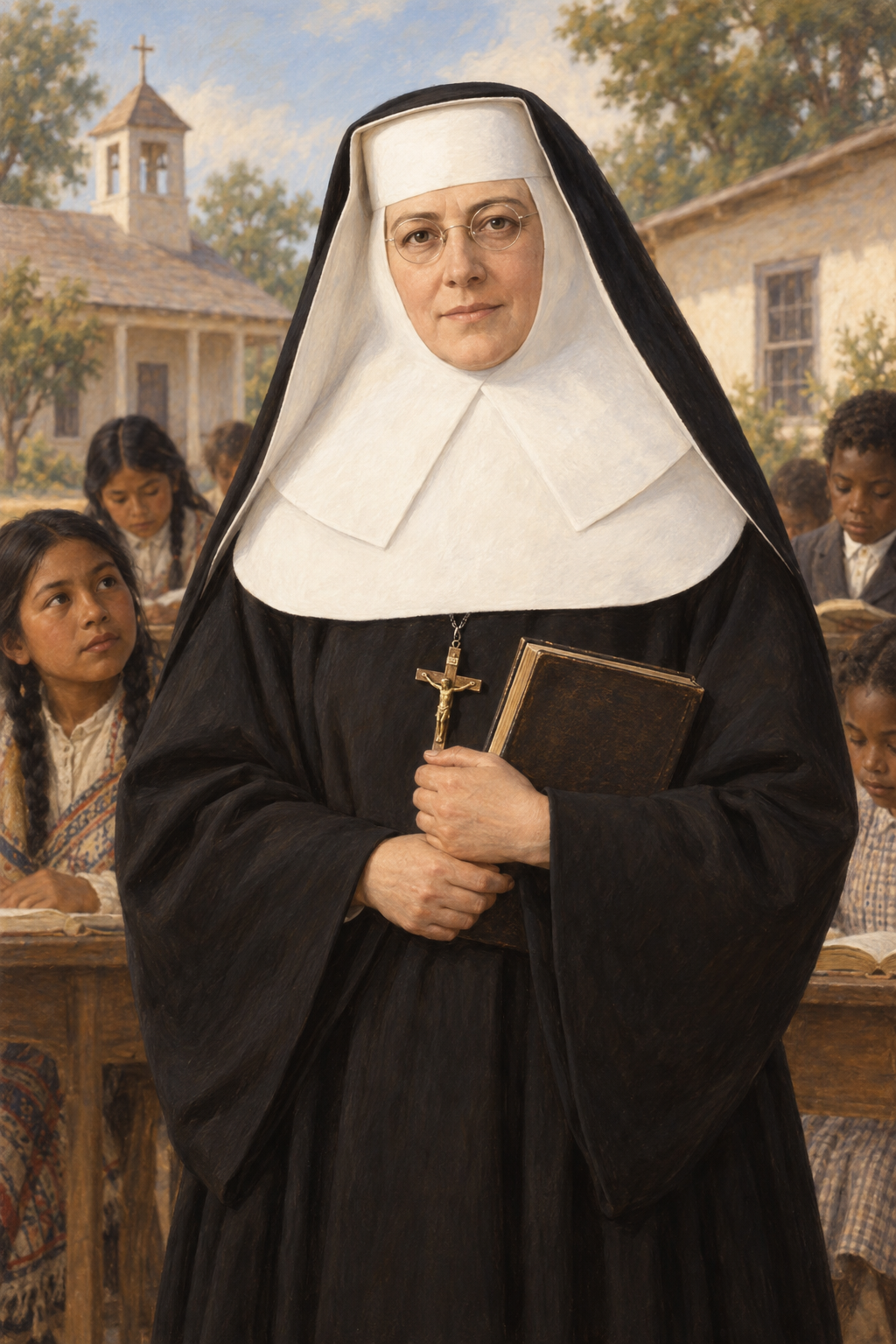
About Katharine Drexel
Katharine Mary Drexel was born in Philadelphia on 26 November 1858 to Francis Anthony Drexel and Hannah Langstroth Drexel. The Holy See's biography describes her family as financially prominent and deeply committed to charity. Her parents taught their daughters that wealth was loaned to them and had to be shared. That principle became more than a family custom: it shaped Drexel's understanding of religious vocation, property, education, and responsibility toward people who were denied equal opportunities. [D1]
During a family journey through the American West, Drexel saw the poverty and disadvantage experienced by Native American communities. The experience led her to support missions and missionaries financially, and in 1887 she established Saint Catherine Indian School in Santa Fe, New Mexico. The school became an early expression of her conviction that durable service required education and local institutions rather than occasional charitable relief. [D1]
Drexel later visited Pope Leo XIII in Rome and asked him to send missionaries to the Native American missions she was financing. Instead, the pope suggested that she become a missionary herself. After consulting Bishop James O'Connor, she decided to give both her life and her inheritance to God through service to Native Americans and African Americans. The decision changed the scale and form of her work: she would no longer be only a benefactor of missions but the founder of a religious community dedicated to them. [D1]
On 12 February 1891 she professed her first vows and founded the Sisters of the Blessed Sacrament. The congregation's mission was to bring the Gospel and Eucharistic life to Native American and African American communities. Drexel's work addressed religious formation, schooling, poverty, and the effects of racial discrimination. The Vatican biography states that many African Americans still lived under severe economic and legal disadvantages, including poor education and restricted civil rights. Drexel responded by establishing and supporting schools, speaking publicly when discrimination was present, and encouraging her sisters to combine prayer with determined action. [D1]
Her approach was neither activism detached from prayer nor prayer detached from public responsibility. The Holy See describes her as a woman of intense prayer who drew love for poor and oppressed people from the Eucharist. She depended on Providence while also taking practical initiative, negotiating obstacles and building institutions. Her social witness helped the Catholic Church in the United States recognize the domestic need for an apostolate among Native Americans and African Americans. [D1]
Drexel's ministry continued through the sisters and the schools they founded. The record should distinguish her personal acts—founding the congregation, directing its resources, and speaking against discrimination—from the wider work of later members. Her lasting contribution was a structure in which women religious could sustain education and religious service among communities that had often been ignored or actively excluded. [D1]
For the last eighteen years of her life, serious illness left Drexel almost completely immobile. The Holy See presents this period not as an erasure of her earlier work but as a return to the contemplative life she had desired from childhood. She died on 3 March 1955. Her official memorial in the United States is observed on 3 March as an optional memorial. [D1][D2]
Drexel's significance rests on the combination of inherited privilege, deliberate renunciation, institutional leadership, and sustained attention to racial injustice. A responsible profile should acknowledge that her work arose within the historical structures of American Catholic missions while preserving the documented facts: she founded the Sisters of the Blessed Sacrament, devoted her resources to education and missions, and made the dignity and education of Native American and African American people central to her vocation. [D1]
The decision to use inherited wealth for a religious foundation gave Drexel a particular responsibility within the Church of her time. She did not simply finance isolated projects; she organized a congregation whose members could teach, evangelize, and remain present in places where schools and churches were scarce. That distinction matters for the profile because the enduring work was carried by a community with formation, rules, and a defined mission. Drexel's role included discernment about where resources were needed, encouragement of the sisters, and persistence when local opposition or distance made a project difficult. [D1]
Her schools also belong to the history of American Catholic education. They served communities whose children had often been denied equal educational opportunity, and they joined academic instruction with religious formation. The available official account supports describing this educational purpose, but it does not justify assigning unsupported enrollment totals or claiming that every later institution was personally founded by Drexel. The safest account keeps her direct foundation work distinct from the broader legacy of the sisters who continued it. [D1]
When illness restricted her movement, Drexel's public activity changed rather than disappearing. The official narrative describes a prolonged period of physical limitation and a more hidden life of prayer. This final period should not be used to invent private sayings or spiritual experiences; it is enough to record the documented transition from active institutional leadership to contemplative endurance. Her life therefore presents two connected forms of service: practical education and mission-building, followed by faithful intercession within severe illness. [D1]
Wondering how to weigh the stories and sources? Learn how to read a saint biography.