Biography
Laura Montoya
About Laura Montoya
Laura Montoya y Upegui, later Laura of Saint Catherine of Siena, was born on May 26, 1874, at Jerico in Antioquia, Colombia. The Dicastery for the Causes of Saints says her parents were economically modest, upright, and fervent Christians.
Laura was only three when her father was killed by political opponents. Her mother could not support the whole family, so Laura was entrusted to her maternal grandparents at the estate called La Vivora, near Amalfi. The profile should state this without turning the violence into melodrama.
With her grandparents she received a strong human and religious education. The Dicastery profile says she learned the catechism by heart and was admitted to First Communion in July 1881, at the age of seven.
Laura completed primary studies in several villages where her mother worked as a teacher, then settled in Medellin to attend the normal school for teacher training. After receiving her teaching credential, she began a teaching career.
The apostolic letter on her beatification adds that before regular schooling she learned to read and write largely by her own effort. That detail helps explain both her resilience and her later attentiveness to education as a missionary tool.
She served first as director of the higher school for girls at Amalfi, then at Fredonia and Santo Domingo, and in 1909 as a professor at the Immaculate College in Medellin. This teaching background shaped her later missionary method.
From childhood, Laura felt called to religious and missionary life. The Dicastery profile says she desired to be a Discalced Carmelite, yet at the same time was troubled by the situation of Indigenous peoples and by the lack of evangelization available to them. Her vocation moved between cloister and forest.
In 1907, while she was teaching at Marinilla in Antioquia, Laura experienced the mystery of God's fatherhood with unusual intensity. The official profile says that this experience helped clarify her missionary vocation and awakened in her a strong desire for spiritual motherhood.
The page should handle that mystical material carefully. It can say that the experience deepened her missionary commitment, but it should avoid long quoted passages or claims about interior visions beyond the official source.
Her first apostolic and missionary journey took place in 1908 in the Guapa-Chami region, with two companions and a priest. The Dicastery profile describes the journey as decisive for her commitment to mission. The final page should keep the Indigenous communities as people, not as scenery.
After returning to Medellin, Laura organized further mission journeys with her mother and women who joined her work. She called the undertaking Obra de los Indios. In English prose, describe it as her work among Indigenous communities, with care not to repeat period language uncritically.
On the advice of ecclesiastical superiors, Laura sought a stable basis for the work and began founding a religious congregation. From the beginning it was called the Missionaries of Mary Immaculate and Saint Catherine of Siena.
The new congregation received its first ecclesiastical approval in 1916. Laura made first profession on January 1, 1917, and perpetual profession on December 8, 1924. She was elected first superior general and governed until 1929, then again from 1938 until her death.
The Dicastery profile says that in 1914 Laura went with her mother and five companions to the mountains of Dabeiba to meet Indigenous people. It also says the sisters crossed mountains, forests, and rivers to evangelize. This material should be used to show concrete effort, not conquest.
Pope Francis's canonization homily is especially useful for tone. He said Laura was first a teacher and then a spiritual mother to Indigenous people, and that her evangelization welcomed them with love, brought them to God, and respected their culture rather than opposing it.
The same homily says she teaches Christians to communicate the joy of the Gospel by word and life, to overcome indifference, and to welcome everyone without prejudice or discrimination. Those themes should guide the public page's pastoral application.
The congregation developed rapidly during her lifetime, with houses in Colombia, Ecuador, and Venezuela, but this draft avoids repeating numerical expansion as a present-day fact. If current statistics are later used, they need a fresh, dated congregational source.
After nine years in a wheelchair and a long final illness, Laura died in Medellin on October 21, 1949. The Dicastery records her beatification by John Paul II on April 25, 2004, and her canonization by Pope Francis in Saint Peter's Square on May 12, 2013.
The same official profile gives October 21 as her liturgical memorial. The page should present Laura as teacher, foundress, and missionary, while keeping the language about Indigenous communities respectful, sourced, and free of triumphalism.
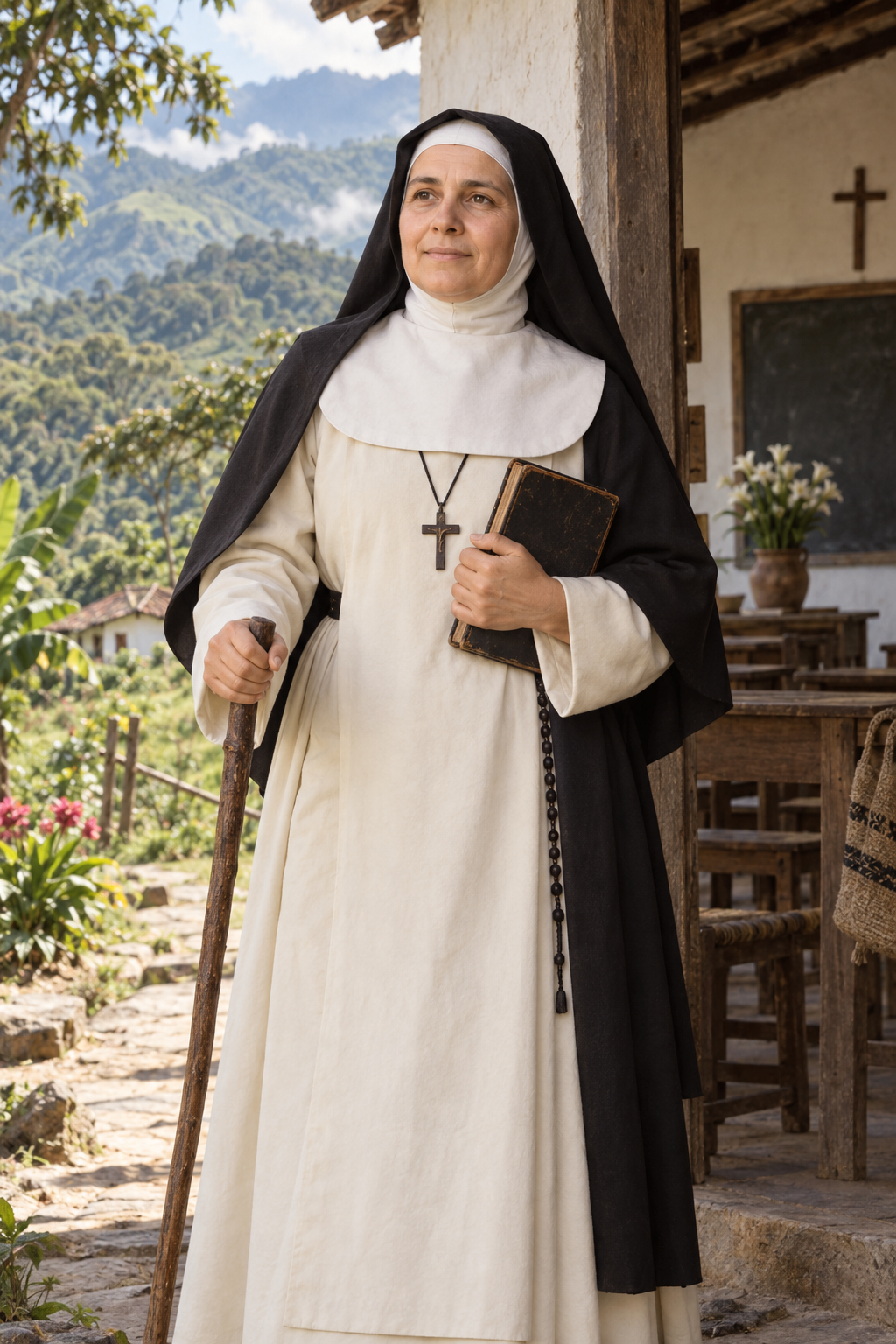
Artwork should show a Colombian religious sister in a simple habit with a book, walking staff, and modest mission-school setting in Antioquia mountain terrain. Avoid using Indigenous people as props, colonial imagery, rendered words, logos, halos, and exact-likeness claims.
Wondering how to weigh the stories and sources? Learn how to read a saint biography.