Biography
Marianne Cope
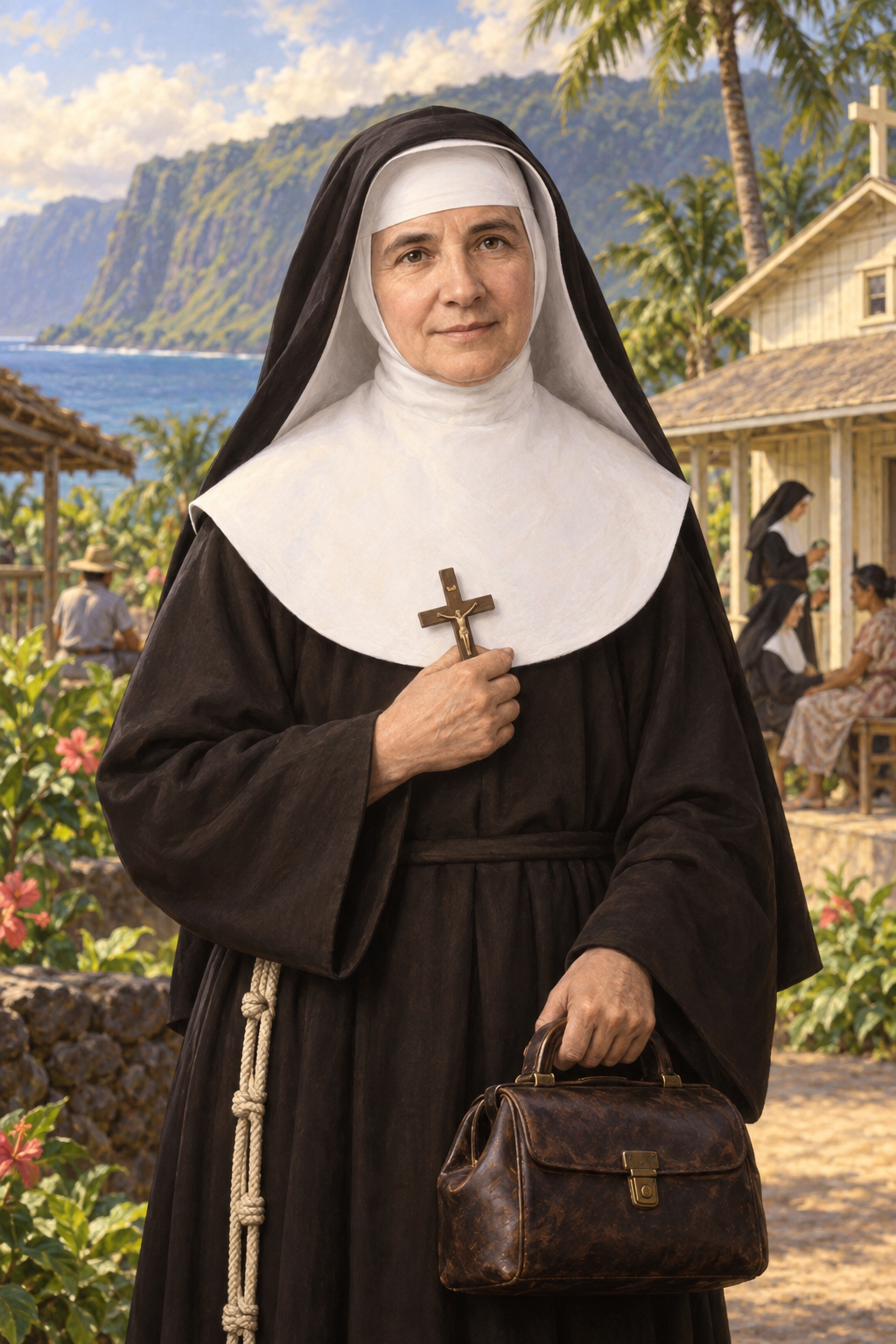
About Marianne Cope
Marianne Cope was born Barbara Koob in Darmstadt, Germany, on 23 January 1838. Her family emigrated to the United States while she was a child, and she grew up in New York. The official accounts connect her vocation with the needs of immigrant and working families around her. She entered the Franciscan Sisters of Syracuse and took the religious name Marianne. Her early ministry developed within a community that combined religious life with practical service. [M1][M2]
Cope became involved in the growth of hospitals and health-care institutions. The sisters' work required more than bedside care: it included administration, training, fundraising, and the creation of places where people who were poor or chronically ill could receive sustained attention. Cope's leadership in Syracuse gave her experience in organizing a ministry that treated health care as a matter of human dignity and community responsibility. [M1][M2]
In the nineteenth century, people with Hansen's disease in Hawaiʻi were being isolated at Kalaupapa on Molokaʻi. The official accounts state that religious communities had been asked to help, but that many declined because of the danger and stigma associated with the disease. Cope and a group of Franciscan sisters accepted the invitation. Their decision placed them in a setting where ordinary social contact had been disrupted and where patients needed both medical help and the restoration of family and community life. [M1][M2]
Cope's ministry at Kalaupapa was expressed through presence. She cared for patients, helped organize homes, welcomed children, and worked to create a stable environment in which people could be treated as neighbors rather than as objects of fear. The sisters' work included care for the sick, practical household support, religious companionship, and the protection of children. These activities should be recorded as distinct events rather than compressed into a generic claim that Cope was compassionate. [M1][M2]
The official narratives present Cope's service as a response to people whom society had pushed to the margins. That language should be handled carefully: the profile can report the conditions of isolation and stigma without suggesting that every historical detail of the settlement is established by the short biographical sources. The strongest supported claims concern her decision to go to Hawaiʻi, her service at Kalaupapa, her care for patients and children, and her role in building a community of care. [M1][M2]
Cope remained at Kalaupapa for the rest of her life. She died on 9 August 1918 on Molokaʻi, Hawaiʻi. The Church later recognized her through beatification and canonization, and the USCCB observes her memorial on 23 January. The feast date is not a death-date claim and should remain in the observance record separately from the historical death event. [M1][M2][M3]
Marianne Cope's significance lies in the practical shape of her solidarity. She did not merely speak about people who were excluded; she entered the place to which they had been sent, accepted the risks and responsibilities of their care, and helped form homes and institutions around them. A careful biography should honor that documented commitment without turning suffering into a devotional spectacle or claiming that her work alone transformed Hawaiʻi's public-health system. [M1][M2]
Cope's earlier leadership prepared her for this later mission. Before going to Hawaiʻi, she had served in the religious community that developed hospitals and other works of mercy in the United States. That experience helps explain why her ministry at Kalaupapa included organization as well as personal kindness: care required schedules, supplies, housing, education, and the patient work of building trust. The sources support this general institutional character, while the profile should avoid assigning her individual responsibility for every service later associated with the sisters. [M1][M2]
Her response to the request for sisters at Kalaupapa also carried a clear ethical meaning. The patients had been separated from ordinary social life, and the community needed caregivers willing to share daily conditions rather than visit briefly from a safe distance. Cope's decision to remain made presence itself part of the ministry. It is appropriate to describe that choice as courageous when the official account records the risks and the long duration of her service; it is not appropriate to add unverified episodes of danger or miracles. [M1][M2]
The homes and routines established at Kalaupapa should be described with care. They offered practical stability and human companionship to people living with illness and social exclusion. Cope's work with children likewise belongs to the history of community care, but the short sources do not support invented names, numbers, or individual case histories. A responsible profile keeps the focus on the documented pattern: welcoming patients, caring for children, organizing the sisters' presence, and remaining faithful to the community until death. [M1][M2]
That continuity is important to the historical account. Cope's service was not limited to a single dramatic gesture; it was sustained through ordinary work, shared responsibility, and attention to the dignity of people whom others had been taught to fear. The official sources permit that broad conclusion because they describe both her arrival and her remaining years of service. They do not permit a detailed reconstruction of every day, so the profile keeps individual anecdotes and numerical claims deliberately outside the record. [M1][M2]
Wondering how to weigh the stories and sources? Learn how to read a saint biography.