Biography
Moses the Black
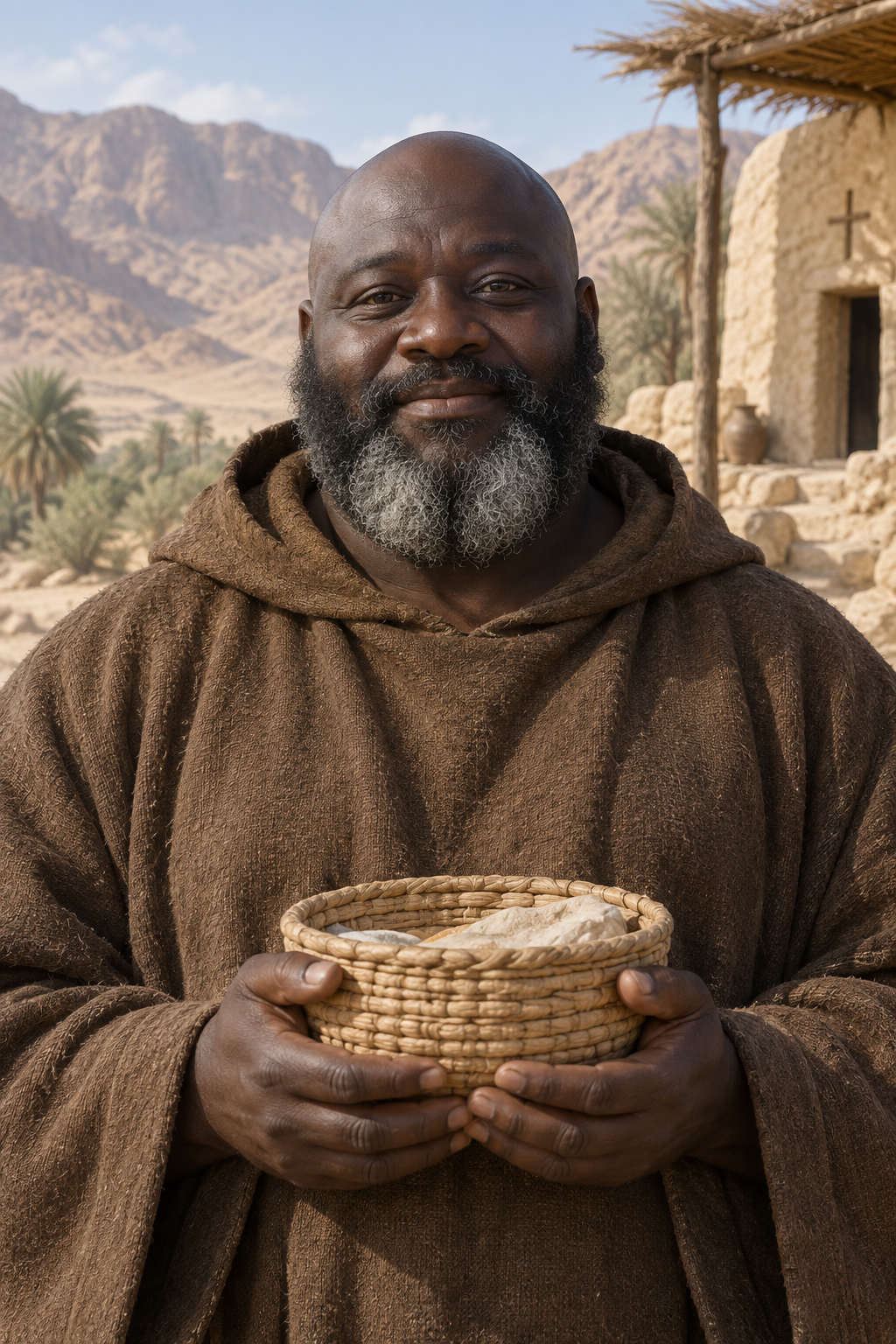
About Moses the Black
Moses the Black lived approximately from 330 to 405, according to E. D. Carter's entry in the New Catholic Encyclopedia. Carter describes a former servant or slave who became a robber, while acknowledging that the circumstances of his conversion are unknown. The same account names Theophilus of Alexandria as the bishop who ordained him, after hearing of his changed conduct. His standing among the monks eventually included priestly service.
Palladius introduces Moses through the contrast between his reported crimes and his repentance. He describes repeated struggles, counsel sought from Isidore, and water carried secretly to older monks. His Moses learns through service and help received, not through a single untroubled decision.
Sozomen's Church History gives another early telling of the change in his use of strength. Four robbers enter his dwelling, and Moses overpowers them. Instead of taking revenge, he binds them and carries them to the assembled monks, leaving the decision about their treatment to the community. The narrator says he did not regard himself as entitled to punish anyone. This is an ascetic exemplum, with extraordinary physical strength, rather than an independently established arrest. The action at its centre is restraint: the former robber surrenders the power to retaliate. Sozomen also describes severe fasting, labour and prolonged standing prayer. These demanding practices belong to the ancient narrative of his struggle, not to a prescription for readers to copy. His account is a parallel retelling, not a separate eyewitness confirmation. Sozomen closes with his ordination over the monks at Scetis and the disciples who survived him.
The Coptic Synaxarium places Macarius the Great among his teachers. Macarius instructs and baptizes him in this received narrative, not a surviving baptismal record. He confides his temptations to Isidore, who comforts and instructs him.
The Orthodox Church in America's life recounts the final raid on his community. Moses allowed others to escape but chose not to fight. It places his death around 400, showing that the received chronology is not exact.
Stories about Moses also carried the racial assumptions of their tellers. In a 2004 study, historian Brian Noell examines the account of his ordination and the insulting treatment attributed to other clergy. Noell argues that a dialogue written down generations later cannot reveal Moses's private feelings about his own skin. He notes that the story combines admiration for a holy man with imagery associating dark skin with sin and whiteness with purification. Those associations belong to the literary and social world under examination; they are not an acceptable measure of anyone's dignity. Noell also identifies the title given to the ordaining churchman as evidence of later retelling. His analysis distinguishes a remembered African ascetic from a character shaped to teach humility to subsequent audiences. Respect for Moses therefore does not require accepting the humiliating language put into his mouth as his authentic self-understanding.
In a 1977 article, Pope Shenouda III presented Moses as an example of repentance and of the patient work of a spiritual guide. His account stresses Isidore's perseverance and Moses's changed treatment of strangers. It also recalls his importance to African Christians. The article locates the celebration at Al-Baramous, the monastery where it says Moses lived and was buried. This is a later pastoral reading of the saint, not an additional eyewitness to his fourth-century life.
The Fellowship of St. Moses the Black connects his name with racial reconciliation today. Its stated mission includes sharing Orthodox Christianity with African Americans and other people of color. The fellowship gathers annually for prayer, learning and mutual encouragement, extending his remembrance into a contemporary community.
His memory also survives in Coptic liturgical manuscripts. Youhanna Nessim Youssef examines doxologies that honor his martyrdom and the place of his relics. One text associates him with Gaza, but Youssef cautions that this may reflect local tradition or confusion with another saint.
Youssef's manuscript comparison makes the liturgical evidence more specific. He identifies witnesses in Paris, BnF Copte 42, and the Coptic Museum, manuscript 292. The Paris witness joins two doxologies that he treats separately in his edition. The second centres on martyrdom and remembrance after death, with a cave associated with the saint's remains. Youssef explicitly observes that it is not primarily a biography. The manuscript evidence therefore records how a worshipping community remembered Moses, rather than establishing where he was born or supplying a missing sequence of dates. Its enduring setting is communal commemoration, not a recovered personal diary.
The fellowship's executive board explains how that remembrance informs its practical work. It describes education through books, classes and conferences, and dialogue through moderated gatherings and local chapters. In 2020 the organization changed its name from Brotherhood to Fellowship to make women's inclusion explicit. Men and women share its leadership. This institutional reception joins learning and conversation to prayer, while acknowledging that racial healing requires continuing effort.
Wondering how to weigh the stories and sources? Learn how to read a saint biography.
Explore similar vocations
Prayers for Moses the Black
Moses the Black: prayer excerpt
May his prayers be with us.