Biography
Nicholas of Flüe
About Nicholas of Flüe
Nicholas of Flüe was born in 1417 in Flüeli, in the region of Obwalden in the Old Swiss Confederacy. The Historical Dictionary of Switzerland identifies his family as agricultural and remembers him as a man who combined civic commitment with a religious vocation. Known in German as Niklaus von Flüe and popularly as Brother Klaus, he first lived within the ordinary responsibilities of a rural community.
Before becoming a hermit, Nicholas worked as a farmer and took part in civic life. Sources describe service as a judge and public officer. The modern historical literature cautions that later accounts of his life mingle documentary evidence with devotional memory, so individual stories about private visions or extraordinary fasting should be presented with their source and degree of certainty. His public reputation was built not only around withdrawal from society but also around a continuing relationship with neighbors and political leaders.
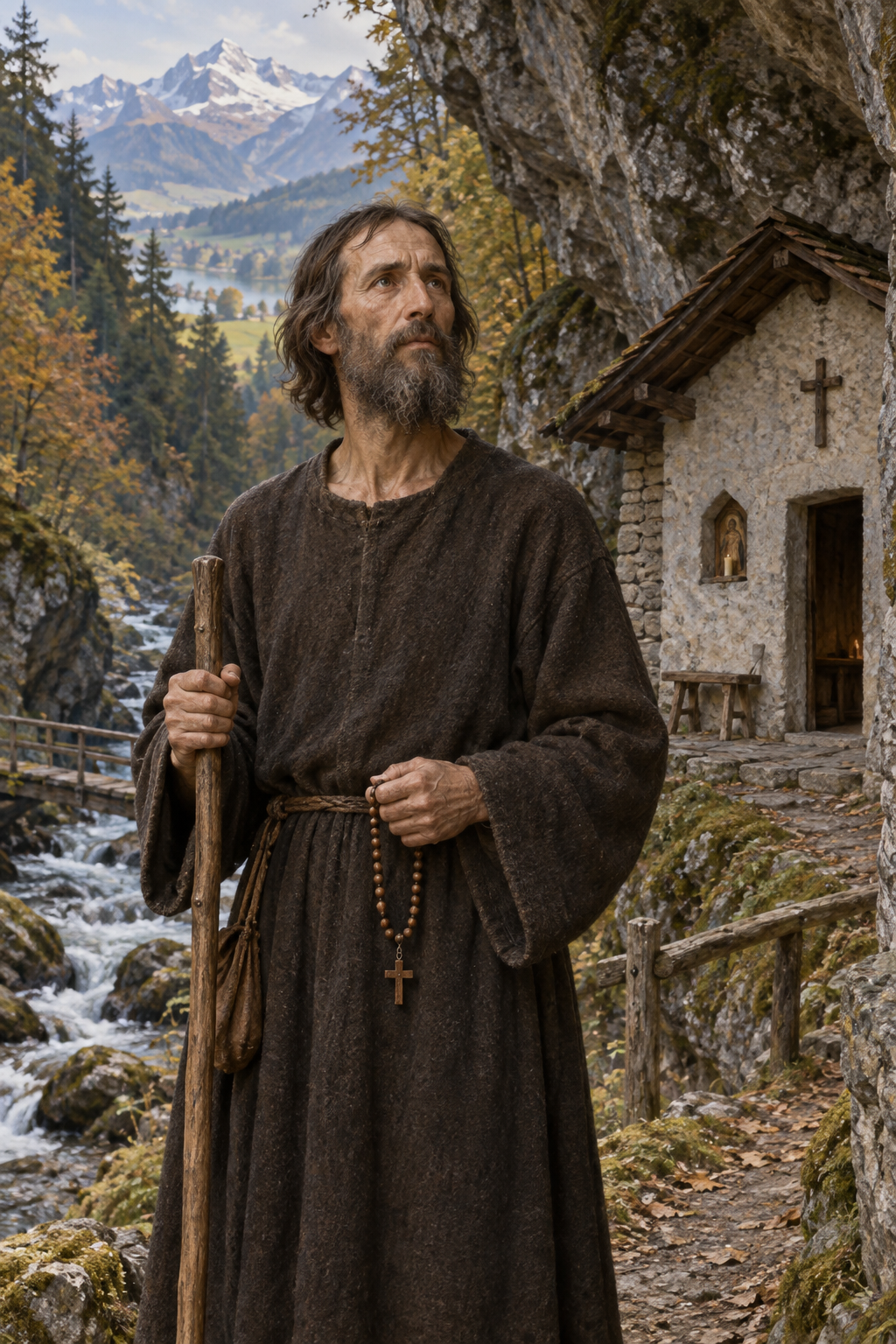
Nicholas married Dorothea Wyss and the couple raised a large family. Around 1467 he left ordinary household life, with his wife’s consent according to the traditional account, and withdrew to the Ranft ravine near his home. His hermitage was close enough to the settled community that visitors could seek him out. Sources describe a life of prayer and severe ascetic practice, although reports of a miraculous long fast belong to the tradition and require separate qualification.
The hermit’s influence grew beyond the ravine. People visited him for advice, and accounts of his counsel connect spiritual reflection with practical public questions. At the Diet of Stans in 1481, representatives of the Swiss Confederacy faced serious disagreement. The Historical Dictionary of Switzerland treats Nicholas’s mediating influence in the settlement as established, while the precise words and the degree of his influence should not be embellished. A biography can therefore recognize his role without making him the sole architect of the agreement.
The Historical Dictionary of Switzerland notes that he appears in only three documents before 1467. In one, from 1462, he represented Obwalden in a judgment concerning a dispute between Engelberg Abbey and parishioners of Stans. The document suggests that he belonged to the local council and court.
On 16 October 1467 he left his family on a pilgrimage, then turned back and established himself in the Ranft ravine near his farm. Accounts describe a vision and unusual fasting; the latter attracted attention from both secular and church authorities. According to the HLS, local officials watched him for a month, and a church examination took place in 1469 when the chapel at Ranft was consecrated.
Nicholas’s counsel also reached people beyond his immediate neighbors. A report by the Milanese envoy Bernardino Imperiali describes a visit to Ranft in 1483 and finds the hermit well informed about political affairs. The HLS regards Nicholas’s mediating influence in the 1481 agreement at Stans as established, while it does not make him the sole author of the settlement.
The written record itself developed close to his death. An illustrated pilgrim tract appeared around 1487, and early biographies followed in 1488 and 1501. His later political reputation grew over centuries, especially as Swiss communities remembered him as a figure of peace.
Nicholas died at Ranft on 21 March 1487. His grave and the nearby places associated with his hermitage became important destinations for remembrance. The Catholic Church later beatified him in 1669 and canonized him in 1947. His cult is especially associated with Switzerland. His memorial is observed on 21 March.
Wondering how to weigh the stories and sources? Learn how to read a saint biography.