Biography
Odette Prévost
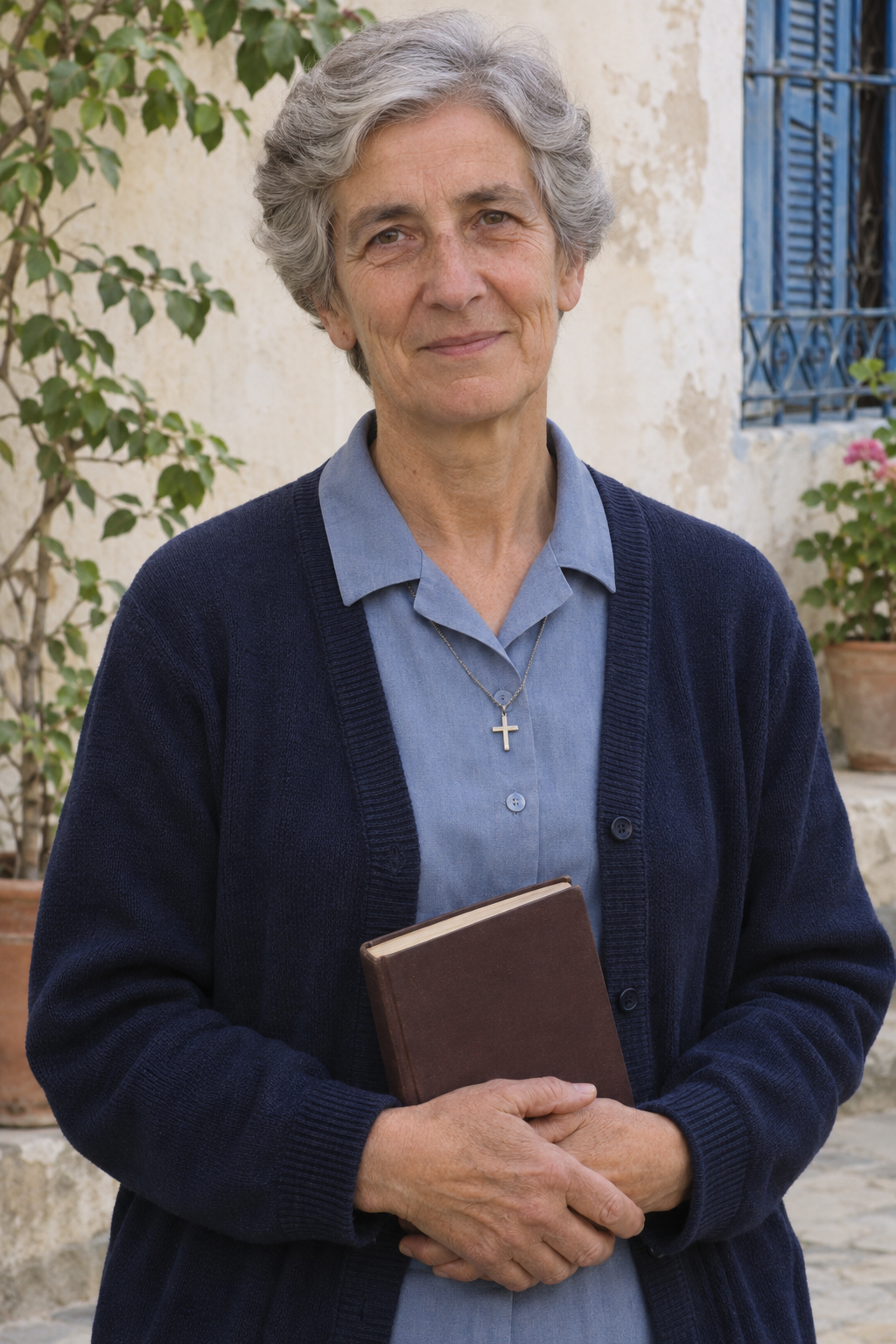
About Odette Prévost
Odette Prévost was born at Oger, a village in Champagne, France, on July 17, 1932. She was a teacher before entering the Little Sisters of the Sacred Heart of Charles de Foucauld in 1953. Her formation took place at Montpellier. She made her lifelong religious profession in 1959. By then she had begun serving at El Kbab in Morocco. At El Kbab she taught girls sewing. She later helped establish a community at Kouba, on the outskirts of Algiers, between 1968 and 1970. An assignment at Argenteuil brought her among working families and people of North African background in the Paris region. She returned to Algiers in 1975. Beginning in 1980, studies in Arabic and Islam at Rome helped her understand the people among whom she lived.
Her congregation's prioress remembered her intellectual gifts and a difficult temperament, but also remarked on the changes before her death. Her companion Chantal Galicher lived with her at Kouba at different periods and observed changes over time. Odette gave particular attention to children who came for help with schoolwork after her working day. Teaching remained part of her vocation even outside a formal classroom. She also cared about the preparation of parish worship, wanting it to express both God's greatness and nearness. She was remembered for attentive listening and a desire for dialogue with Muslim neighbors. During the difficult final years, the community took part in a course concerned with personal growth. Her companion associated that experience with a gradual change: Odette became calmer and less ready to criticize. The testimony preserves her effort to change as well as the abilities and generosity others admired. Galicher understood her religious life as a continuing inner struggle rather than an effortless possession of serenity.
In a reflection dated June 1994, Odette linked shared daily life with prayer. She wanted the sisters to bring their neighbors' names, hopes and distress before God. Prayer, in her account, returned them to a deeper availability to other people. She acknowledged that such availability was difficult and could never be considered finished. The Eucharist connected the community's life to the lives of those around it. Her language of hope concerned a responsibility shared by the sisters, rather than an assurance that suffering would disappear.
A November 1994 reflection confronted the deaths of other religious in Algeria. Odette read those events alongside the Christian account of Jesus' life offered for others. She described the Eucharist as a call to the church and to each believer. The community's vulnerability also led her to reconsider mission as a gift whose future she could not control. She joined Ribât es-Salâm, a group for Muslim-Christian dialogue. She wrote about continuing an ordinary routine in solidarity with neighbors. Odette worked at Les Glycines, the diocesan cultural center, as a librarian and Arabic teacher. She recognized that institutions concerned with culture and openness were exposed to danger. Continuing their work therefore involved both awareness of risk and a decision to remain close to the people they served.
Galicher's later testimony recalls their return to Algeria after time in France during the summer of 1995. Security precautions reduced travel between the center of Algiers and their home at Kouba. A neighbor with six children regularly prepared couscous when they returned, knowing they would have little food in the house. The remembrance shows that care moved in both directions. On November 9 a young neighbor came to Odette for help with a school assignment. The parish priest also arranged the following morning's Mass, varying the time because journeys to church had become dangerous. On November 10, Odette and Chantal left the house to meet a friend who would drive them. A gunman attacked them. Odette was killed, and Chantal was seriously wounded. Galicher later wrote about the long physical recovery and the questions the event left with the surviving community. Her account remembers neighbors' friendship alongside the violence that ended Odette's life.
In her home diocese, the Maison Odette Prévost was inaugurated in 2004 to keep the memory of her life.
The congregation received her beatification with a mixture of reserve and gratitude. In 2018 its prioress, Isabel Lara Jáen, explained that the sisters had not sought the recognition. They wished to remain discreet and to keep the suffering of the whole Algerian people in view. Concern for Chantal, the survivor of the same attack, also mattered. Lara Jáen nevertheless welcomed the recognition as encouragement for their vocation of hope. Her letter emphasized that Odette's life included weaknesses and a growing ability to trust. She linked the sister's educational gifts and care for young people with a religious calling lived among others. The account resists separating public honor from the ordinary relationships and unfinished personal growth that had shaped her life.
Odette was beatified at Oran on December 8, 2018, among the nineteen Algerian martyrs.
Wondering how to weigh the stories and sources? Learn how to read a saint biography.