Biography
Pantaenus
About Pantaenus
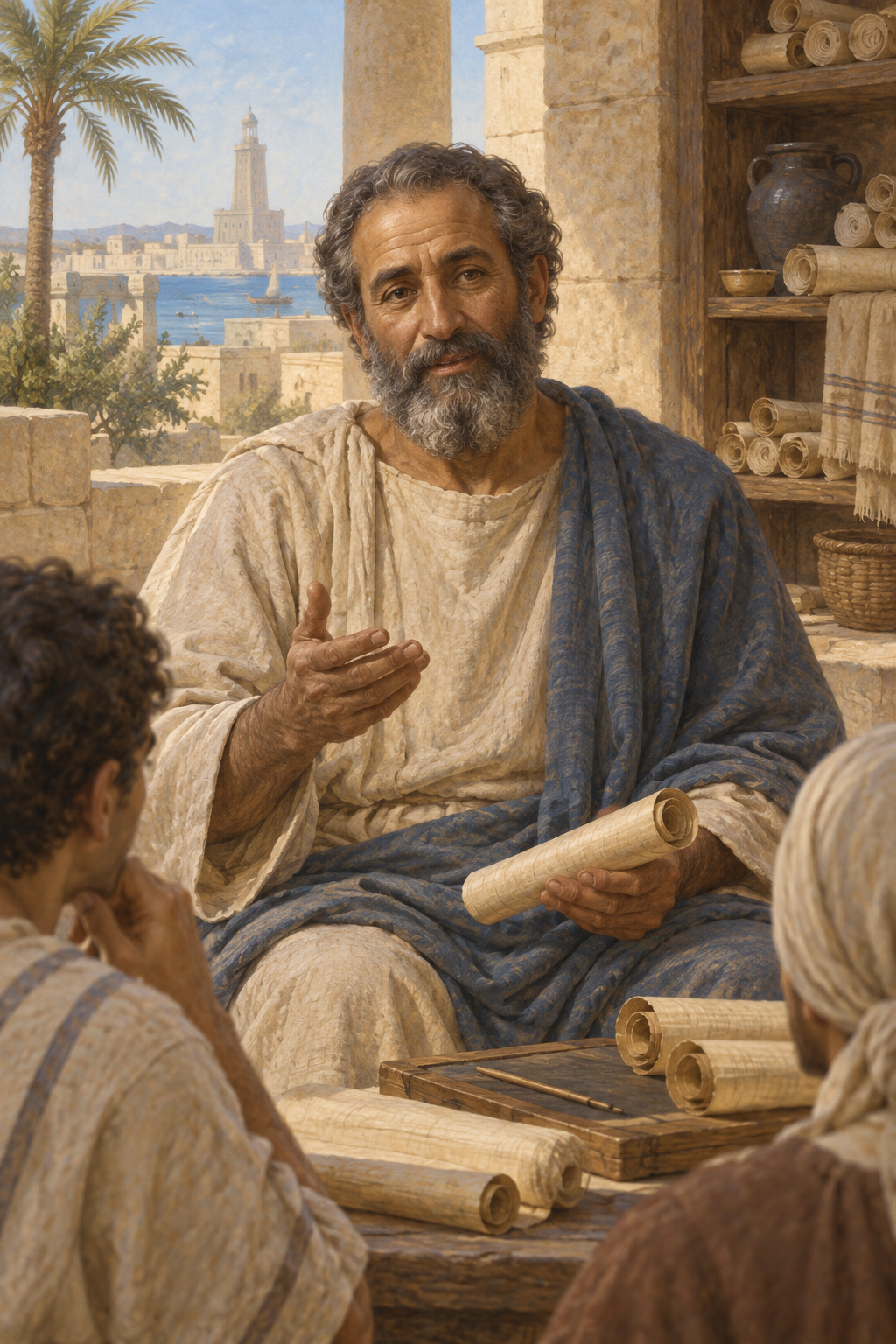
Pantaenus is known chiefly through Eusebius, a church historian writing more than a century after the teacher's lifetime. Eusebius places him in Alexandria, the Mediterranean city where Greek philosophical learning and Christian scriptural study could meet. He describes Pantaenus as distinguished for learning and says he came from the Stoic philosophical tradition. The passage places him among Christian teachers around the reign of Commodus, in the late second century. It does not supply his birthplace, family, exact age, or a precise year when he began to teach. Later accounts have often filled those gaps with a neat biography, but the surviving witness is much smaller. The reliable profile begins with his Alexandrian role and the limits of the evidence for it.Eusebius describes a school of sacred learning among Alexandrian Christians and puts Pantaenus at its center. This says something important about how a later Christian historian remembered him, but it does not show us a charter, a building, a curriculum, or an unbroken list of appointed directors. A recent Cambridge study argues that the familiar picture of a formal second-century catechetical school goes beyond what Eusebius actually establishes. In that reading, Pantaenus was a respected instructor within a looser setting of Christian learning. The distinction matters because the impressive later history of teaching in Alexandria can otherwise be projected backward onto someone for whom the institution itself is not securely documented. His teaching can be honored without giving it a modern organizational structure.The best-known travel story is also filtered through Eusebius. He says Pantaenus was sent as a preacher toward eastern peoples and is reported to have reached a land he calls India. There, according to the report, he found Christians who possessed a writing associated with Matthew and a tradition about the apostle Bartholomew. Eusebius signals that he is passing on what people said. Neither the particular community nor the document is independently identified by his short account. Even the geographic term is difficult: an older Catholic reference observes that writers have considered South Arabia rather than the modern country of India. The responsible description is therefore that Eusebius reports a journey, not that Pantaenus founded a documented Indian mission or authenticated an apostolic manuscript.Eusebius connects Pantaenus with Clement of Alexandria, saying Clement named him as a teacher in a work that no longer survives. He also takes a passage in Clement's surviving writing to point to Pantaenus, although the figure there is not named. That connection has shaped how later readers see a lineage of Alexandrian Christian thought. Yet the modern study notes that the lost testimony cannot be checked directly and that Eusebius's reconstruction should be handled carefully. The same difficulty affects Pantaenus's own written work: Eusebius says he taught in speech and writing, while the study notes a conflicting statement attributed to Clement that he left no writings. No securely identified text by Pantaenus is available for the catalog to quote or analyze as his own.An older Roman martyrology remembers Pantaenus at Alexandria on July 7 and praises his wisdom. That observance shows a later Christian tradition of honor; it does not establish that he died on July 7. The primary record does not permit an exact death year or a verified place of burial either. What remains is the picture of a remembered Christian teacher whose name linked philosophical training, scriptural instruction, Clement's circle, and a reported eastward journey. Each part has a different evidential weight. His Alexandrian teaching is the center of Eusebius's account, the travel story is explicitly reported tradition, and a formal institutional succession is a later interpretation now disputed. Keeping those distinctions visible makes the sparse life more useful than a falsely precise chronology.
Wondering how to weigh the stories and sources? Learn how to read a saint biography.