Biography
Patrick of Ireland
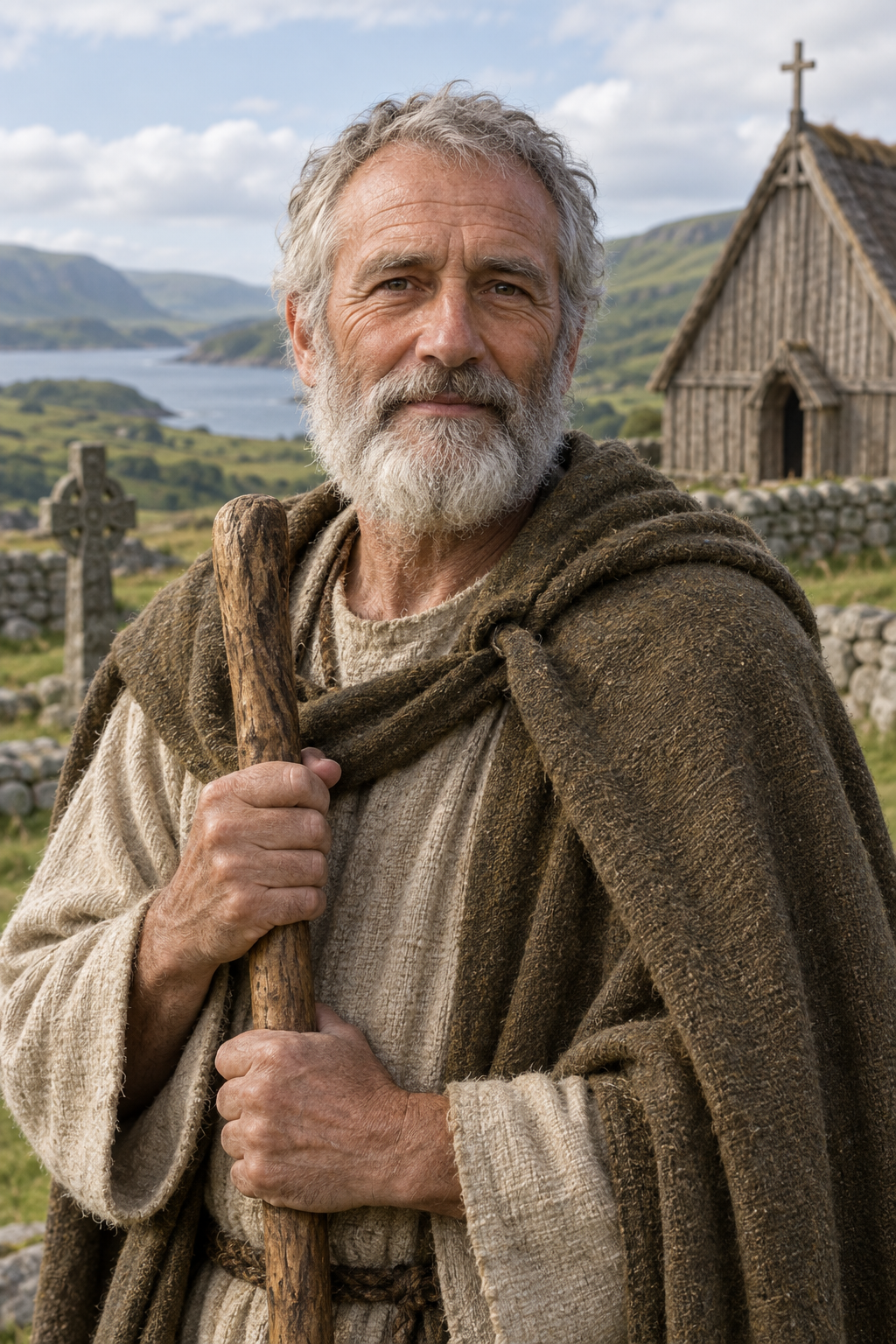
About Patrick of Ireland
Patrick's life began in Britain, not Ireland, within a society shaped by Roman government and Christianity. His family belonged to the provincial world in which civic responsibilities and church ministry could overlap. Historian David Kelly places his early life against the weakening of imperial protection, when a family's social standing offered no guarantee of safety. Ireland, across the sea, had trading connections with Britain but had not come under Roman rule.
In his Confessio, Patrick says he was taken captive at about sixteen and brought to Ireland. While tending sheep, he began praying with an intensity he had not known at home. He remembered prayer outdoors in cold weather, by night as well as by day. After six years, he escaped, encouraged by a dream about a ship. Eventually reunited with his family in Britain, he was urged never to leave again. But another vision, in which Irish people called him back, moved him deeply. He understood his return to Ireland as a calling from God.
The missionary entered an island where Christianity was already present. Cormac Bourke's Dictionary of Irish Biography account points to Palladius's appointment in 431 for Irish Christians as evidence of that earlier presence. Patrick's work therefore belongs within a developing Christian community, not a story in which one outsider changed an entire country alone. The same account places his travels among small kingdoms rather than under a single ruler of all Ireland. His mission crossed political boundaries; its practical demands included relationships with local rulers. The years of his training remain uncertain, and the familiar precise chronology of his life cannot be securely recovered.
Patrick's account of ministry includes the awkward business of money. He insists that he did not charge for baptisms or the ordination of clergy. He also describes paying royal companions and being imprisoned despite those connections. For him, service involved practical risks as well as preaching. He still longed to see his family in Britain and fellow Christians in Gaul, yet believed he should remain with the people entrusted to his care.
His Letter to the soldiers of Coroticus reveals a pastor facing a different kind of loss. Some newly baptized Christians had been killed; others were carried away captive. Patrick sent a priest and other clerics to ask for their return, but his messengers were mocked. He wrote with grief for the dead and those still enslaved, calling on other Christians to withhold fellowship from the attackers until they repented and freed their captives. The letter also asks to be read publicly, including before Coroticus himself. Its fierce language comes from a demand that the lives of these converts should matter. Patrick wanted a response from the people who could release them, not merely sympathy from a distant audience. Even his condemnation left room for change: he hoped the wrongdoers would repent, release the baptized women they held, and find life with God at last.
Patrick was also sensitive to criticism of his own abilities. Kelly's reading of his writings cautions against treating his modest descriptions of his education as a complete measure of his skill. The texts communicate through Scripture, and scholars have debated how deliberately their language was constructed. His Confessio is more than a defense of a troubled ministry. Kelly explains its title through three connected meanings: acknowledgment of sin, declaration of faith, and praise of God. Together they give the work its personal character: Patrick looks back at a life he believes was sustained by grace, rather than presenting achievement as his own possession.
After Patrick's lifetime, Irish writers gave his memory a larger public role. Elizabeth Dawson shows how the seventh-century authors Muirchú and Tírechán told different stories of conversion. Muirchú's dramatic portrait concentrates the struggle around a king and his religious advisers; Tírechán's account follows encounters across the country. Their communities were remembering their beginnings and explaining their place within Christian history. Those later portraits helped shape the familiar heroic Patrick. They should be read as the work of later generations, not folded into his own recollections as additional eyewitness episodes.
Patrick's own voice survived through manuscript copies. One witness is the Book of Armagh, produced in the early ninth century. Franz Fischer's account of the Royal Irish Academy's digital project describes bringing these witnesses, printed editions, and translations together so readers can encounter the writings for themselves. The project makes room for both scholarship and ordinary curiosity. Behind the many images attached to Patrick, it invites attention to the two Latin works that preserve his testimony.
His commemoration remains an occasion for practical care. For Saint Patrick's Day in 2022, Ireland's Catholic bishops asked parishes to reach out to Ukrainians in distress with prayer and solidarity. Remembering the country's patron became a call to notice people facing displacement and suffering in their own time.
Wondering how to weigh the stories and sources? Learn how to read a saint biography.
Explore similar vocations
Prayers for Patrick of Ireland
St. Patrick’s Breastplate
Christ with me, Christ before me, Christ behind me…