Biography
Paul Favre-Miville
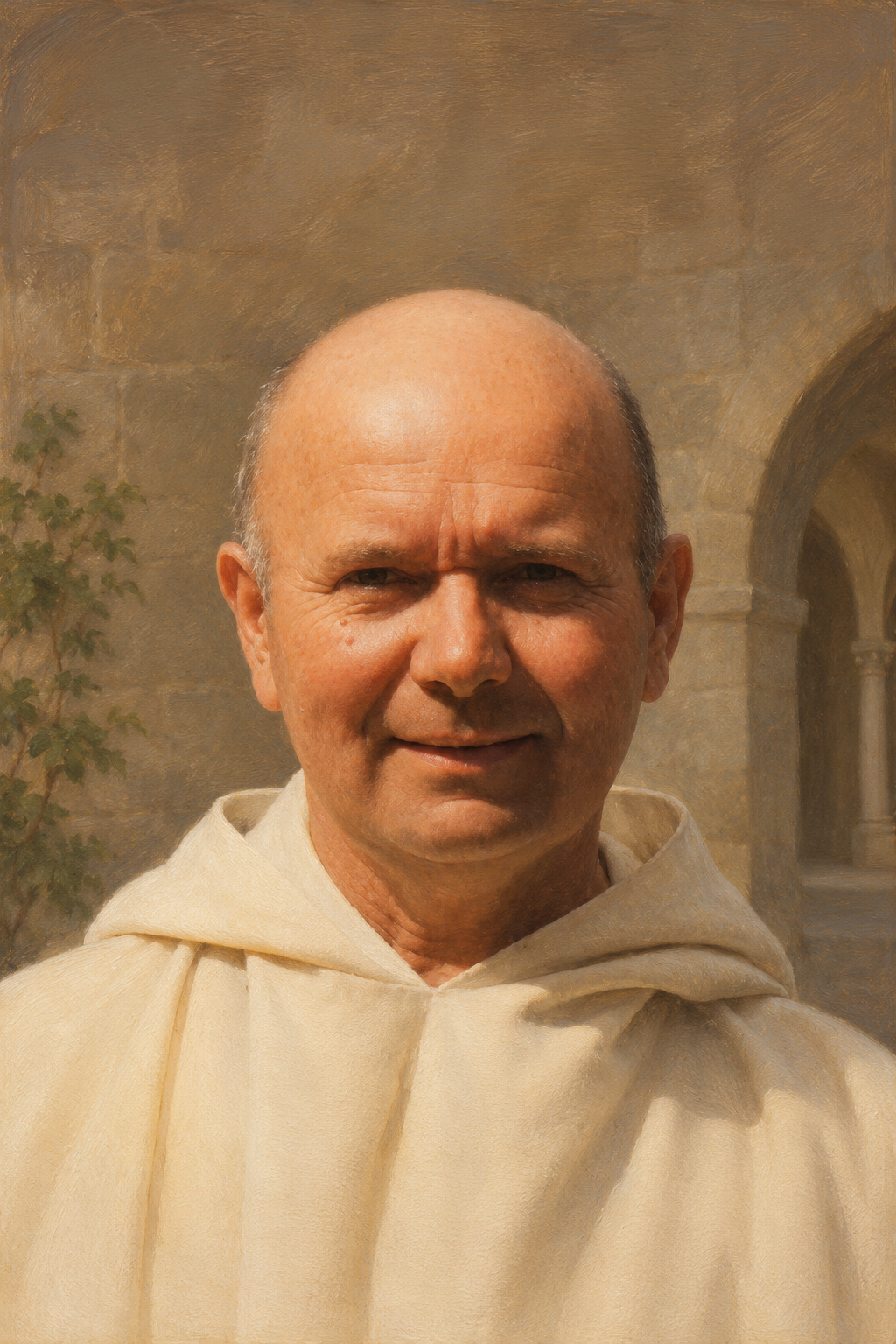
About Paul Favre-Miville
Paul Favre-Miville brought a working life to the monastery of Tibhirine. Born in 1939 at Vinzier in Haute-Savoie, he grew up in Bonnevaux. His father was a blacksmith and farrier, and his mother helped run the family’s business. Paul interrupted his education to work beside his father. After military service in Algeria, he trained as a plumber and heating specialist and established his own business. His responsibilities extended beyond the workshop: he served in local government, volunteered as a firefighter and sang in the parish choir. He entered the Trappist abbey of Tamié in 1984, at forty-five, and moved to Tibhirine in 1989.
Michel Sol, who knew him during his first year at Tamié, remembered a quiet, modest man whose gentleness was evident in his voice. Sol’s personal recollection emphasizes how naturally Paul found a place in the community.
At Tibhirine he applied the skills of his former trade to the monastery’s water supply and irrigation. The community’s account places this practical service beside his happiness at living among people of another faith. His move was a response to an appeal for brothers to strengthen the small community of Our Lady of the Atlas.
His fellow monk Jean-Pierre remembered a cheerful and helpful brother who communicated with neighbors through gestures and kindness despite not knowing Arabic. Humor was one of his characteristic ways of sharing life with others. Work did not displace the monastery’s prayer: Jean-Pierre recalled Paul taking care to finish his tasks in time for the offices and arriving calmly in a clean monastic cowl. This recollection joins technical usefulness with the daily liturgical rhythm that gave his work its setting.
The community’s life became increasingly dangerous as violence spread. On Christmas Eve 1993 armed men came to the monastery. Paul opened the door and went to find the prior, Christian de Chergé. The intruders eventually left, but the encounter forced the monks to consider their future. Paul later spent time in France caring for his sick mother. He returned to Tibhirine on 26 March 1996, bringing practical supplies for the community. During the following night he was abducted with six other monks.
In a letter dated 11 January 1995, Paul had asked what would remain of the Church in Algeria in the months ahead. He did not dismiss the possibility that very little would be left of its visible structures and personnel. Yet he expressed confidence that the Gospel had already been planted and that God’s Spirit was working within human hearts. He connected that hope with prayer and a loving presence among other people. The surviving excerpt offers his own account of hope under conditions in which the community’s future was profoundly uncertain.
A family letter from 1994 also became public through relatives. In 2015 journalist Nicolas Ballet reported receiving it from one of Paul’s nieces. The published introductory report says that Paul criticized people who claimed authority to speak in God’s name and saw the danger of using that claim to justify anything. This is a limited surviving excerpt, rather than a complete account of his views on the conflict.
His correspondence remained important to his family after his death. In 2024 the collection Nous, belle vie! brought together 162 letters sent to relatives between 1984 and 1996, covering both Tamié and Tibhirine. The publisher describes contextual notes and photographs preserved by relatives and the Tibhirine archives. Its presentation emphasizes tenderness, humor and an outlook sustained by belief in the resurrection. The publication preserves the family relationships that continued through his years in the cloister and makes his letters available beyond their original recipients.
The theologian Laure Blanchon, reviewing that collection in 2025, draws attention to the spiritual development visible across the correspondence. She notes that the early letters can seem very ordinary. As Paul discerned the call to Algeria, she sees resurrection becoming a central theme, followed by the paschal mystery after his arrival at Tibhirine. With growing violence, her reading finds an increasing emphasis on Christ’s life given for others. This is a later scholar’s interpretation of the letters, rather than an account of private motives independently available to a biographer. It helps explain why the correspondence is valued as more than a record of the community’s final crisis.
His niece Odile Chessel remembered how closely the family had remained in contact with him. Speaking at the time of the 2018 beatification, she recalled visiting the household where he lived with his mother. She described him through openness, compassion and practical service. For her, his life showed the possibility of friendship across cultures. Members of the family traveled to Oran for the ceremony, while another celebration was planned at Tamié. Her recollection places him within an extended family that continued to preserve his memory.
A communiqué dated 21 May 1996 announced the monks’ killing. Their recovered remains were buried in the monastery cemetery. The Catholic Church recognized the seven monks as martyrs and beatified them in 2018 with twelve other religious killed in Algeria. Paul’s remembered life includes the trade, civic responsibilities, family ties and monastic prayer that preceded those final events.
Wondering how to weigh the stories and sources? Learn how to read a saint biography.