Biography
Pedro of St. Elijah (Pedro Heriz Aguiluz)
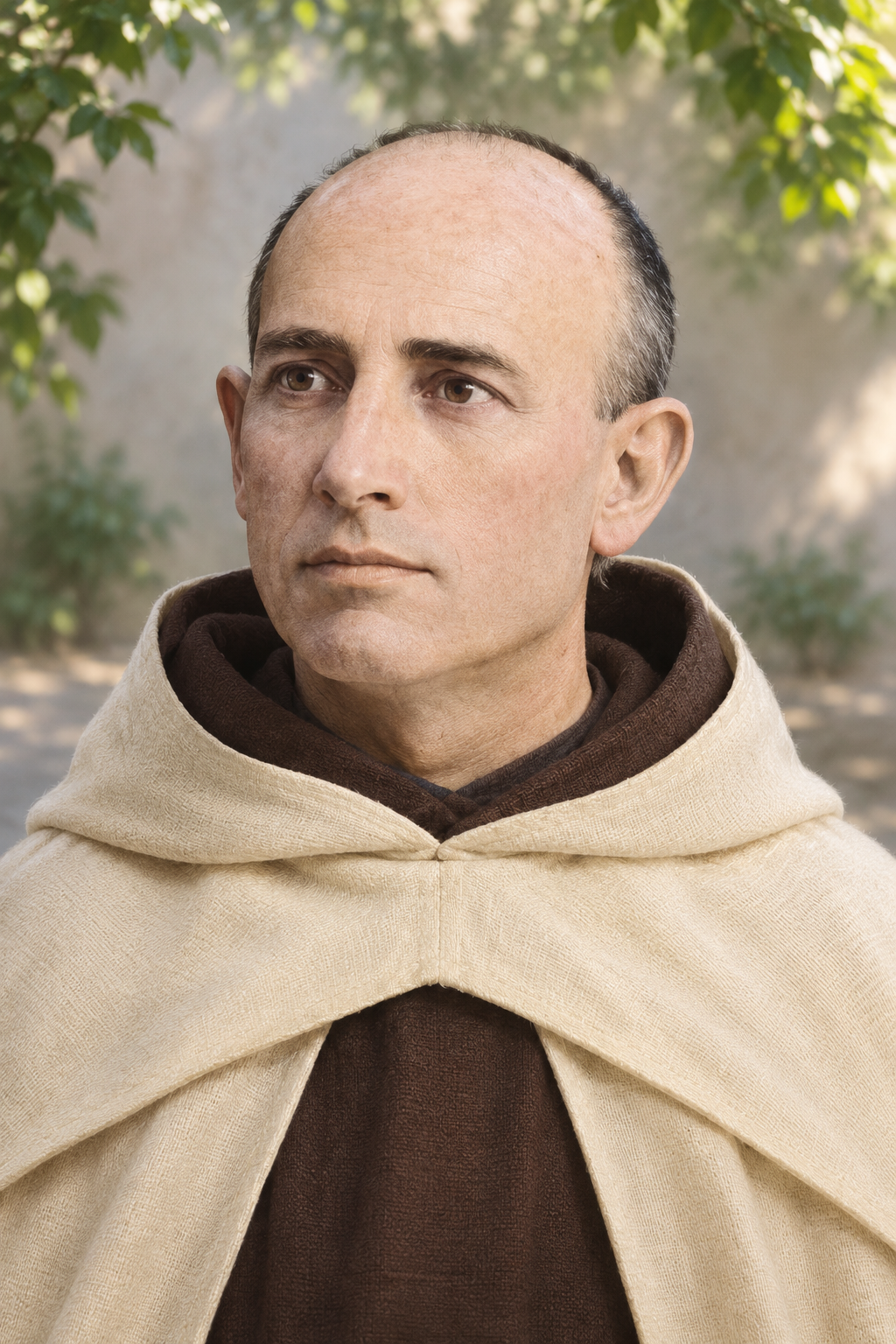
About Pedro of St. Elijah (Pedro Heriz Aguiluz)
Pedro worked in the mines of Somorrostro in the Basque Country before he had a church or a mission of his own. Born in 1867 in Barajuen, Álava, he and his twin brother grew up in the farming household of Domingo and Clara. It was his twin who first entered the Discalced Carmelites, taking the name Pascasio of the Virgin of Carmel. The American province remembers a letter from Pascasio telling Pedro that he had found the community he had been looking for and inviting him to come too.
Pedro joined the friars at Larrea and made his first profession in 1890. He studied philosophy and theology at Burgos. A respiratory illness interrupted his coursework, and he stayed on to complete the studies he had missed. He was ordained in December 1897. One of his early homes as a priest was the Carmelite retreat at Hoz de Anero in Cantabria, a community devoted to silence and solitude. His next appointment took him to Mexico, where much of the work waiting for him concerned buildings, people and money.
He arrived in Mexico in 1899 as one of the Spanish friars asked to assist the Carmelites there. The Mexican province already had friars and a superior, Father Checa. A task assigned to Pedro was to open a novitiate, the house where men would begin their religious formation. He bought back part of a former Carmelite property at San Joaquín, had the building repaired and a well dug. He never opened the proposed novitiate himself. His attention had turned to Durango, where a community of Carmelite nuns was trying to reestablish its monastery. The account of the purchase records two distinct outlays of two thousand pesos each, one for acquiring the property and one for putting it back into use.
With the support of the bishop, Pedro helped the sisters in Durango and established a house of friars there. His pace created difficulties. He sought reinforcements from Spain before the local superior knew that more men were coming. When Rome appointed Pedro to inspect the Mexican houses, Father Checa objected to the lack of consultation. Even the Spanish friars were divided. A second visitor came from Rome and assigned separate houses to the two groups. The history of Pedro’s work in Mexico preserves these disagreements along with the communities he helped establish.
His first attempt to establish an American house also ran into a practical difficulty. In Los Angeles in 1905 the bishop offered the Carmelites a former mission on condition that they supply priests who spoke English. They had no one available. In Arizona, by contrast, a priest Pedro had cared for during an illness in Mexico introduced him to the bishop of Tucson. Pedro preached at Saint Augustine Cathedral, and in 1912 the bishop offered him a church at Winkelman. A mining community became the starting place for a group of Arizona missions.
His letters give a sense of the distances and numbers behind that work. Writing from Superior, Arizona, in March 1928, he explained to Mother Luisa Josefa that the mining settlement had no resident priest. He reckoned that about four hundred children were in his catechism classes. He also worked at Morenci, where the Iberian province credits him with restoring the church in 1914. Parish work in Arizona did not end his responsibilities to friends across the Mexican border.
When religious communities fled Mexico in the 1920s, Pedro helped sisters find places where they could live and continue their work. Letters to Mother Luisa Josefa record visits, introductions and searches for accommodation. He visited sisters at Moraga in California, brought a letter of recommendation to El Paso, and found lodgings in Tucson with nuns he already knew. After returning to Spain he continued to send the community the Carmelite liturgical calendar. His correspondence preserves the names and movements of women whose experience of exile might otherwise disappear behind a list of new foundations.
In 1930 the province recalled Pedro to Spain to serve on its council and train novices in Tarragona. When violence reached the city in July 1936, the safety of those young men became his immediate concern. According to the American province, he sent them out in pairs to the homes of friends. Pedro eventually found shelter with two fellow Carmelites, Elipio and Damián. On August 6 guards arrested all three and took them aboard the prison ship Río Segre.
They remained prisoners until November 11, when they were taken to the cemetery at Torredembarra and shot. Pedro was sixty-nine. His remains were later brought to the Carmelite community in Tarragona, the city where he was beatified in 2013. Parishioners in Arizona have also continued to commemorate him. In the letters he left behind, his work can still be traced at the scale at which people experienced it, from a room for a displaced sister to a priest’s visit to a mining town.
Wondering how to weigh the stories and sources? Learn how to read a saint biography.