Biography
Peter
About Peter
The earliest sources call Peter by several related names: Simon, Symeon, Cephas and Peter. John's Gospel identifies him as Andrew's brother and places their home at Bethsaida in Galilee. The Gospel traditions also remember him as a fisherman, married, and connected with a household at Capernaum where Jesus healed his mother-in-law. They do not preserve a reliable birth year. Peter's life before meeting Jesus is therefore visible only in outline, and the catalog leaves his birth date unknown.
The Gospels present Simon's call in more than one scene. Mark and Matthew place it beside the Sea of Galilee, where Simon and Andrew leave their nets; Luke frames it around a large catch of fish. John instead tells how Andrew brought Simon to Jesus and how Jesus gave him the Aramaic name Cephas, rendered Petros in Greek. These accounts agree on his early place among Jesus' followers while arranging the beginning differently. The fishing images remained central to Christian memory because Peter's ordinary work became a way of describing mission.
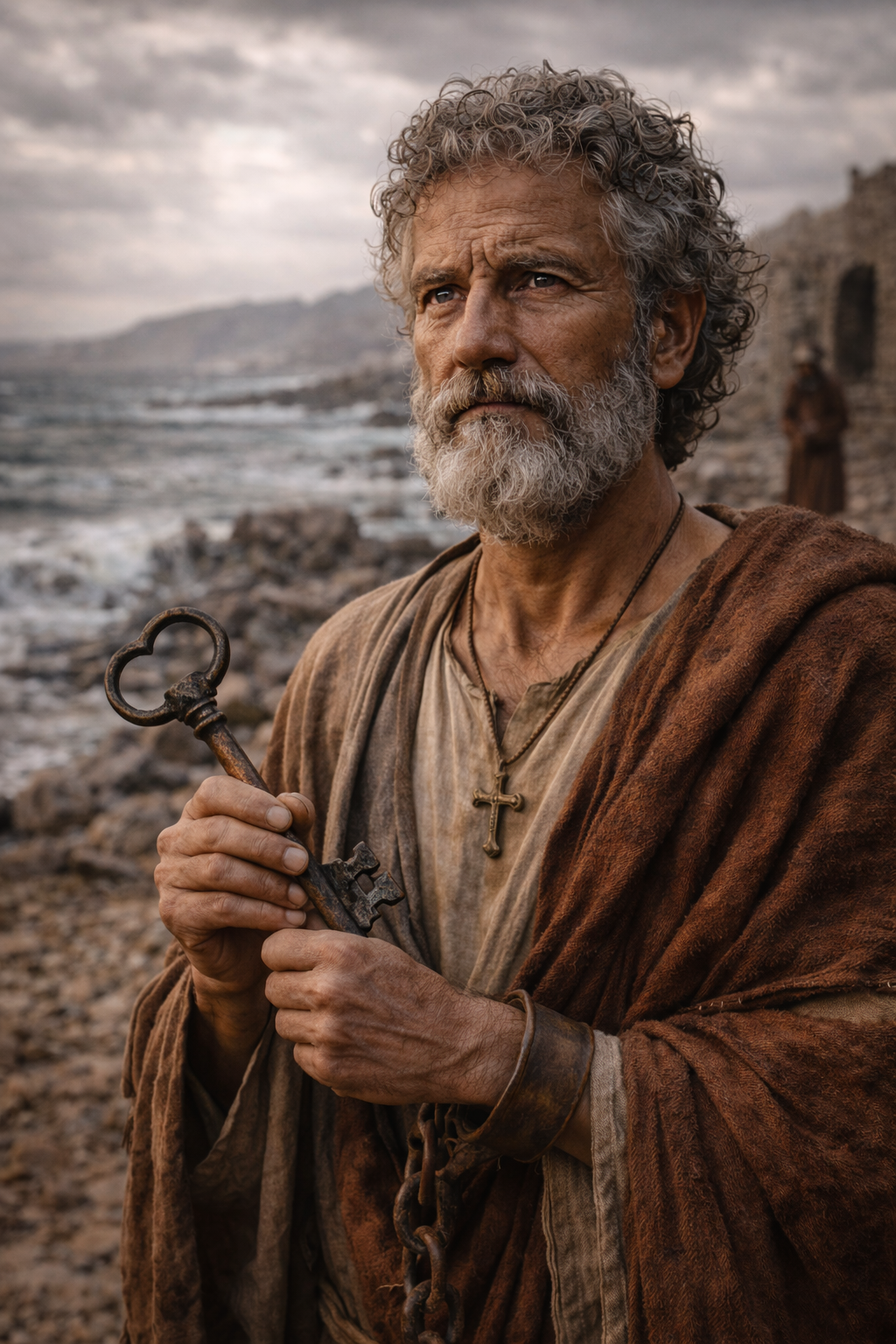
Peter repeatedly appears as spokesman for the Twelve. Near Caesarea Philippi he confesses Jesus as the Messiah, and Matthew's account joins that confession to the images of rock, keys, binding and loosing. Christian traditions interpret those images differently, so the narrative should not collapse them into one later theory of church government. The same episode immediately exposes Peter's incompleteness: he resists Jesus' prediction of suffering and receives a sharp correction. Prominence and misunderstanding stand beside each other in the sources rather than forming separate stages of a flawless career.
That pattern becomes stark during Jesus' arrest. All four Gospels remember Peter denying association with Jesus after promising loyalty. The accounts differ in details, but they agree that fear overcame his resolve and that the denial was remembered with grief. John's final chapter then places Peter beside the Sea of Tiberias and gives him a threefold charge to tend Jesus' flock. The text itself connects Peter's future with a death by which he would glorify God. Later Christian interpretation read the scene as rehabilitation and pastoral commission, while the Gospel's repeated questions preserve the pain of the earlier failure.
Acts portrays Peter as a leading voice in the Jerusalem community after Easter. He proposes replacing Judas, speaks publicly at Pentecost, joins John in healing and testimony at the temple, and answers authorities who order the apostles to stop teaching. Acts also refuses to make leadership solitary: Peter acts with the Twelve, with John, and alongside James and other elders. When Herod imprisons him, the community prays and Acts narrates his escape; afterward he tells the believers to report the event to James. The book's focus gradually shifts away from Peter, leaving much of his later itinerary unrecorded.
One of Peter's most consequential actions in Acts begins at Joppa and ends in Caesarea. A vision challenges his inherited boundaries around food and purity, and messengers invite him into the household of Cornelius, a Gentile centurion. Peter enters, speaks about Jesus, and orders baptism after the Holy Spirit falls on the listeners. Back in Jerusalem he must explain why he ate with uncircumcised people. Acts later has him appeal to this event during debate over Gentile believers. The story depicts discernment as a change Peter must receive, defend and translate into communal practice.
Paul's own letter to the Galatians provides an independent and less harmonized glimpse. Paul names Cephas, James and John as recognized pillars who extended fellowship to him and Barnabas, with different missionary emphases acknowledged. The same letter says Paul later confronted Cephas at Antioch because Peter withdrew from table fellowship with Gentiles under pressure. This disagreement matters historically: Peter could exercise wide influence and still be criticized by another apostle. A joint Lutheran–Catholic study accordingly describes Peter as prominent, but warns against projecting the fully developed papacy backward into the first century.
The New Testament says little about Peter after the Jerusalem debates. Later texts fill that silence unevenly. First Clement, written from the Roman church near the end of the first century, remembers Peter enduring many trials and dying after bearing witness; it does not specify the city or method. Irenaeus, writing in the later second century, associates Peter and Paul with preaching and founding memory at Rome, and also transmits the tradition that Mark wrote what Peter preached. These witnesses make a Roman end probable, but they do not provide a day-by-day account of Peter's final years.
By the early fourth century Eusebius reports that Peter was crucified under Nero. He also quotes the earlier Roman writer Gaius, who pointed to memorials of Peter and Paul at the Vatican and on the Ostian Way. This is strong evidence for an established Roman burial tradition, but it is later than Peter's lifetime. The Holy See gives alternative death years, 64 or 67; the exact year remains uncertain. The familiar story that Peter requested an upside-down cross belongs to later tradition and is not treated here as established history.
Roman veneration gathered around the site on Vatican Hill. The Constantinian basilica and its successors marked the place, and twentieth-century excavations investigated the necropolis beneath the present church. A 2019 papal letter carefully describes this as the uninterrupted testimony of the Roman Church and records the modern custody of relic fragments. It does not turn every archaeological identification into certainty independent of that tradition. Catholics, Eastern Orthodox Christians in the OCA, and Anglicans in the Church of England commemorate Peter with Paul on June 29. Across these traditions, Peter remains significant as a candidly remembered witness: called from work, entrusted with responsibility, corrected by companions, and associated with a martyr's death.
Wondering how to weigh the stories and sources? Learn how to read a saint biography.
Explore similar vocations
Prayers for Peter
Peter-alone collect excerpt
Almighty God, who inspired your apostle Saint Peter to confess Jesus as Christ and Son of the living God