Biography
Peter Canisius
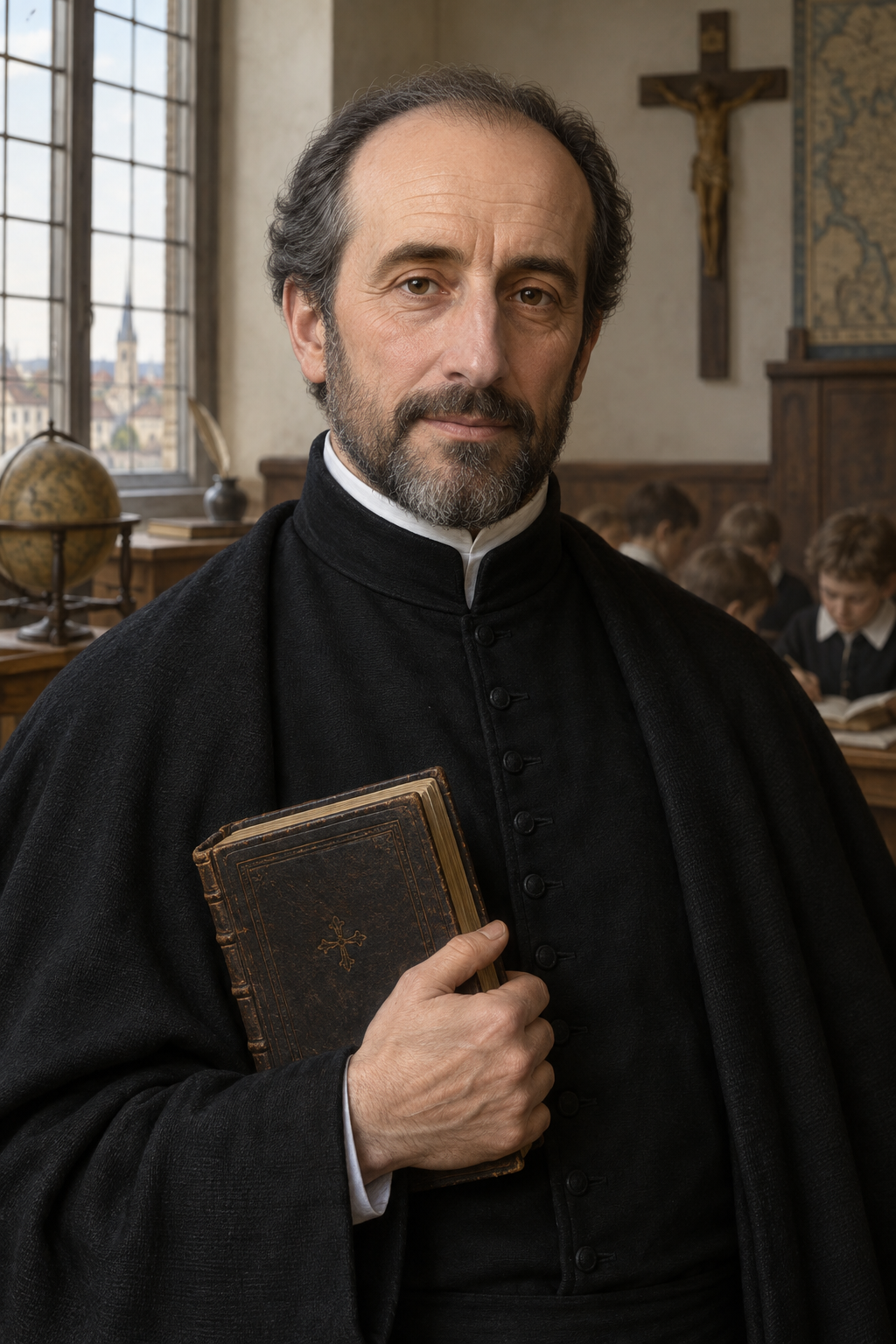
About Peter Canisius
Peter Canisius became a teacher in places where Catholics were struggling to explain and sustain their faith. Born at Nijmegen on 8 May 1521, he studied in Cologne before meeting Peter Faber, one of the first Jesuits. Under Faber's guidance he made the Spiritual Exercises and entered the Society of Jesus on his twenty-second birthday. His decision joined a life of prayer to an active ministry of teaching, preaching, and helping others learn the faith. After ordination in 1546, his assignments carried him from northern Europe to Italy and back again.
His religious formation had begun before that encounter. In Cologne he came into contact with Carthusian spirituality and the devotional tradition known as the devotio moderna, which encouraged a personal life of prayer. He also edited writings by earlier Christian teachers, including Cyril of Alexandria and Leo the Great. For Canisius, study of the Church Fathers became part of explaining Catholic belief during the Reformation. Sent to Rome for further Jesuit formation, he undertook humble household work before teaching at the order's college in Messina.
The mission to Germany brought responsibilities he found demanding. Ingolstadt was not simply a story of immediate success: his early letters complained about the limited progress of his teaching and preaching. Thomas Flowers's study of his catechesis follows those difficulties into the educational work for which he became best known. Canisius developed three catechisms for different readers: an advanced text in 1555, a very short one for children in 1556, and an intermediate version in 1558. Rather than give every audience the same amount of information, he adjusted the presentation to its capacity. Flowers argues that the arrangement also reflected the Spiritual Exercises, joining knowledge of belief to practical discernment about how to live.
His work was not confined to writing books. In Vienna he served people in hospitals and prisons as well as the university, and for a time administered the diocese. He helped establish the Jesuit college in Prague and became the first superior of the order's Upper German province in 1556. That position made him responsible for other Jesuits and their expanding ministries until 1569. University lectures, care of the sick, schools, and administration belonged to the same crowded working life.
Canisius also traveled on church business beyond the German-speaking lands. After the election of the Jesuit general Diego Lainez in 1558, he accompanied a papal nuncio to Poland. His letter of 10 February 1559 described difficult conditions and argued against giving up. Historian Mathias Moosbrugger connects that response with the persistence visible in Canisius's earlier notes and later advice to his superiors. The optimism was not a report that everything had gone well; it was a decision to keep working when his own assessment of the situation was bleak. In a memorandum of 1583, he again warned against surrendering to discouragement.
His convictions also had troubling limits. Canisius believed that people could cooperate with demons to injure their neighbors. In a sermon of March 1564, he attributed ruined crops, illness, and destructive weather to such activity. Historian Thomas Groll documents these claims while disputing a stronger interpretation that the sermons directly promoted witch persecution. Groll notes that the sermons he examined did not call for prosecution; other historians have argued that Canisius helped intensify the atmosphere of fear. The disagreement over consequences does not make the accusations reliable: they were expressions of his belief in harmful witchcraft.
His loyalty to Catholic reform did not prevent him from criticizing decisions within the Church. In letters and reports he identified failures in church life and judged Paul IV's index of prohibited books impracticable. He took part in the unsuccessful religious discussion at Worms in 1557 and later carried the decrees of Trent to German bishops. In 1580 he moved to Fribourg, where he continued pastoral work and writing until his death. A stroke in 1591 forced him to limit his activities, although he remained in Fribourg for the rest of his life. His publications included prayer books as well as catechisms, and extensive studies assembled material from earlier Christian authors. These were tools for teaching and devotion, not a withdrawal from the ministry that had shaped his travels.
Canisius died at Fribourg on 21 December 1597. His reputation continued to grow through the books and institutions associated with him. In 1897 Leo XIII emphasized his willingness to move between learned instruction and elementary teaching, remembering both his schoolbooks and his short works for ordinary readers. The pope presented him as a model for Catholic education and called him a second apostle of Germany. That honor reflects a particular Catholic memory of the Reformation, centered on the preservation of Catholic faith and schools.
Pius IX beatified Canisius in 1864, and Pius XI canonized him and declared him a Doctor of the Church on 21 May 1925. In a letter marking the fourth centenary of his death, John Paul II returned to his attention to children and to his ability to teach readers with different levels of education. The continuing appeal of Canisius lies especially in that practical vocation: making demanding religious teaching accessible to the people in front of him.
Wondering how to weigh the stories and sources? Learn how to read a saint biography.
Explore similar vocations
Prayers for Peter Canisius
Petition from the Canisius collect
God of patience and compassion, send us in our own day men of vision and wisdom like Saint Peter Canisius,