Biography
Peter Chanel
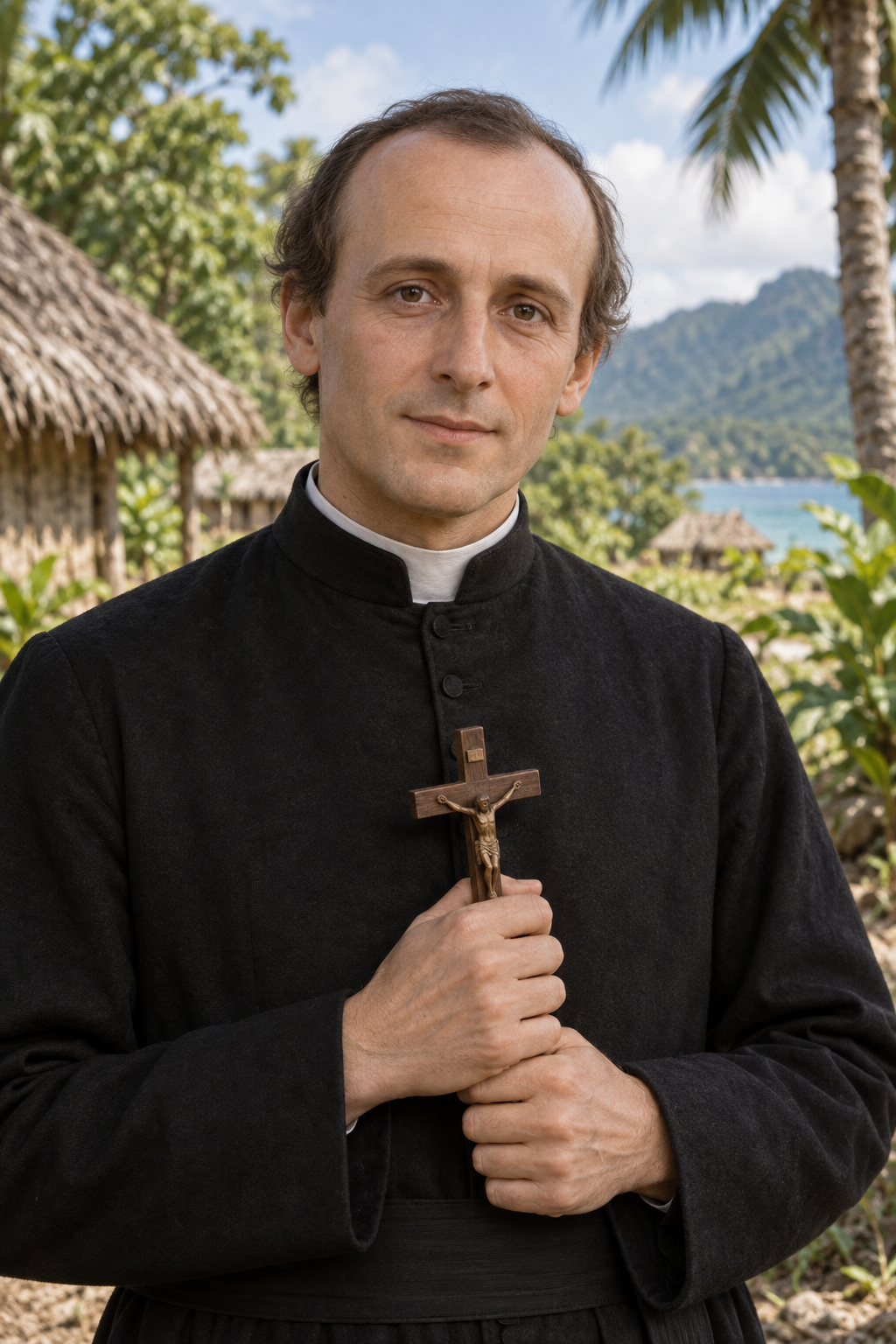
About Peter Chanel
Peter Chanel was a French priest whose years of parish work and teaching preceded a mission to the Pacific. Born at Cuet in the Ain in 1803, he entered the priesthood and later joined the Society of Mary. His final assignment took him to Futuna, where he lived with Brother Marie-Nizier Delorme. Learning the island's language proved difficult, and the missionaries depended initially on the welcome of its ruler, Niuliki. Chanel's presence would eventually become entangled with questions of authority and religious allegiance within the ruler's own household.
As a boy, Chanel helped look after cattle before receiving the education that opened a path toward the priesthood. The parish priest, Trompier, took responsibility for his schooling and introduced him to Latin. After ordination, Chanel served at Ambérieu and then at Crozet. Courtais's biography describes a pastor who visited people at home and in the fields, tended the sick, assisted poor households and promoted schooling. His work was not confined to services in the church.
At Crozet he also inherited an unresolved dispute over the parish church. The bishop wanted it rebuilt nearer the village, but the municipal authorities opposed the plan, and Chanel did not succeed in settling the matter. His practical kindness was more effective: a later witness remembered him carrying bread, meat and wine to an elderly Protestant woman. After moving to Belley, he taught boys and took on responsibilities as spiritual director, bursar and assistant to the college superior. The appointment made him responsible for much of the college's daily direction, since Colin was occupied with the growing society and no longer lived at the school.
The decision to join the Marists placed him in a religious society still seeking formal recognition. In 1833 he accompanied Jean-Claude Colin to Rome, where they were received by Gregory XVI. The society's approval in 1836 was linked with responsibility for a mission in Western Oceania. Chanel sailed on Christmas Eve that year with the party led by Bishop Jean-Baptiste Pompallier. The journey was costly in human terms: one of the priests, Claude Bret, died before the group reached its mission fields.
On reaching Futuna in November 1837, Pompallier met Niuliki and arranged for Chanel and Delorme to remain. A traveller who had worked aboard a whaling ship helped make the first approach. The bishop left gifts intended for the island's other ruler when a change in the wind forced his ship to depart before another visit could be made.
Chanel's diary shows how much missionary life depended on ordinary exchanges. He visited homes, attended gatherings where kava was shared, accepted food and gifts, and tried to find occasions for conversation about religion. He also cared for sick people. These encounters required him to learn local expectations as well as vocabulary. His observations were not always sympathetic to European visitors: he criticized conduct associated with whaling crews and traders. The diary presents an uneven daily effort, not a story of immediate or effortless conversion. He admired the island's carefully tended taro gardens and enjoyed excursions to nearby Alofi, where he gathered food with his companions. Hospitality did not eliminate disagreement: when he and Delorme put a latrine behind their house, they broke a taboo concerning the streams used for drinking water.
The Catholic Encyclopedia describes him as a patient worker who had to master a new language before he could teach effectively. His nursing of the sick was an important part of that work. Those who accepted baptism were initially few, and his position remained dependent on the people among whom he lived. Isolation from the other missionaries added to the difficulty. The growth of interest in Christianity did not remove the political risks created when religious allegiance challenged a ruler's authority.
The conflict sharpened when Niuliki's son Meitala sought to become Christian. The account maintained by the Causes of Saints connects that decision with the ruler's hostility toward Chanel. On April 28, 1841, attackers killed the priest. His companion survived because other islanders protected him and helped him reach the nearby mission on Wallis.
In a report written soon after Chanel's death, Father Chevron said that Delorme had been away visiting a sick person and had found protection among other islanders before reaching Wallis. That help matters alongside the story of the murder: the mission's survivors owed their safety to local people. The later effort to recover Chanel's remains also drew French naval power into the response.
Catholic recognition came long after his death: he was beatified in 1889 and canonized by Pius XII in 1954. The Marists remember him as a missionary and the patron of Oceania. His story joins the patient everyday work of a rural pastor and teacher to a small, vulnerable mission across an ocean, sustained for a time by hospitality and remembered through the religious community that sent him.
Wondering how to weigh the stories and sources? Learn how to read a saint biography.
Explore similar vocations
Prayers for Peter Chanel
Peter Chanel: petition
O Mary may the name of Jesus be known and adored everywhere.