Biography
Peter Chrysologus
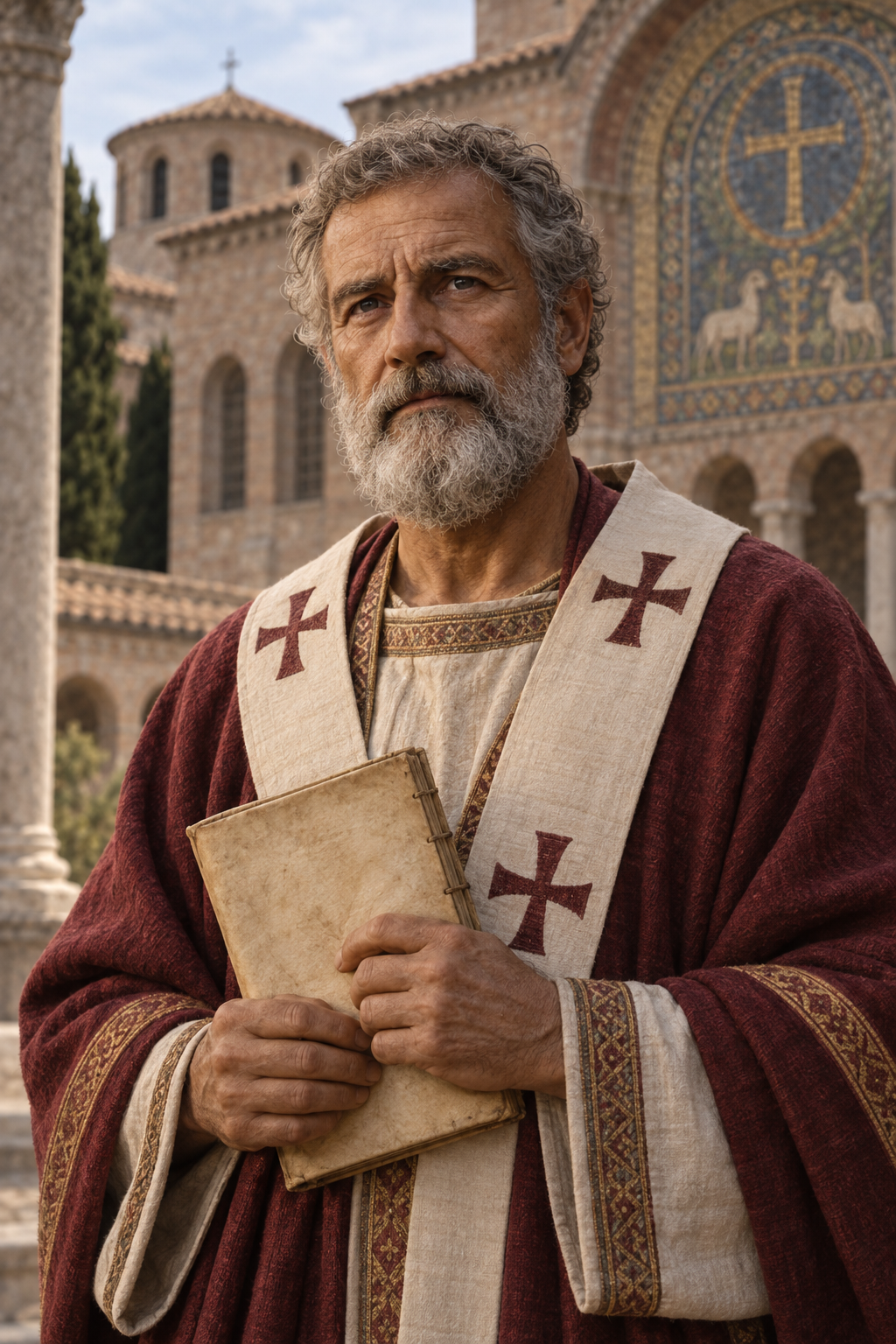
About Peter Chrysologus
Peter Chrysologus was probably born around 380 at Forum Cornelii, the Roman settlement now called Imola in northern Italy. The year is approximate, and another regional authority places his birth more broadly near the end of the fourth or beginning of the fifth century. Evidence for his youth is thin because the first surviving biography was written centuries after his death. Later church tradition says that Cornelius, bishop of Imola, baptized and educated Peter and ordained him a deacon. The profile retains that relationship as tradition rather than treating it as a contemporary record.
By the early 430s Peter had become bishop of Ravenna, although surviving accounts do not establish one secure date or a fully recoverable sequence for his elevation. Older references give 433, while the Emilia-Romagna cultural record gives 426; the discrepancy is why the event is stored as an approximate range. Ravenna had become the capital of the Western Roman Empire in 402, and its court, churches, and mosaic culture made the bishop's ministry unusually visible. Modern scholarship describes Peter preaching before the imperial family for nearly two decades and serving within the political world of Valentinian III and Galla Placidia. That setting explains his public prominence without requiring the stronger claim that he was simply a court official.
Peter's surviving sermons, rather than a detailed contemporary life, provide the clearest evidence for his work. A medieval collection associated with Bishop Felix of Ravenna counted 176 homilies, though older scholarship notes that the collection includes interpolations and omits other authentic material transmitted elsewhere. Modern English editions therefore speak of an authentic corpus rather than treating every transmitted item as equally secure. The sermons are generally concise by patristic standards, but their short form carries dense rhetoric, repeated phrases, and images drawn from Scripture and ordinary life. They open a window onto worship, controversy, moral teaching, and daily experience in fifth-century Ravenna.
His preaching returns repeatedly to the Incarnation: the claim that divine life meets mortal humanity in Christ. Other sermon groups address Gospel scenes, Paul's letters, saints' feast days, and the recurring seasons of the liturgical year. The Catholic University of America Press describes him chiefly as a pastor who made Scripture accessible, urged moral growth, and addressed his congregation in language shaped by their surroundings. One surviving sermon links prayer, fasting, and mercy so closely that none is complete without care for another person's need. This practical union of doctrine and action is more characteristic of his legacy than the image of a speculative theologian writing detached treatises.
The arrangement of the surviving corpus also shows how closely Peter's preaching followed a worshipping community's year. Homilies address Lent, Easter, Pentecost, the approach to Christmas, and the Christmas and Epiphany cycle, alongside readings from the Gospels and Paul's letters. He sometimes returned to the same biblical scene or even a single phrase, building instruction through repetition rather than through one long systematic exposition. For modern readers, that pattern preserves the sound of recurring pastoral teaching more than the chapter plan of a later theology manual.
Peter entered a major Christological dispute through a short letter. After Eutyches was condemned at Constantinople in 448, he appealed to Peter for support. Peter answered in 449 that he would not judge a dispute after hearing only Eutyches, because Bishop Flavian's account had not reached him. He urged Eutyches to heed Pope Leo's written judgment and placed peace and faith above an independent ruling of his own. The response is significant both for its allegiance to Roman authority and for its refusal to decide a case from one party's presentation. It shows a bishop using brevity not to avoid responsibility, but to mark the limits of what he could fairly determine.
Peter's association with the title Chrysologus, meaning 'golden-worded,' arose from the reputation of his preaching. A modern patristics study notes that he was known by this epithet from the early Middle Ages, so it should not be projected uncritically into every episode of his lifetime. He died about 450, probably at Forum Cornelii or Imola, but the exact chronology remains unsettled. The official Vatican City account gives a wider range from 449 to 458, while modern scholarly shorthand commonly uses about 450. The catalog therefore preserves an approximate year and keeps the probable death place separate from the uncertain date.
Peter's sermons continued to be collected, copied, edited, and read long after late-antique Ravenna ceased to be an imperial capital. In 1729 Pope Benedict XIII declared him a Doctor of the Church. The current calendar for the dioceses of the United States lists Saint Peter Chrysologus, Bishop and Doctor of the Church, as an optional memorial on July 30. His significance rests in the convergence of office and craft: a bishop at the center of the western imperial world who explained Scripture in compact sermons and answered a major dispute with both conviction and procedural restraint. That combination makes his surviving words useful evidence for Christian teaching and pastoral life in fifth-century Ravenna.
Wondering how to weigh the stories and sources? Learn how to read a saint biography.