Biography
Peter Claver
About Peter Claver
Peter Claver was born at Verdú in Catalonia around 1580, although official sources differ between 1580 and 1581. The municipal sanctuary in Verdú preserves the Catalan form Pere Claver and places his birth there in 1580. After early study in his home town, he continued his education in Barcelona and entered the Society of Jesus in 1602. During philosophy studies on Mallorca he formed a friendship with the older Jesuit brother Alphonsus Rodríguez, who encouraged his desire for overseas mission work. That relationship belongs to the documented history of his formation, not to a claim that one mentor predetermined every later choice.
Claver volunteered for the overseas missions and sailed to the New Kingdom of Granada in 1610. He continued theology in Bogotá before moving to Cartagena de Indias, the Caribbean port where he would spend the rest of his ministry. He was ordained a priest in Cartagena in 1616. There he entered a Jesuit mission shaped by Alonso de Sandoval's study of African peoples and catechesis among people carried through the slave trade. The setting was not an abstract mission field but one of Spanish America's principal ports for the forced arrival and sale of Africans. His priesthood therefore unfolded inside a commercial, legal, and religious order built around colonial rule and human trafficking, not at a safe distance from it.
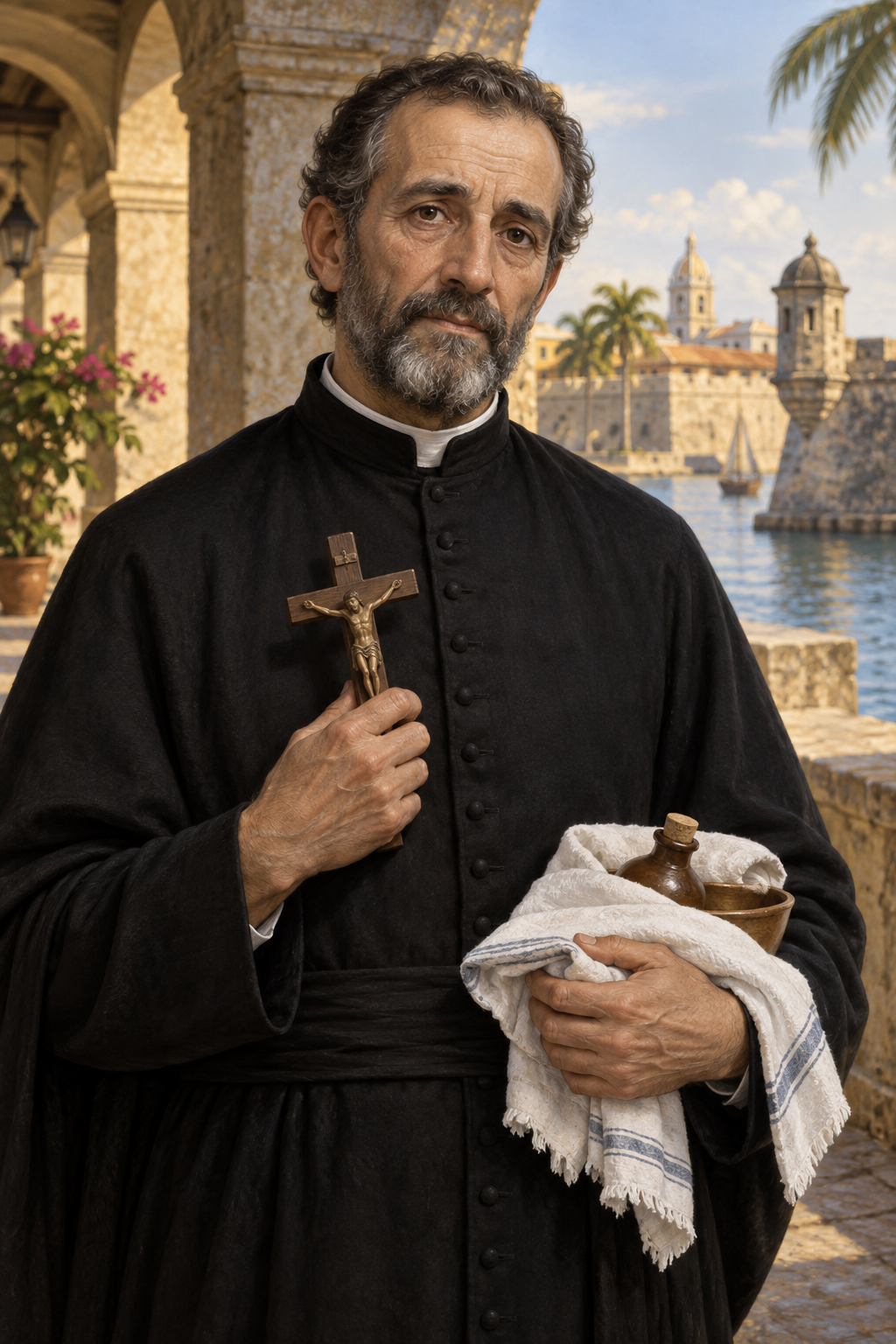
When slave ships reached Cartagena, Claver gathered food and care supplies and went to meet people who had survived the Atlantic crossing. The official Jesuit account describes him entering ship holds, cleaning wounds, applying ointment and bandages, and attending people who were sick. Black interpreters were indispensable because the arriving captives spoke many languages and remained in port only briefly. Testimony preserved in the canonization process records the interpreters' skills, assigned tasks, and solutions to recurring communication problems. Their labor must remain visible: some interpreters working with the Jesuits were themselves enslaved by the Cartagena college. The interpreters did more than replace words from one language with another; their knowledge mediated meanings across African languages, European catechism, and the violent uncertainty of arrival.
Claver's ministry joined bodily care to urgent religious instruction and baptism. Scholarly analysis describes a catechetical method built around multiple interpreters, oral teaching, repetition, memorization, and adaptation to the short time before people were sold onward. Those methods show both practical attention to language and the unequal conditions under which instruction took place. Later biographies repeat very large totals for baptisms, but this profile does not present those estimates as verified counts. The absence of a reviewed contemporary ledger makes a rounded traditional number unsuitable as a precise catalog fact. Because people could be dispersed soon after landing, speed shaped the mission's choices; historical explanation of that urgency does not remove questions about consent under captivity.
Claver also visited hospitals, including care for people with leprosy, and attended prisoners and other marginalized residents of Cartagena. His work extended beyond moments of disembarkation, even though ministry to newly arrived Africans remained its defining focus. In 1622 he signed his final Jesuit profession with the Latin self-description 'Petrus Claver, aethiopum semper servus.' The phrase expressed a lifelong religious commitment to Africans subjected to trafficking and enslavement. Its devotional force should not erase the legal captivity of the people to whom he ministered.
Claver's compassion and persistence are extensively remembered, but responsible history must also locate him inside Cartagena's colonial slave society. The Jesuit college owned enslaved people, and enslaved interpreters supported the mission's work. The reviewed evidence shows strenuous care and appeals for humane treatment; it does not show Claver organizing to abolish the institution of slavery. A modern critical interpretation goes further, arguing that Jesuit catechesis also participated in the destruction of African cultural life under colonization. The profile records that critique as an interpretation rather than converting it into an uncontested judgment about every encounter.
A serious illness followed his care for people during an epidemic in Cartagena around 1650 and left him largely unable to continue his former work. He lived for several more years in the Jesuit residence while illness restricted his movement and communication. The contrast between his earlier public activity and these final years is part of the received biography, although retrospective accounts supply more detail than a modern clinical record can verify. Spanish archival and Vatican sources place his death at Cartagena de Indias on 8 September 1654. The catalog keeps the death place in both its historical New Granada form and its modern Colombian form.
Pope Leo XIII canonized Peter Claver in 1888 and invoked his example in an encyclical opposing the persistence of slavery. That later use belongs to the history of his reception and should not be projected backward as proof that his seventeenth-century ministry was abolitionist. The current United States Catholic calendar observes Saint Peter Claver, Priest, as a memorial on September 9. John Paul II later presented his memory as a summons to attend people displaced from their homes and exploited through poverty. Read with historical honesty, his life joins demanding personal care to an unresolved question about how religious service relates to coercive systems.
Wondering how to weigh the stories and sources? Learn how to read a saint biography.