Biography
Philip
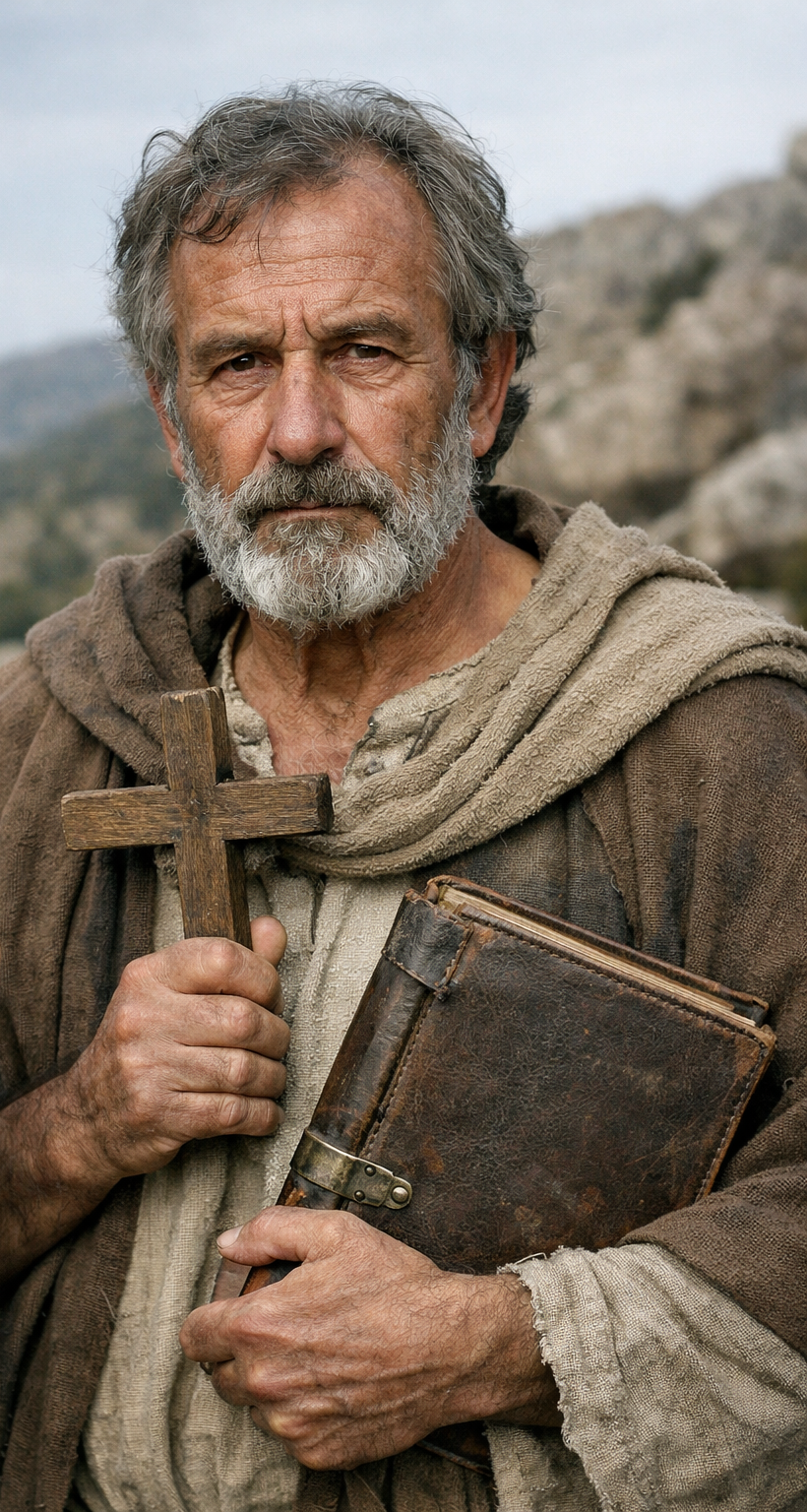
About Philip
The surviving sources do not provide Philip's birth year, age, parents, or early education. John's Gospel names Bethsaida as his town and places his call at the beginning of Jesus' public activity. Bethsaida is also associated there with Andrew and Peter, but the text does not make Philip their relative or coworker. Philip's Greek name was used among Jews of the period and does not by itself establish his language, ancestry, or social position. The record therefore begins with a place, a name, and a call rather than a reconstructed childhood.
John says that Jesus found Philip and addressed him with the short command, ‘Follow me.’ Philip then found Nathanael and identified Jesus as the one written about by Moses and the prophets. When Nathanael questioned whether anything good could come from Nazareth, Philip replied, ‘Come and see.’ The scene presents invitation rather than a successful argument: Philip directs another person toward an encounter he cannot control. John does not call Nathanael Bartholomew, so the widespread identification of those names remains a probable or traditional harmonization rather than a documented relationship.
Philip appears in each New Testament list of the Twelve, normally in the fifth position. Those lists establish his place in the apostolic group but do not narrate a separate preaching assignment for him. Acts later names Philip among the apostles gathered in Jerusalem after the ascension. The group, including women, Mary the mother of Jesus, and Jesus' brothers, is described as persevering together in prayer. This is the last canonical notice that securely names Philip the apostle after Jesus' earthly ministry.
Before the feeding of a large crowd, John says that Jesus asked Philip where bread could be bought. The narrator explains that the question tested Philip and that Jesus already knew what he would do. Philip answered by estimating that two hundred days' wages would not buy enough for each person to receive a little. His calculation is the action the source records; it does not justify diagnosing his personality or condemning him for insufficient faith. The episode shows a disciple stating the scale of a practical problem before Andrew identifies the available loaves and fish.
John next places Philip in Jerusalem when Greek worshipers at the festival ask to see Jesus. The visitors approach Philip, Philip tells Andrew, and the two apostles tell Jesus together. The narrative does not say why they selected Philip, whether he interpreted for them, or whether the meeting then occurred. Benedict XVI describes Philip as an intermediary but marks the suggestion that he spoke Greek as a probability. For historical purposes, the secure event is the cooperative delivery of the visitors' request, not a later mission route into Greek lands.
At the farewell discourse, Philip asks Jesus to show the disciples the Father and says that this would be enough for them. Jesus answers that anyone who has seen him has seen the Father and directs Philip to his words and works. The exchange gives Philip an attributable question and preserves a moment of instruction rather than a complete portrait of his interior life. It should not be expanded into claims that he was habitually skeptical, literal-minded, or slower than the other disciples. His question matters because the Gospel uses it to introduce teaching about the relationship between Jesus and the Father.
The New Testament also names a different Philip, one of seven chosen in Acts to serve the Jerusalem community. That Philip preaches in Samaria, meets an Ethiopian court official, and later appears at Caesarea with four daughters who prophesy. Acts calls him the evangelist and one of the Seven, while Philip the apostle belongs to the Twelve. Later writers sometimes combined details belonging to these two men, especially traditions involving daughters and Hierapolis. A responsible biography therefore does not assign the evangelist's journeys, household, or daughters to the apostle as established fact.
Near the end of the second century, Polycrates of Ephesus wrote that Philip, one of the Twelve, rested at Hierapolis with two aged daughters, while another daughter rested at Ephesus. Eusebius preserved this statement more than a century later and also transmitted related traditions involving Papias. Polycrates provides early evidence for an Asian Christian memory of Philip, but the overlap with traditions about Philip the evangelist leaves the identification disputed. Hierapolis may therefore be recorded as a traditional association, not as a confirmed death site or a plotted apostolic destination. Neither Polycrates nor the canonical texts supplies a defensible year or manner of Philip's death.
Later hagiographies greatly enlarge Philip's travels and martyrdom. The Orthodox Church in America transmits preaching across several regions, conflict with pagan worship at Hierapolis, wonders, and death by crucifixion. The apocryphal Acts of Philip likewise contains elaborate journeys and supernatural episodes, and the Catholic Encyclopedia describes that work as legendary. These accounts explain the received titles Missionary and Martyr, but they cannot establish an itinerary, coordinates, an execution method, or a death date. This packet preserves Hierapolis and martyrdom only with traditional confidence and excludes the dramatic episodes from featured map events.
Different churches remember Philip on different dates and often together with another apostle. The Roman Catholic calendar in the United States celebrates Saints Philip and James as apostles on May 3. The Church of England keeps Philip and James on May 1, while the Orthodox Church in America commemorates Philip on November 14. These observances document present liturgical practice rather than the historical date of Philip's death. Across the limited canonical record, Philip remains significant for concrete acts of response, invitation, practical questioning, cooperation, and an honest request to understand Jesus more clearly.
Wondering how to weigh the stories and sources? Learn how to read a saint biography.
Explore similar vocations
Prayers for Philip
Philip and James collect excerpt
grant us grace to know your Son Jesus Christ