Biography
Pierre Aumaître
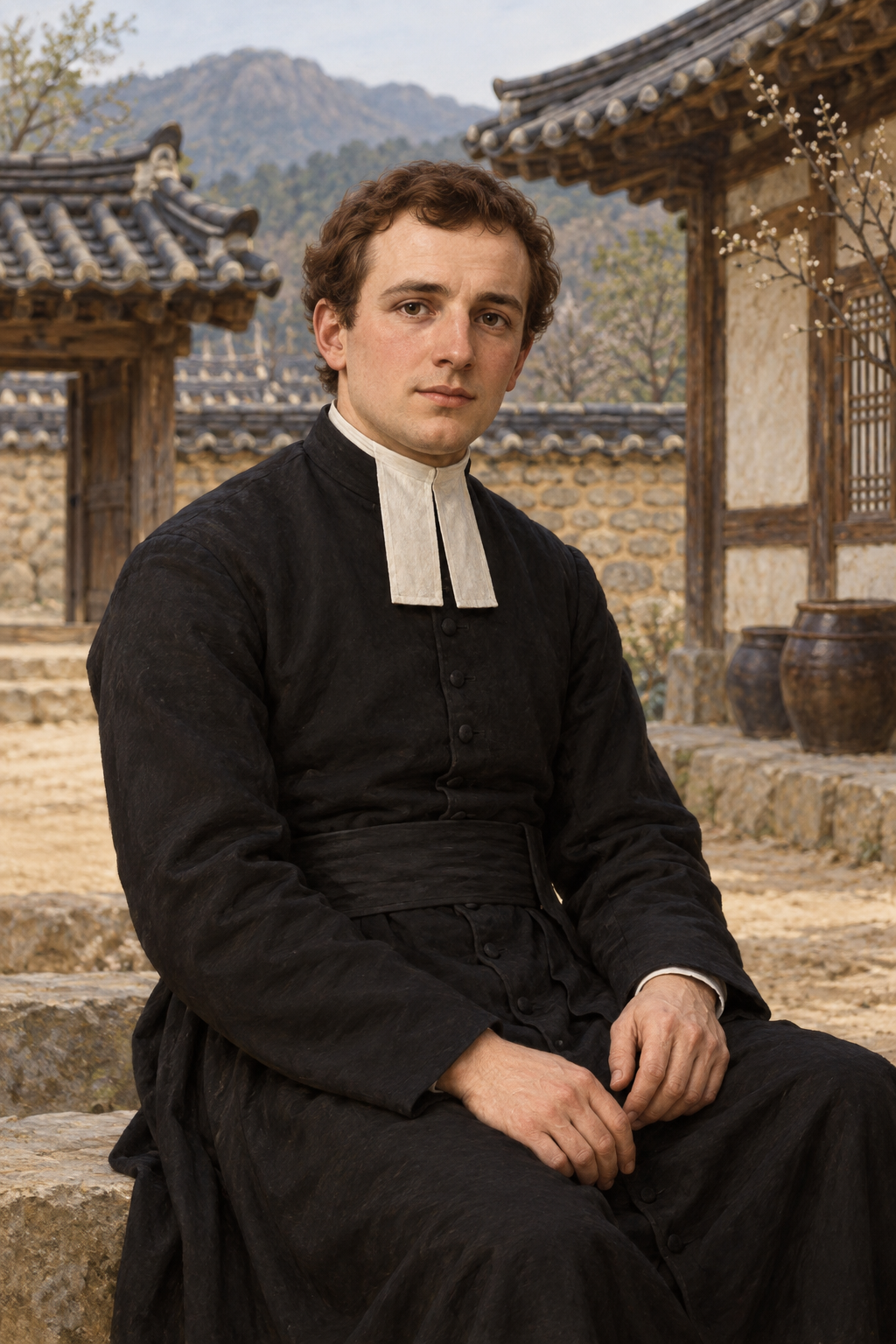
About Pierre Aumaître
Pierre Aumaître was born in Aizecq, France, and studied at Richemont and Angoulême before entering the Paris Foreign Missions Society. He was ordained in June 1862 and left France for the Korean mission that August. His correspondence preserves both his preparations for priesthood and the practical demands of the ministry he later undertook.
Before his ordination, he told his sisters that he wanted to celebrate his first Mass among poor people. He connected that choice with his own poor background and with Jesus’ preaching to the poor. His first intention would be for the people who would eventually be entrusted to him. He planned to remember his family at the next Mass and his benefactors at the third. The letter shows him preparing for a responsibility whose future setting he did not yet know.
After his first Mass, Aumaître sent his mother an image with an inscription describing his ordination the previous day. He explained that he could now offer Mass for her and for the rest of the family. He also asked her to pray for the people who would become his spiritual family. The message brought his new priestly responsibilities into an existing relationship of affection and prayer.
Writing to his father in July, he described the happiness he found in celebrating Mass each morning. He also acknowledged his weakness and his need for God’s help. He did not treat the enthusiasm of a newly ordained priest as a guarantee of lasting faithfulness. He asked his father to accept his departure willingly, rather than merely endure the loss of daily contact with his son. For Aumaître, his father’s consent belonged to the same religious commitment that was taking him away from home.
Aumaître later described how Korean Catholics helped him enter the country in June 1863. He waited at a rendezvous in a Chinese boat until a Korean vessel arrived late at night. Two Korean students returning from Penang accompanied him. He changed into Korean clothing, and additional hair was used to make a topknot because his own hair was still too short. The arrangements depended on people familiar with the journey and the clothing needed to conceal a foreign missionary.
He stayed below deck during the passage, following Bishop Berneux’s instructions. Near the river leading toward the capital, he transferred to a smaller boat and reached a Catholic household by morning. Berneux then sent a carrying chair to bring him through the city. Aumaître explained that this avoided the risk of losing his guide while walking in unfamiliar streets. The meeting with the bishop took place in a secluded room, where they spoke quietly.
After a month in Seoul, he moved to the Catholic village of Sonkol to learn Korean. In a letter to Adolphe Pichon, he described a small room built of wood and earth. It served for study, sleep, meals, prayer and Mass. An adjoining room housed the man who assisted him and taught him Korean. Opening the paper-covered door between the rooms made space for village Catholics to attend Mass. Aumaître spent almost all his time indoors to avoid being recognized. He filled his days with language exercises, theological study, religious reading and prayer.
Writing to a priest who had helped him during his education, he admitted that he could still speak very little Korean. He was not yet able to take up the wider ministry he hoped to undertake. Each morning he celebrated Mass at an altar made from two boards. Village Catholics came on Sundays, and some attended during the week. He regarded this daily service as valuable even while language study delayed other work.
By November 1865, Aumaître was visiting Catholic villages on foot. He reported that illness had interrupted the previous round of visits and that he was now proceeding more slowly. A wooden basket covered with paper held the equipment needed for Mass and the sacraments, together with spare clothing. A wool blanket served as bedding. He traveled with an assistant, wearing mourning clothes, and stayed in each village according to the number of Catholics there. Mass ended before sunrise to reduce the risk of unwanted visitors. Without a watch or alarm clock, he sometimes found daylight arriving sooner than expected.
In another November letter, he explained why correspondence with France was slow. A Catholic traveling with the Korean tribute mission carried the missionaries’ letters toward China. That opportunity came only once a year. During the hot and rainy season, Catholics rented or built rooms where he could stay within his district. He used that period for study and prayer, visits to sick people nearby and meetings with fellow missionaries. When travel resumed, his books remained behind and he carried only the essentials for ministry.
When persecution began in 1866, Aumaître gave himself up in the hope of protecting Catholics from mistreatment. He was taken to Seoul, imprisoned and condemned to death. On March 30, he was beheaded with Bishop Daveluy and Martin-Luc Huin at Suyong.
Wondering how to weigh the stories and sources? Learn how to read a saint biography.