Biography
Pietro Berno
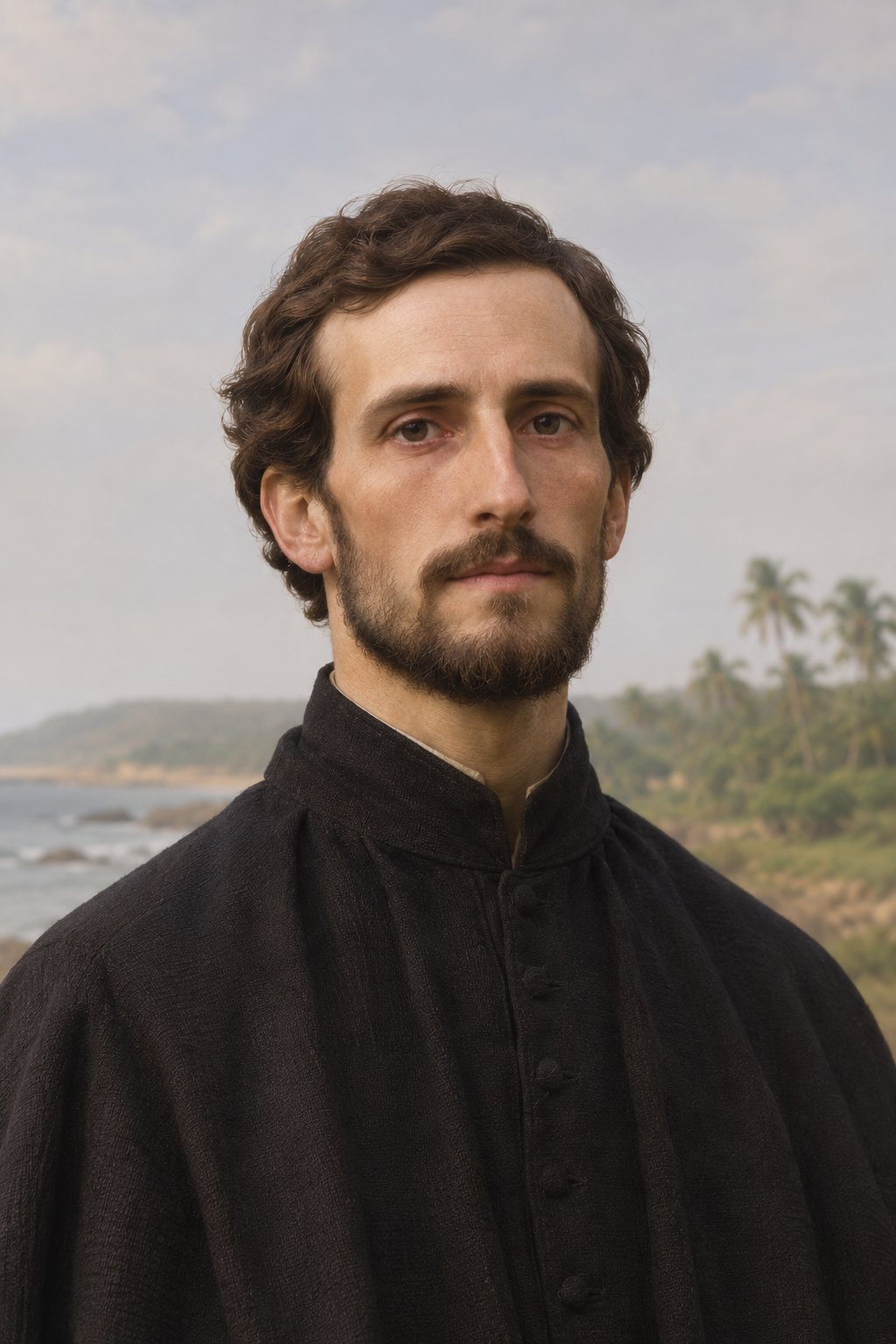
About Pietro Berno
Pietro Berno was born in Ascona, on the Swiss shore of Lake Maggiore, and grew up in a family that later took him to Rome. The Swiss Historical Dictionary places his studies at the German College and his entrance into the Jesuit novitiate at Sant’Andrea in 1577. The Society of Jesus account gives a different birthplace description but agrees on his Swiss origins and Jesuit formation. The sources also disagree about whether he had already been ordained before entering the novitiate; the precise sequence is therefore uncertain.
Berno was assigned to India soon after entering the Society. He accompanied Rodolfo Acquaviva to Lisbon but stayed there to complete his novitiate, then reached Goa in 1579. Jesuit accounts state that he completed his studies and was ordained there. He learned Konkani and served at Margao on Salsette, where the Jesuits describe him as effective in forming relationships with local people. His work took place in a Portuguese colonial setting in which missionary activity and military power were closely intertwined.
The account of Berno’s final year requires more than a devotional portrait. The Jesuits’ own institutional biography acknowledges that he accompanied the 1582 Portuguese expedition against the people of Cuncolim and helped destroy Hindu shrines and temples. It also records local memories that he desecrated sacred sites. These reports complicate the later account of him as a missionary arriving peacefully at the village in 1583 and should remain part of his history.
In July 1583, Berno returned to Cuncolim with Acquaviva and companions, intending to establish a chapel and cross. They were attacked and killed. The Society of Jesus says Berno was the third of the five missionaries to die; Vatican and Jesuit martyrologies preserve 25 July as their date. Later local memory and Catholic retellings differ in details, but the shared core is the group’s death at Cuncolim during the Salsette mission.
Berno’s cult was formally recognized through beatification in 1893, recorded by the Swiss Historical Dictionary. The later transfer of a relic to Ascona connected the missionary’s memory with his birthplace. His story is now told within a broader history of the Salsette martyrs, but should include both his work in Goa and the earlier expedition against local sacred places. That fuller record allows readers to understand why the mission’s arrival at Cuncolim did not occur in a vacuum.
The Jesuit account says Berno accompanied the 1582 Portuguese expedition against Cuncolim and helped destroy Hindu shrines and temples. It also records local memories of further desecrations. This history places the missionaries’ return to the village in 1583 within an existing conflict, alongside Berno’s earlier work at Margao.
Wondering how to weigh the stories and sources? Learn how to read a saint biography.