Biography
Pope Celestine V
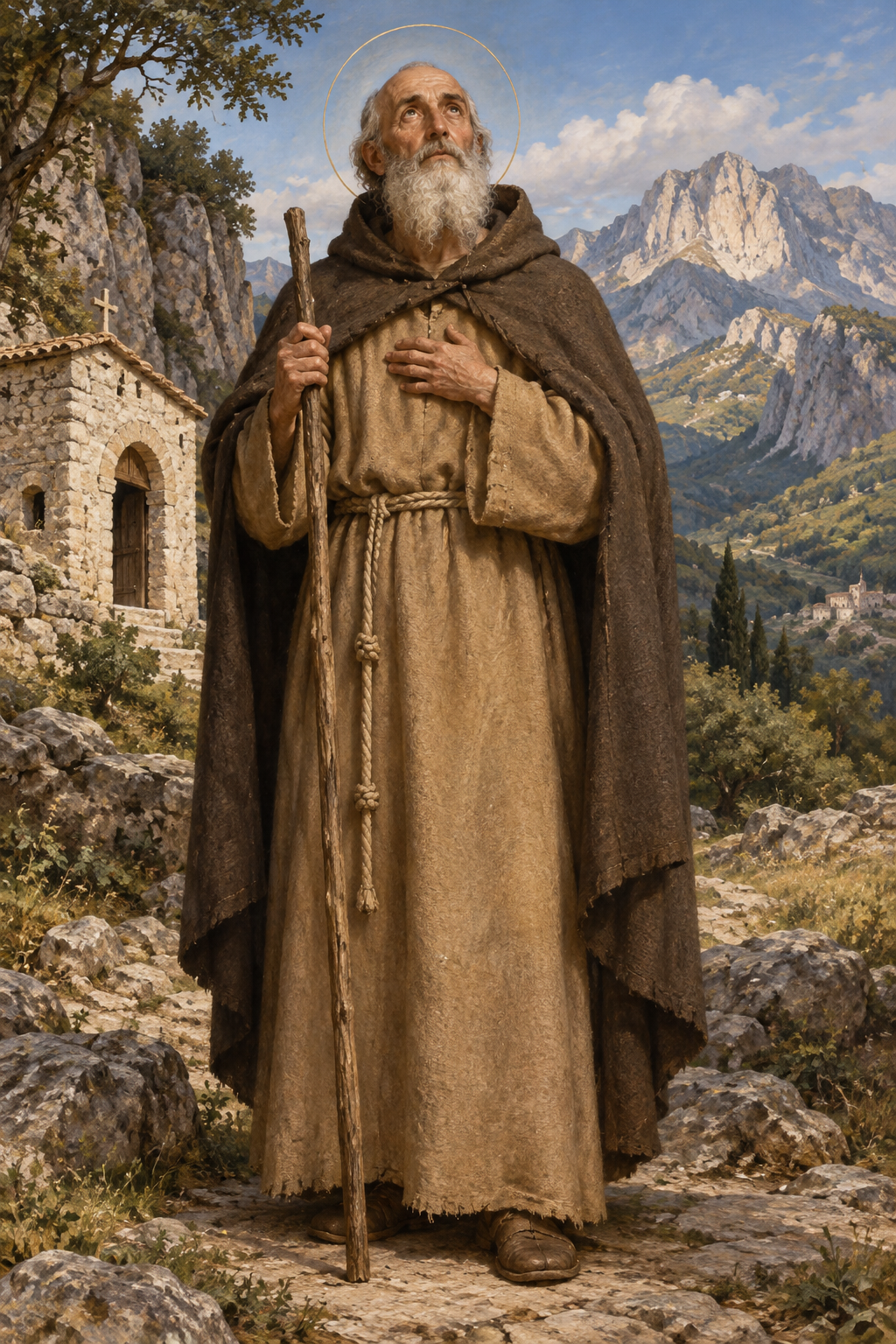
About Pope Celestine V
The Vatican papal chronology gives his secular name as Pietro del Morrone, places his origin in Molise, and records his pontificate from July to December 1294.
Benedict XVI’s homily in Sulmona identifies Monte Morrone and the Hermitage of Sant’Onofrio as places closely linked with his hermit life.
Around 1231 Pietro chose the eremitical life. On a journey toward Rome, he stopped first at Castel di Sangro and then lived for years on Mount Porrara, where he sought permission to become a hermit and possibly to be ordained. He reached Rome around 1233 or 1234 and was ordained there, though the evidence does not identify the ordaining pope with certainty. After a period in a Benedictine monastery, he withdrew to Mount Morrone around 1235–40.
Pilgrims increasingly sought him out, and between about 1240 and 1245 he moved farther into the Maiella range. There, with other hermits, he established the community of Santo Spirito a Maiella. Pietro did not intend to create a separate religious order; in 1263 Urban IV directed that the congregation be incorporated into the Benedictine Order. Its houses and churches nevertheless grew, and the community developed a more formal system of chapters and leadership.
The papal election followed a long vacancy after the death of Nicholas IV in 1292.
In 1294 the cardinals elected Pietro, who took the name Celestine V.
The Vatican chronology gives the date of his election and coronation, and Benedict XVI recalls that news of the election reached him at the Hermitage of Sant’Onofrio.
Celestine’s pontificate lasted only a few months.
He was crowned at the Basilica of Collemaggio in L’Aquila, a site Benedict XVI connects to his local history and burial.
The Vatican record dates the beginning of the pontificate to 5 July and the coronation to 29 August 1294, with the end of the pontificate on 13 December.
He also issued the bull associated with the Perdonanza, granting a plenary indulgence under specified conditions at Collemaggio.
The Holy See’s historical note identifies this as an enduring annual observance in L’Aquila.
On 13 December 1294, Celestine resigned the papal office.
At the 2022 Perdonanza celebration, Pope Francis challenged the shorthand of Dante’s “great refusal,” saying Celestine was remembered too narrowly as a man who said no. Francis instead presented the resignation as a yes to a religious vocation. This is a modern pastoral interpretation, not proof of Celestine’s private motive; it is useful chiefly as evidence that the meaning of the resignation remains contested in public memory.
The older reference biography reproduces the decree of Boniface VIII confirming that a Roman pontiff could freely resign, while the Vatican chronology records the exact end date of Celestine’s pontificate.
After resigning, Celestine hoped to return to a secluded life, but the new pope, Boniface VIII, kept him under close control.
The Catholic Encyclopedia relates that he was moved between places of confinement and died at Fumone in 1296.
Celestine was canonized by Pope Clement V in 1313.
His remains are preserved at the Basilica of Santa Maria di Collemaggio in L’Aquila, where later popes have prayed at his tomb.
The May 19 feast commemorates the date of his death.
His leadership alternated with renewed retreats. He organized houses, secured privileges and donations, and served as prior. Even after the community moved toward Sulmona, he chose Sant’Onofrio’s small hermitage above its larger monastery. The choice captures the tension between organizing a congregation and seeking solitude.
The surviving narrative tradition also requires care. In 1408, during the Great Western Schism, Parisian Celestine monks asked Pierre d’Ailly to write a life of their founder. An incomplete text presented to d’Ailly as Pietro’s autobiography described his youth and asceticism but not his papacy; d’Ailly added an account of the election, resignation and imprisonment. Historian Christopher Bellitto notes that the text’s authenticity is uncertain and that d’Ailly’s account was shaped by an argument that a pope could resign without harming the Church. It is evidence for Celestine’s later reception as well as a source about his life.
The Perdonanza remains central to L’Aquila’s memory of Celestine. At its 2009 opening, the Holy See’s Secretary of State described the annual rite as part of the city’s religious and civic history; that year also marked the eight-hundredth anniversary of Celestine’s birth according to the celebration’s stated chronology. The event was held after the devastating earthquake earlier that year, and the homily connected its rituals with reconciliation and the community’s recovery. These modern observances show how the medieval indulgence continues to shape local identity.
Wondering how to weigh the stories and sources? Learn how to read a saint biography.