Biography
Rodolfo Acquaviva
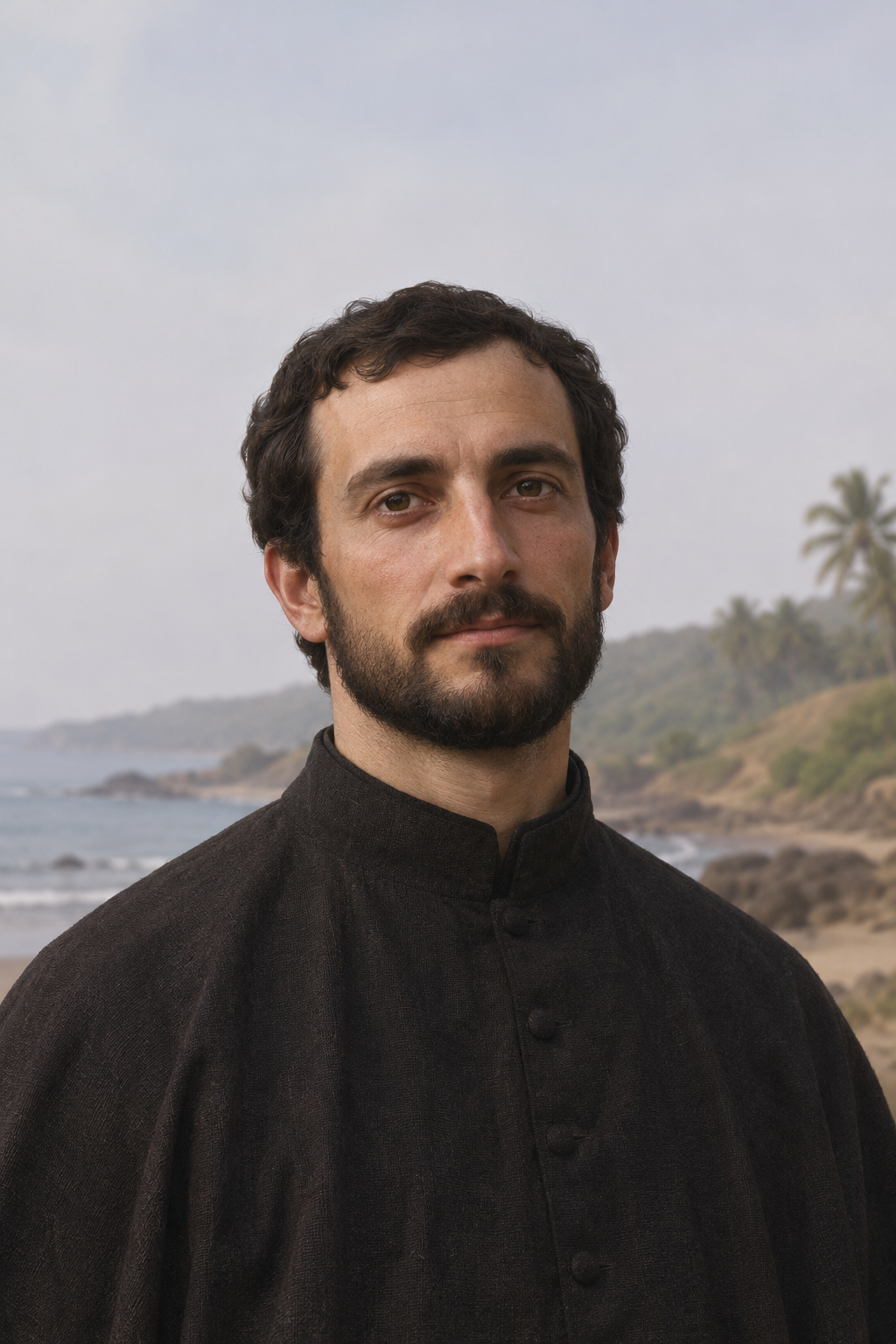
About Rodolfo Acquaviva
Rodolfo Acquaviva was born at Atri in 1550 into the family of the Duke of Atri. His uncle Claudio held a position in the papal household, and family members expected Rodolfo to take up that path. The Society of Jesus biography says he instead asked to enter the Jesuits and needed months to obtain his father’s permission. He entered the Society on 2 April 1568, aged seventeen. This choice redirected him from a noble career toward religious formation and overseas mission.
After the novitiate, Acquaviva studied humanities, philosophy, and theology. The Society assigned him to the Indian mission; he travelled from Rome to Lisbon and was ordained in early 1578. He reached Goa later that year and taught philosophy to seminarians at St Paul’s College. This initial post linked his academic training to the Jesuit institution that was then a center for missionary formation in Portuguese India.
Treccani dates the arrival of Acquaviva and two companions at Fatehpur Sikri to February 1580, after Akbar requested Christian missionaries. The emperor received them at court and provided accommodation in the palace. Their chapel displayed an image of the Virgin, a sign of the court’s hospitality to the delegation.
In 1579, Emperor Akbar invited Jesuit scholars from Goa to his court at Fatehpur Sikri. Acquaviva travelled with Antonio Monserrate and another Jesuit, carrying a Bible and Christian books. Akbar’s court hosted recurring religious discussions, and the Jesuits were asked to explain Christianity. Their letters and reports reveal the encounter from the missionaries’ own perspective, including their hope that the emperor might convert and their admiration for his questions.
Acquaviva remained at court after one companion returned to Goa. Jesuit reports say Akbar showed sustained interest in Christian teaching and gave the mission protection. Acquaviva nevertheless concluded after several years that the emperor would not become Christian. He received permission to leave and returned to Goa in 1583. The sources describe disappointment, but the encounter also exposed him to the religious and political complexity of the Mughal court, which cannot be summarized as a simple failed conversion attempt.
Akbar’s invitation did not mean that he shared the Jesuits’ aim of conversion. Treccani describes his interest in a synthesis of religious traditions and says he considered a diplomatic mission to Philip II in 1582; Portuguese political concerns prevented it. Acquaviva was recalled in May 1583 and returned to Goa before receiving the Salsette assignment.
In July 1583 Acquaviva became superior of the Jesuit mission on Salsette, south of Goa. Missionaries planned to visit the peninsula’s villages, including Cuncolim. The context was already tense: Portuguese forces had conducted punitive campaigns against the region, including destruction of shrines and temples. Recent historical analysis emphasizes this political and religious background, complicating later narratives that describe the deaths only as an abstract conflict between faiths.
On 25 July 1583, Acquaviva and four companions entered Cuncolim to establish a chapel and cross. A local leader warned them not to proceed; after waiting and hearing a growing crowd, the group chose to plant the cross at the proposed chapel site and leave. They were surrounded and killed. The account in Jesuit institutional history says Acquaviva was attacked first, followed by Peter Berno, Alphonsus Pacheco, Anthony Francis, and Francis Aranha.
Acquaviva’s companions had taken part in the 1582 punitive expedition against Cuncolim. The Jesuit account says they helped destroy shrines and temples; this history shaped the reception of their 1583 return. The missionaries intended to establish a chapel, but their presence followed an earlier use of Portuguese force in the same region.
The sources differ on the date of the killings: Treccani gives 15 July, while Jesuit and Vatican commemorations give 25 July. Alessandro Valignano’s relation, written in 1584, is among the early accounts. Jesuit sources trace the bodies’ transfer from Cuncolim to Goa and later church repositories; Cuncolim’s petition for the cause formed part of the process that ended with Leo XIII’s beatification decree in 1893.
Acquaviva was beatified in 1893. Jesuit and Vatican commemorations remember him as a missionary and martyr, while the historical record also places his work in the colonial expansion of Portuguese India. His years at Akbar’s court and his leadership at Salsette belong to the same life, though the settings and purposes of those missions differed.
Acquaviva’s surviving letters from Fatehpur Sikri make the court mission more complex than the later account of a failed conversion. He wrote of the debates with Muslim scholars, where the Trinity, the Incarnation, and Christ’s identity were repeatedly disputed. His correspondence says that Akbar protected the Jesuits even when their statements about Islam were direct, and that the emperor’s freedom to explore religious ideas could attract missionaries while also making a conversion commitment less likely. In a letter of September 1582, Acquaviva reported that he had learned the local language and described conversations with a Sufi from Bengal and new religious practices at court. He also proposed seminaries in Goa where Muslims could study in Persian and Hindus in Hindustani. The proposals show how he imagined the court experience informing missionary education back in Portuguese India.
The evidence for Cuncolim needs similar distinctions. Alessandro Valignano, the Jesuit provincial in India, sent a report from Goa dated 28 December 1583, five months after the deaths; this is an early institutional report, not an eyewitness account of the attack. Historian Pilar Cañeque notes that the report became the principal source for Francesco Benci’s 1591 epic, which shaped later Jesuit memory of the five deaths. She also cautions that Acquaviva’s later prominence as group leader was exaggerated: this was his first visit to Salcete, he did not know the local language, and he was poorly informed about local conditions. The colonial setting was concrete. The village resented Jesuit evangelization after the destruction of a Hindu temple, part of the earlier punitive campaign. Thus the later martyr narrative preserves the Jesuits’ understanding of their deaths, while the 1583 encounter also belonged to Portuguese colonial expansion and local resistance.
Wondering how to weigh the stories and sources? Learn how to read a saint biography.