Biography
Roque González de Santa Cruz
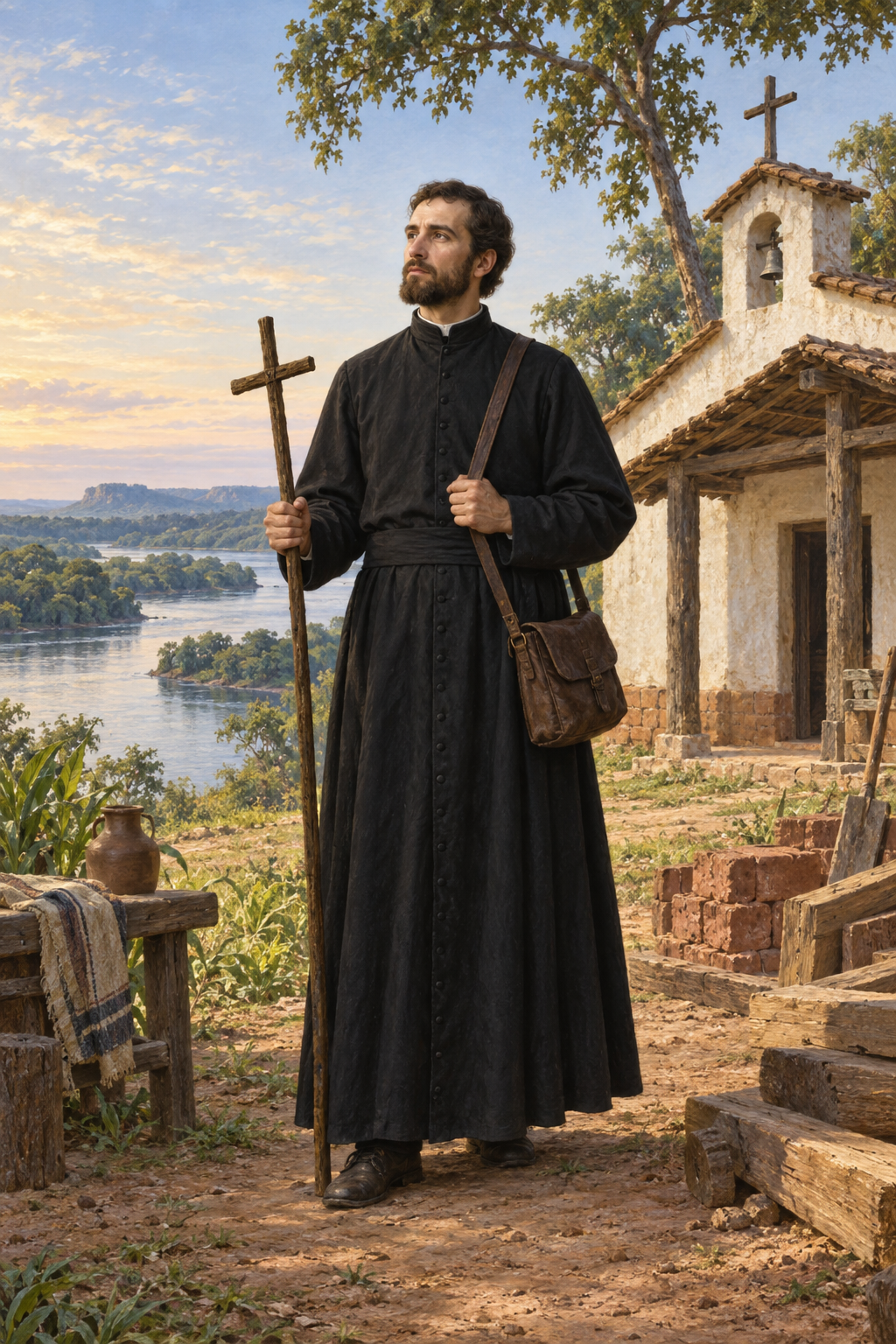
About Roque González de Santa Cruz
Roque Gonzalez de Santa Cruz was born in Paraguay in 1576. The reviewed sources support Asuncion as the fuller birthplace, but this deferred draft preserves the catalog's broad `Paraguay` field until final normalization.
That conservative choice matters because the final packet may need to decide how to express historical and modern place hierarchy. The biography can explain Asuncion, while the structured field remains untouched until approval.
He was ordained a diocesan priest on March 25, 1599. For about ten years he served as pastor of the cathedral at Asuncion and declined appointment as vicar general. This early diocesan ministry matters because his later Jesuit mission grew from priestly experience, not from restlessness alone.
The cathedral years also show that Roque was trusted before he became a Jesuit. He had already learned pastoral responsibility, preaching, sacramental care, and the obligations of a settled priestly assignment.
On May 9, 1609, Roque entered the Society of Jesus. The page should present this as a vocational deepening: a local priest becoming a Jesuit missionary in a region marked by complex encounters among colonial power, Indigenous peoples, and evangelization.
This phrasing is important because Jesuit mission history can be oversimplified in several directions. The page should neither celebrate colonial expansion nor erase Roque's sincere pastoral commitment. It should stay close to the source facts and acknowledge complexity.
Roque worked especially in Jesuit reductions. The Society of Jesus profile notes his knowledge of Guarani and his effort to understand Guarani life.
Learning Guarani belongs near the center of the biography. It suggests that mission was not only movement across territory, but also the harder work of listening, speaking, catechizing, and living near people whose world was not his own.
That context requires careful language. The page should not treat Guarani communities as scenery or flatten resistance into caricature. It can say Roque worked among Guarani people and learned their language, while avoiding claims that make mission history simple or triumphalist.
The reductions should also be named without making them sound like neutral modern villages. They were Jesuit mission settlements in a colonial frontier. The final profile can explain their role briefly, while leaving deeper mission history to sources beyond a short saint page.
Roque is associated with Alonso Rodriguez and Juan del Castillo. The final page should name the companions without letting the summary become a list. Their shared memory helps locate Roque within Jesuit mission rather than as an isolated heroic figure.
Alonso Rodriguez died with Roque at Caaro, while Juan del Castillo is remembered with them in the wider martyr group. The page should keep those relationships clear so that companion names do not blur into a general title.
He was killed at Caaro on November 15, 1628, while directing work after Mass. The martyrdom should be stated plainly. Avoid graphic detail, anonymous hostile figures, or language that reduces a local religious and cultural conflict to villain imagery.
The art follows the same boundary. A chapel, river, cross, satchel, and building materials can evoke mission without showing violence or using Indigenous people as background proof of the missionary story.
The existing catalog records Caaro as the death place and November 15 as the memorial. This draft preserves those fields. Any final expansion of Caaro's geographic hierarchy should be evidence-backed and tested.
The same caution applies to names with accents and local forms. This packet uses plain ASCII in filenames and notes where needed, but the public catalog already carries Roque's accented display name and should preserve it.
John Paul II canonized Roque, Alonso, and Juan in Asuncion on May 16, 1988. The canonization setting matters because Roque is often remembered as the first saint of Paraguay, but that distinction should be used briefly and carefully.
If the public page uses the "first saint of Paraguay" description, it should be framed as a received commemoration, not as the core of the profile. The core is the life: priesthood, Jesuit mission, language, reductions, companions, and martyrdom.
His witness is best framed as priestly mission, language learning, pastoral nearness, and martyrdom in a contested frontier. The public page should be devotional without pretending that early modern mission history is uncomplicated.
That balance lets the page be reverent and honest at the same time. Roque can be honored as martyr and missionary while the prose refuses colonial triumphalism, caricature, and easy scenery.
For a reader, the devotional invitation is not conquest but costly nearness: learn language, respect people, serve with clarity, and tell the truth about conflict without turning other communities into props. That is the line the final profile should hold.
Artwork should show a Jesuit priest in a simple black cassock near a modest mission chapel and river landscape, with wooden cross, travel satchel, and building materials as restrained attributes. Avoid violence, weapons, colonial triumphalism, rendered text, logos, halos, and exact-likeness claims.
Wondering how to weigh the stories and sources? Learn how to read a saint biography.