Biography
Simeon Stylites
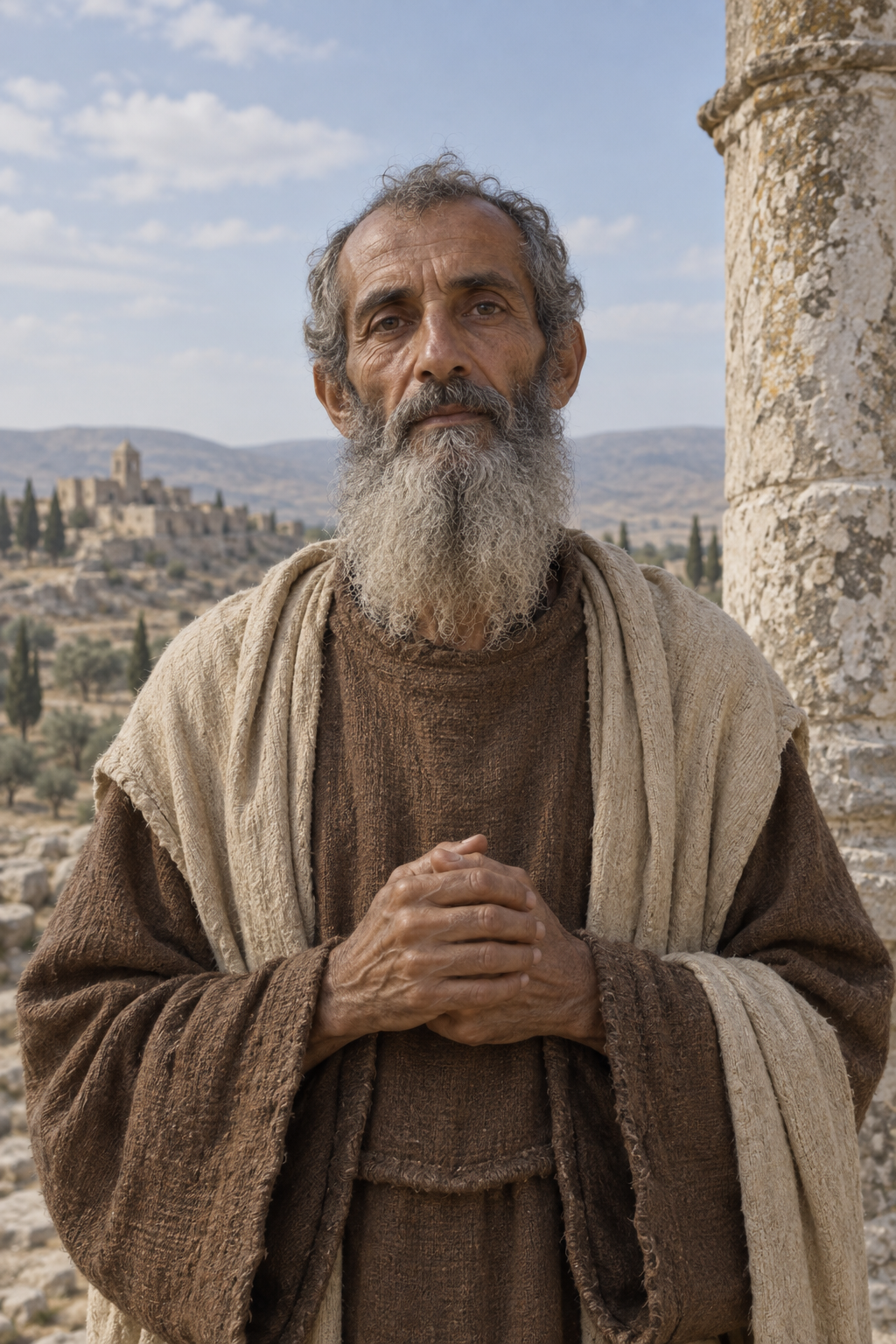
About Simeon Stylites
Simeon Stylites was a Syrian monk whose pillar drew crowds seeking counsel. He was born around 388. Tradition remembers a shepherd entering monastic life young.
The Syriac Life describes gifts of inherited property to poor people and monasteries, including Eusebona. He gives grain to people in need and brings food to harvest workers. He and his brother receive the tonsure. These hagiographic scenes are not estate records.
Theodoret’s account, examined by Andreas Westergren, describes a young ascetic whose dangerous practices alarm his superiors and lead to his expulsion. Later, he accepts advice that he does not need a painful chain to govern his conduct. The same ancient account portrays the mature Simeon answering artisans, beggars and peasants with an approachability that contrasts with his earlier excesses.
His search for solitude took him to Telanissos, identified today as Deir Sem’an. After living in an enclosed room, he occupied an outdoor enclosure on the ridge northeast of the village. He then used increasingly elevated supports, the distinctive practice that gave the stylites their name. The French archaeological account distinguishes those successive settings instead of presenting his entire religious life as one uninterrupted stay on a single column. His retreat was a developing way of life, rooted in a particular village landscape.
The pillar also became a meeting place between a solitary ascetic and the wider Christian world. Jean-Pierre Sodini describes a devotion that attracted both nearby visitors and pilgrims from farther away during Simeon’s lifetime. Theodoret had visited him and wrote before his death; other major narratives took shape afterward. Their different dates matter: testimony from someone who encountered Simeon is not the same thing as a later retelling of his reputation. His example also helped establish a recognizable form of religious life that other stylites subsequently adopted. The later Simeon Stylites the Younger was a different man, not another name for the same ascetic.
An account still told in Orthodox commemoration makes obedience, rather than height, the test of his vocation. Elders question his new practice and send an order that he come down. When he shows himself ready to comply, they allow him to remain. The episode presents willingness to accept correction as the point of the story; it does not establish that every reported physical feat happened exactly as later biographies describe. The Orthodox Church in America commemorates Simeon on September 1.
His public influence also had a troubling side. Torrey examines an attributed letter opposing the restoration of synagogues seized by Christians. He judges some intervention with the emperor Theodosius probable, while questioning whether the surviving letter gives Simeon’s actual words. He doubts the story that the emperor dismissed an official. The evidence therefore does not justify either a confident personal quotation or silence about the hostility toward Jewish worship reflected in the tradition. The man sought out for counsel belonged to a religious world whose conflicts could also bring pressure against other communities.
Other writings attributed to Simeon raise a different problem of identity. Torrey examined three letters preserved in Syriac manuscripts that present their speaker as an opponent of the Council of Chalcedon. Their position conflicts with other letters transmitted under Simeon’s name. Attribution alone therefore cannot make every surviving letter a dependable expression of his beliefs. The surviving manuscripts Torrey used belonged to collections of documents assembled for theological controversy.
Evagrius reports that Bishop Domnus visited Simeon and celebrated communion with him. After his death, his body was taken to Antioch, according to the church historian Evagrius. He also describes Antioch’s desire to retain the remains as a protection for the city. That transfer belongs to the history of his remains, not to a final journey made by the living Simeon. Evagrius also describes visiting the later sanctuary built around the pillar. His account places the column in an open central space surrounded by the arms of a cross-shaped church. He writes as a later visitor to the place, not as an eyewitness to Simeon’s whole life. The sanctuary and the stories attached to it show how a solitary dwelling became a public focus of remembrance and pilgrimage.
Medieval readers also encountered him through illustrations. Barbara Crostini discusses an eleventh-century lectionary in which the dead Simeon lies beside his column, showing how later artists could remember him without placing him atop it.
Study of the sanctuary also depends on drawings, photographs and excavation. Architectural surveys recorded its church, baptistery and other buildings. Twentieth-century work included both excavation and restoration, so the remains seen by later visitors reflect more than the original builders’ decisions.
Simeon died in 459. Nominis identifies July 27 as his entry in the Roman Martyrology, distinct from the September observance in Eastern churches. Those commemorations record the continuing reception of his life; they do not resolve every disagreement in its early narratives.
Wondering how to weigh the stories and sources? Learn how to read a saint biography.
Explore similar vocations
Prayers for Simeon Stylites
Simeon — troparion invocation (excerpt)
Beseech Christ God