Biography
Théodore Guérin
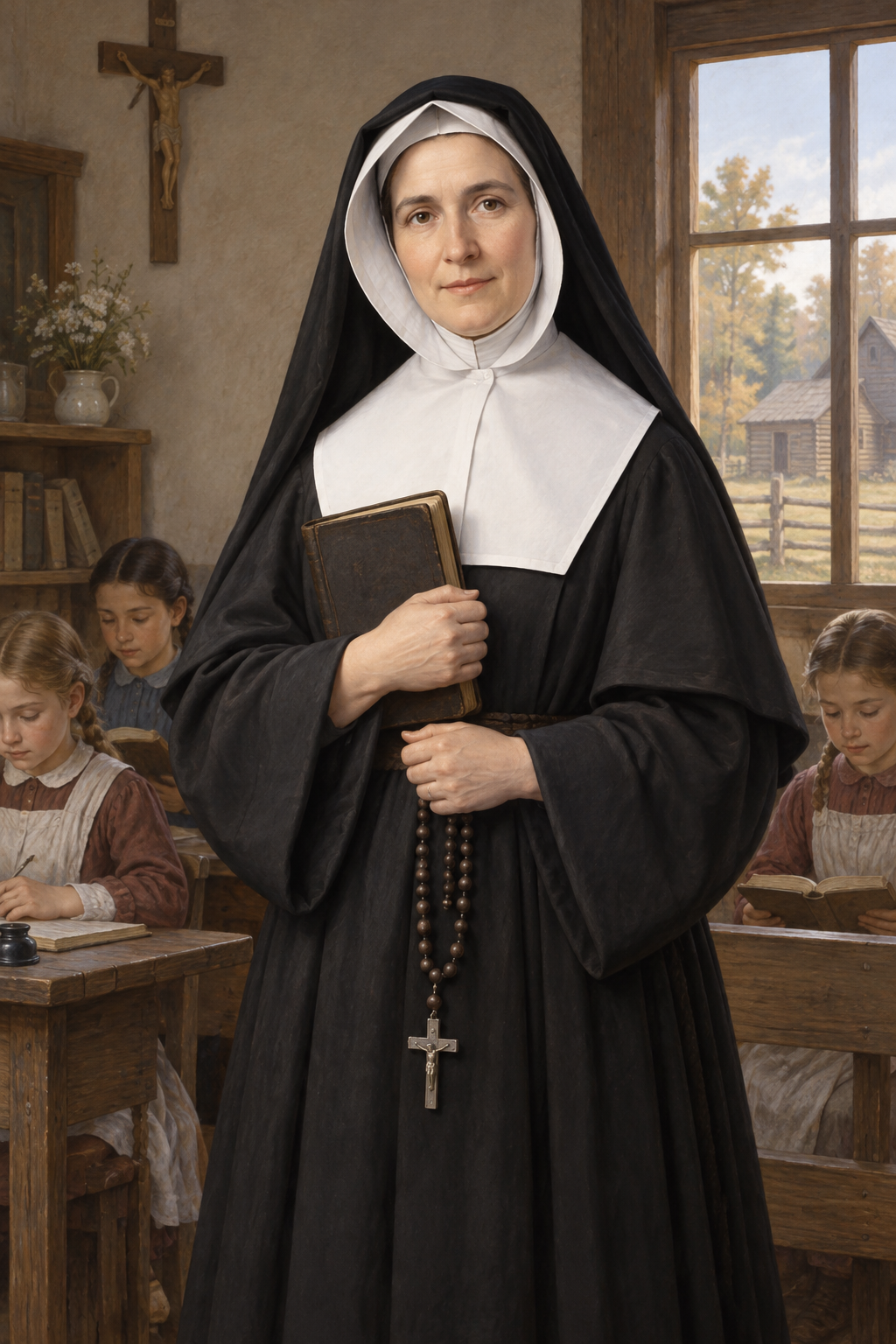
About Théodore Guérin
Anne-Thérèse Guérin was born on 2 October 1798 in Étables, France. The Vatican biography describes a childhood shaped by her mother Isabelle's instruction in Scripture and religious values. Guérin's early formation was not presented as a separate retreat from ordinary life; it prepared her for teaching and for a vocation that would eventually place her far from France. [G1]
Guérin entered the Sisters of Providence and took the religious name Théodore. Her early ministry included teaching and care for the sick. The community's life joined religious discipline with direct service, and those experiences formed the practical habits she later carried into missionary work. The final packet should verify the exact names and dates of her early assignments from the full official biography before treating them as separate structured events. [G1]
In 1838, the Sisters of Providence sent Guérin and several companions from France to Indiana. Their assignment was to support Catholic life in a developing region where children needed education and families needed religious and social institutions. The Atlantic crossing was difficult, and the sisters arrived with limited material resources. Guérin's leadership began under conditions that required both adaptability and the creation of a stable community from the ground up. [G1]
At Saint Mary-of-the-Woods, Guérin helped establish schools and a religious community. Education was central to the mission, especially the education of girls. The sisters taught children, formed future teachers, and built a pattern of service that linked classroom instruction with religious formation and care for neighbors. Guérin's work should therefore be represented through several distinct events—arrival, school foundation, community leadership, and charitable service—rather than a single generalized claim about missionary zeal. [G1]
The Vatican account emphasizes Guérin's prayer and trust in God, including a well-known reflection associated with her experience at sea. A final quotation record should not be created from the short biography alone: the exact edition, language, translation, and attribution require separate review. The safe prose claim is that prayer was a central feature of the official account of her life and ministry. [G1]
Guérin faced the ordinary pressures of a new institution: limited resources, distance from France, changing local needs, and the responsibility of forming a community that could continue without her. Her contribution was organizational as well as devotional. She helped establish a school system and a religious house whose work continued after her death, making education and service more durable than a short-term missionary visit. [G1]
She died on 14 May 1856 at Saint Mary-of-the-Woods in Indiana. The official record recognizes her as a religious sister and missionary, and the Church later beatified and canonized her. The calendar observance must be recorded separately from the death event and only after the exact jurisdiction and rank are verified from G2. [G1][G2]
Théodore Guérin remains significant because she translated a French religious tradition into a new American setting without reducing mission to expansion alone. Her schools, formation of sisters, and attention to local communities made education a long-term form of pastoral care. The profile should preserve that institutional legacy while avoiding unsupported claims about the precise number of schools, students, or later developments unless those figures are independently sourced. [G1]
The journey from France to Indiana was not simply a change of address. Guérin and her companions crossed an ocean and entered a setting in which established religious and educational structures were limited. They had to learn local conditions, identify what families needed, and establish routines that could survive the absence of the founding sisters. The official biography gives the missionary episode its force precisely because the work began with limited resources and depended on patient formation rather than immediate success. [G1]
Education was a practical form of Catholic presence. Schools offered children instruction, but they also created a place where families could encounter a stable community, religious teaching, and women trained for service. Guérin's role included forming sisters who could teach and lead, so her legacy cannot be reduced to the first school building or to her own classroom work. The packet should distinguish her personal leadership from the later growth of the Sisters of Providence. [G1]
Guérin's spirituality and administration were connected. The Vatican account describes her prayer and trust in God, but also records the practical demands of travel, education, community discipline, and charity. The combination matters for the narrative: prayer did not replace organization, and organization was not presented as separate from prayer. A responsible biography can preserve the religious meaning of the source while reporting the observable actions in clear historical language. [G1]
Her work also required collaboration. A missionary superior could not create a school system alone; she needed sisters, local clergy, families, pupils, donors, and people able to maintain the institutions after the first generation. Where the source does not name those collaborators, the profile should not invent them. It is enough to state that Guérin helped form a community whose work continued beyond her lifetime. [G1]
Guérin died in 1856 at Saint Mary-of-the-Woods. Later recognition of her holiness should be kept chronologically separate from her arrival, school work, and death. The official record supports a profile centered on education and missionary leadership; it does not require adding an unverified quotation, a precise number of foundations, or a universal patronage claim. Her significance is clearest in the durable form her vocation took: a religious community, schools, and a pattern of service adapted to a new local setting. [G1]
Wondering how to weigh the stories and sources? Learn how to read a saint biography.