Biography
Thomas Aquinas
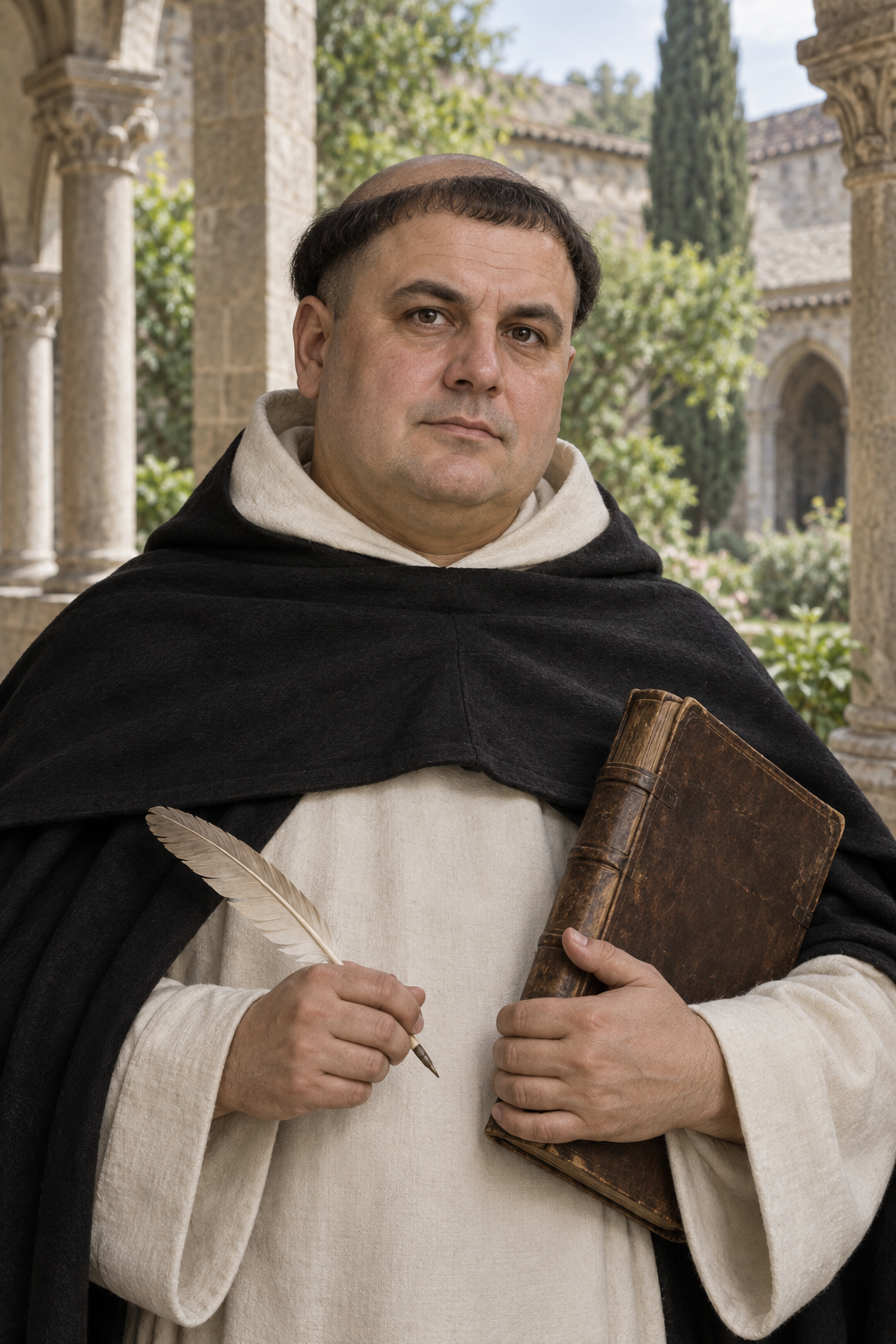
About Thomas Aquinas
Thomas Aquinas chose the life of a Dominican friar against the expectations of his noble family. Born around 1225 at Roccasecca, he received his first schooling at Montecassino before continuing his education in Naples. There he encountered Aristotle's philosophy and the recently established Order of Preachers. His family opposed his decision to join the Dominicans and kept him at home for a time. By 1245 he was free to continue his religious formation, beginning a life in which study, teaching, and preaching remained closely connected.
In Cologne, Thomas studied under Albert the Great, whose work brought Christian theology into sustained conversation with Greek and Arabic philosophy. Albert selected him for advanced theological study in Paris in 1252. Thomas lectured on the Bible and Peter Lombard's Sentences before becoming a master of theology in 1256. His duties included preaching, biblical teaching, and the public discussion of difficult questions. These were not separate careers: they were the everyday responsibilities of a university theologian in a religious order devoted to preaching and learning.
His place in the university was contested during a bitter dispute over the role of the mendicant friars. When William of Saint-Amour attacked the religious orders, Thomas answered with a written defense of their life and teaching. The conflict concerned who could teach and participate in the university, not merely an abstract difference of opinion. Thomas's academic work therefore included defending the institutional setting in which he and other friars carried out their vocation.
His short treatise On Being and Essence shows how carefully he prepared the ground for an argument. Before asking large questions, he examined the meaning of the words being and essence, and their relation to the categories used in reasoning. He began with things more readily understood and proceeded toward what was harder to grasp. The opening distinguishes an actual thing from something that can be described in a true statement, using blindness as an example of a lack rather than a substance. Such distinctions made precise language part of the work of teaching.
In 1265 the Dominican provincial chapter at Anagni assigned Thomas to direct a house of study in Rome. The chapter instructed the students' home convents to supply the clothing they needed while studying with him. It also authorized Thomas to send negligent students back to their own convents. This record places him within the practical administration of education, responsible for a community of students as well as his own teaching.
The Summa Theologiae opens with a teacher's concern for beginners. Thomas explains that unnecessary questions, a confusing order of presentation, and repeated material can obstruct learning. He proposes a clear arrangement suited to introducing Christian doctrine. The familiar pattern of objections, an answering argument, and replies asks readers to examine a difficulty before accepting a conclusion. An objection printed in his work is therefore not necessarily his own position. His purpose was to make a demanding subject teachable, rather than simply to assemble everything previous writers had said.
Benedict XVI described Thomas's approach as a distinction between philosophy and theology without treating them as enemies. Reason examines evidence and arguments, while faith receives what is revealed by God. In Thomas's account, their different starting points need not make their conclusions contradictory. This confidence left room for philosophical inquiry within a life grounded in Christian belief. It also required care about what an argument could actually establish, rather than presenting every truth of faith as a conclusion that reason alone could demonstrate.
Paul VI later placed this intellectual effort within the changing society of the thirteenth century. Growing towns and universities, new encounters with Arabic learning, and the renewal associated with the mendicant orders formed part of Thomas's world. The discussion of inherited authorities increasingly involved comparison, logical argument, and close attention to language. Thomas worked within that movement rather than apart from it. His teacher Albert's interest in the natural world also belonged to a culture seeking explanations of ordinary natural processes without denying religious faith.
Thomas's work was not confined to advanced students. In Lent 1273 he preached at San Domenico Maggiore in Naples, explaining the Creed, the Lord's Prayer, the commandments, and the Hail Mary. The material preserved from this preaching presents central Christian beliefs in a form different from the extended arguments of his major books. Benedict XVI drew attention to this combination of systematic scholarship and instruction for a wider congregation.
Late in 1273 Thomas stopped writing, leaving the Summa unfinished. The accounts of a revelation that made his writings seem inadequate belong to the biographical tradition, not to an explanation he set out in his own books. He died at Fossanova on March 7, 1274.
His influence continued through the Catholic Church's reception of him as a saint and Doctor of the Church. In 2023, Pope Francis announced a celebration at Fossanova to commemorate the seven hundredth anniversary of his canonization. Francis emphasized both his learning and his communication of that learning to others through speech and writing.
Wondering how to weigh the stories and sources? Learn how to read a saint biography.
Explore similar vocations
Prayers for Thomas Aquinas
Thomas Aquinas: sourced prayer excerpt
Thy kingdom come.