Biography
Vittorio Faccin
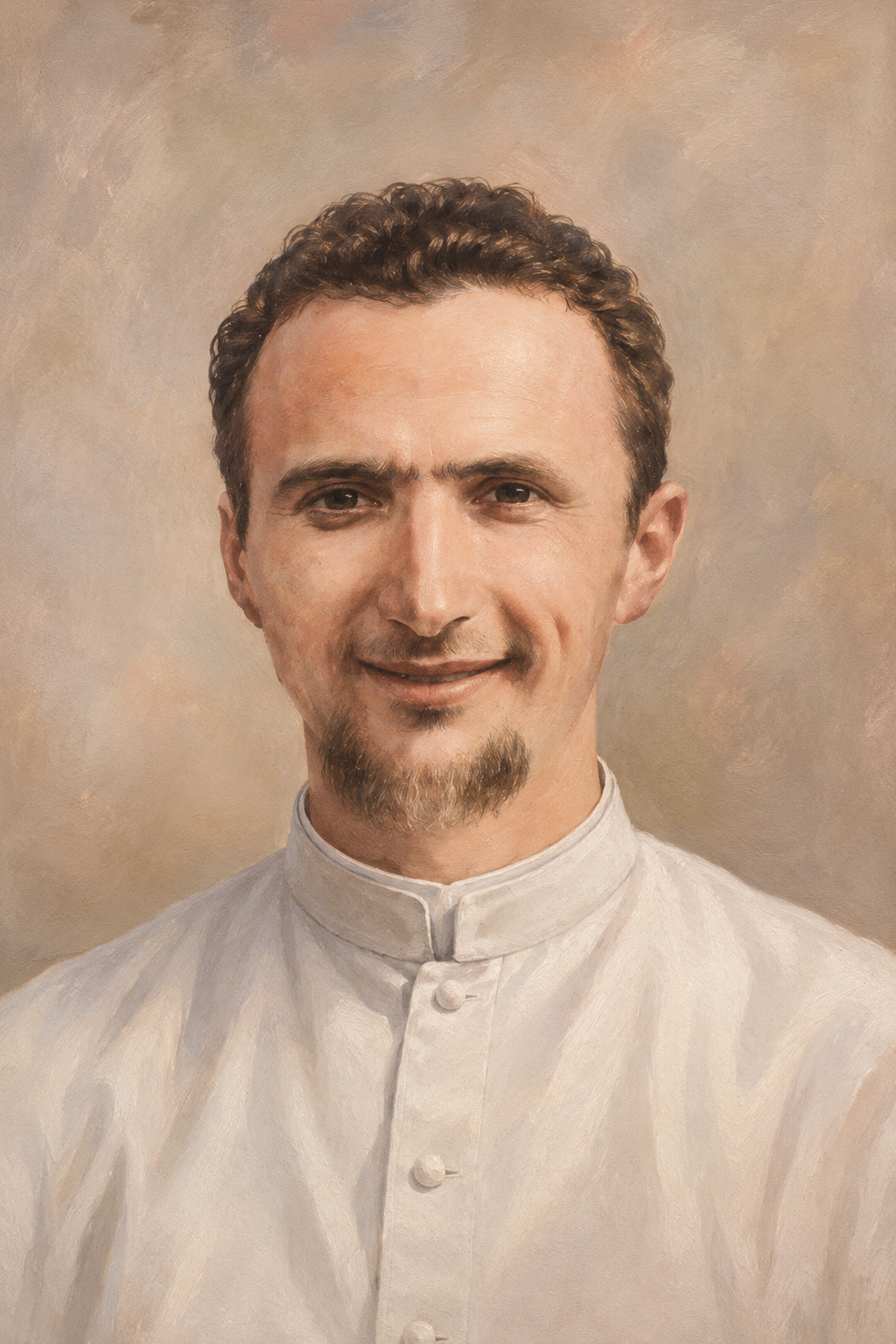
About Vittorio Faccin
Vittorio Faccin was a Xaverian brother whose work in Congo included building, transport and the everyday care of a mission community. He was born in Villaverla on 4 January 1934 and entered the Xaverians in 1950. His first religious profession followed in 1952. In December 1959 he left Italy for Congo. Writing home after arriving, he described meeting schoolchildren, laughing together while struggling to communicate, and beginning work with local laborers. He also thanked his parents for supporting his vocation. These early letters preserve both his enthusiasm and the practical adjustments of a young man learning to live far from home.
His religious vocation took the form of service as a brother rather than ordination as a priest. Giuseppe Dovigo’s account describes the spiritual importance that Faccin attached to this choice: he understood the offering of his own life through the Eucharist. The same account shows him moving between construction and pastoral tasks. He helped build chapels, schools and dispensaries, while also visiting sick people, teaching the catechism and spending time with young people. Travel could mean long walks or difficult journeys on Lake Tanganyika. His correspondence joined descriptions of these demands with enjoyment of the landscape and affection for the people among whom he lived.
Dovigo also draws attention to Faccin’s criticism of attitudes that treated Africa chiefly as a source of wealth. Faccin questioned how readily Italians themselves would abandon familiar customs for the religion of outsiders who had not respected them. These reflections show an effort to consider the demands of missionary life from the perspective of the people receiving the missionaries.
His practical responsibilities continued as conditions deteriorated. In January 1963 he wrote about finishing a house for sisters at Kiringye and his next assignment overseeing construction at Baraka. In November 1964 he appealed to his superior for medicine because wounded young men lacked treatment. His last letter to his family expressed longing for freedom, gratitude for a parcel and a request for prayer for local people.
The danger ended in his death at Baraka on 28 November 1964. Giovanni Zaltron’s account describes the arrival of the rebel commander Abedi Masanga and Faccin’s attempt to speak with him. Ordered to leave in the commander’s vehicle, Faccin was concerned about abandoning Luigi Carrara, who was hearing confessions nearby. He was shot, and Carrara was killed after coming out to him. Giovanni Didonè and Albert Joubert were killed at Fizi later that day. The account brings together the deaths of four men belonging to two neighboring Christian communities.
Faccin’s memory remained part of life in his home region. A missionary center bearing his name opened in Villaverla in 1987. Its own history records the help of Giovanni Spillere, the parish priest Piero Mosele and local volunteers in establishing the association. Its purpose was to support missionaries and people facing hardship in different parts of the world. The center describes its subsequent work as reaching needs both nearby and far away. In this setting, remembrance of Faccin became connected with organized practical assistance, carried forward by people who wanted his name to remain associated with service. The association is recognized as a volunteer organization.
His letters also continued to speak to readers. The Centro Studi Storici Nonantolani published a study edited by Luciano Montanari in 2015, drawing on correspondence preserved by the Xaverians and supplied by Faccin’s family. The center’s description emphasizes the letters’ combination of family affection, religious commitment and observation of life in Congo. They provide a personal voice alongside the later accounts of his death. Their preservation allows his life to be approached through what he chose to tell those close to him, rather than only through the violence that ended it.
In 2024, reporting on preparations for his beatification, Alessandra Zanin recorded testimony from the Congolese Xaverian Emmanuel Adili Mwassa. He described the importance of the martyrs to the communities of Baraka and Fizi, including their desire that the remains stay among them. The report also described a baptismal font placed at the site of Faccin’s killing. Adili interpreted this as an expression of life and belonging after violence. His testimony locates the continuing memory of Faccin within the Congolese communities he served, as well as the Italian places that remembered him. At the Villaverla gathering, Adili presented the four men as an example of fraternity across differences of origin and language. He explained the local understanding of the martyrs as ancestors: people whose goodness continued to matter to the community after death. The commemoration therefore concerned relationships that remained alive in communal memory, as people sought peace and harmony in the places where the missionaries had lived.
Faccin and his three companions were beatified on 18 August 2024.
Their Xaverian liturgical memorial is on 28 November. Faccin is honored as a blessed religious brother and martyr.
Wondering how to weigh the stories and sources? Learn how to read a saint biography.